MetadataUpdated 6 min read
Canonical URLs and Open Graph: Getting One URL Credited Everywhere
Your canonical tells Google which URL to credit. Other AI engines don’t document their rule, so the safe move is one URL that every signal agrees on.

Founder, SEO·AEO·GEO
Builds SEO·AEO·GEO and writes the crawler, schema, and citation research published here.
Key takeaways
- Google treats redirects and rel=canonical as strong signals for which URL to show, and its AI features retrieve pages from that same index.
- No AI vendor documents how it picks a citation URL, so make every signal agree: redirects, canonical, og:url, internal links and the sitemap.
- Tracking-parameter copies, www and trailing-slash twins, and canonicals that point at the wrong page split the signals you control.
- Open Graph controls link previews; no AI engine documents using it for citation cards, though Google lists og:title among the sources for its title links.
- Write a title that names the specific thing first and a description under about 155 characters that answers the query.
Give every page one URL and make every signal agree on it: a self-referencing rel=canonical, an og:url that matches it, internal links and the sitemap that use it, and one-hop redirects from every other version. Google uses those signals to choose the URL it indexes and shows, and its AI Overviews and AI Mode retrieve pages from that same index. Other AI engines don’t document how they pick a citation URL, which is exactly why agreement is the safe choice.
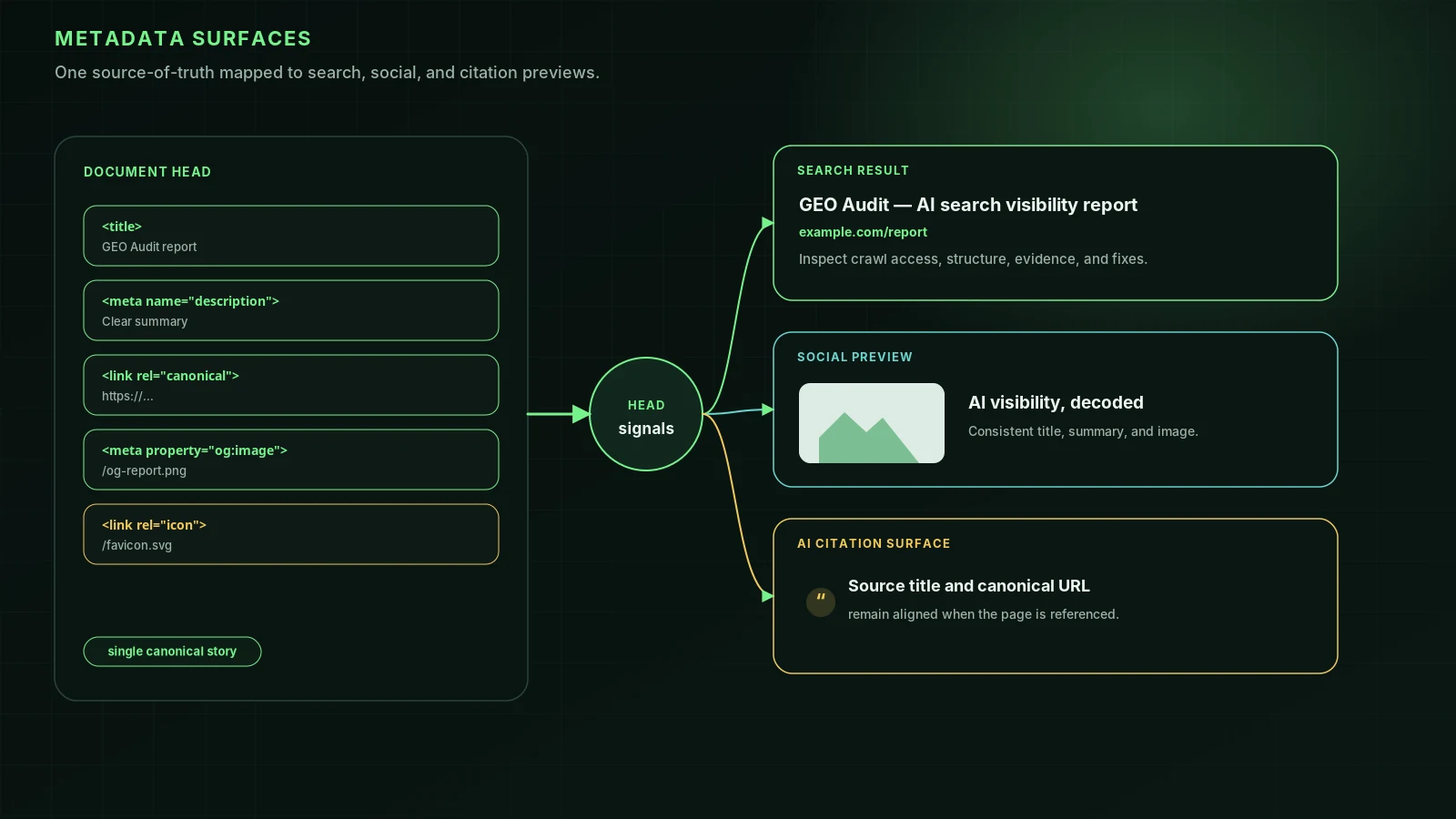
The same few fields (title, description, URL, image) also feed search snippets, Slack and LinkedIn previews and the source links in AI answers. When they disagree, each surface shows a slightly different page, and the URL that collects the credit may not be the one you wanted.
How Google chooses the URL
Google’s canonicalization documentation is the primary spec. It lists the methods in order of strength: redirects are “a strong signal that the target of the redirect should become canonical”, rel=canonical is also a strong signal, and sitemap inclusion is a weak one. It adds that the methods stack, so using several together makes your choice more likely to stick. None of them is a command, though; Google can still choose a different canonical, and Search Console’s URL Inspection tool shows which one it picked.
This matters for AI search because Google’s generative-AI guide says its AI features use retrieval-augmented generation, relying on its core ranking systems “to retrieve relevant, up-to-date web pages from our Search index.” The URL in that index is the URL AI Overviews can show.
- https://example.com/blog/post: the one to credit.
- https://www.example.com/blog/post/: redirect it in one hop; don’t let it become a second ID.
- https://example.com/blog/post?utm_source=linkedin: let it load, but its canonical must point at the clean URL.
- https://example.com/blog/post#faq: a fragment is not a separate document; never put one in a canonical.
Old URLs need the same care. In Vercel and MERJ’s crawler data, 34.82% of ChatGPT’s crawler fetches hit 404 pages, against 8.22% for Googlebot, and Vercel warned that this means a significant chance that the URLs AI tools cite are incorrect or inaccessible. Redirect retired URLs to their replacements rather than letting them die.
What Open Graph does, and doesn’t, do
Open Graph was designed for Facebook and is now what most link previews read: Slack, LinkedIn, iMessage and many others. The protocol defines og:url as “the canonical URL of your object that will be used as its permanent ID”, so it should always equal your canonical.
What is not documented is whether any AI engine builds its source cards from Open Graph. We know of no vendor that says so, and we won’t claim it. What Google does document is that og:title is one of the sources it may use when it writes a title link, alongside the <title> element, the main visible title and the H1. So treat Open Graph as part of keeping one story, not as an AI lever.
| Field | Should match | What goes wrong when it doesn’t |
|---|---|---|
| <title> | The H1 and og:title (the same claim) | Google may rewrite the title link from other sources on the page |
| Meta description | og:description | Previews and snippets show different summaries |
| rel=canonical | og:url, hreflang targets, internal links, sitemap | Credit goes to a tracking copy or a www twin |
| og:image | A real image you own, about 1.91:1 | A blank or cropped preview card when the page is shared |
| Favicon | A square icon larger than 48×48px at a stable URL | Your brand mark can’t appear next to your search result |
Titles and descriptions
Google’s AI guide says you don’t need to write in a special way for generative AI search. You do still need a title that names the specific thing first (“OAI-SearchBot”, “JSON-LD”, “rel=canonical”) rather than a slogan, because the <title> element is the first source Google lists for its title links. Keep it concise, as Google’s guidance asks, with the query words at the start.
Write the meta description as a plain answer under about 155 characters. Google says it builds snippets mainly from the page and may use the description when it describes the page better. If the description can’t stand on its own, the page’s opening paragraph probably can’t either; lead with the answer in both places.
Implementation notes for Next.js and similar frameworks
- Build the canonical, og:url and sitemap URLs from one site-URL constant. Never type the host by hand in three files.
- Set metadataBase in the App Router so relative og:image paths resolve to absolute URLs.
- Remember that page-level Open Graph metadata replaces the parent’s object rather than merging with it, so set title, description, url and image together on every page.
- Preview important URLs in LinkedIn’s Post Inspector and Facebook’s Sharing Debugger, and fetch the raw HTML with curl to see what crawlers get.
- If you A/B test titles, keep one canonical. Experiments that split URLs split the signals.
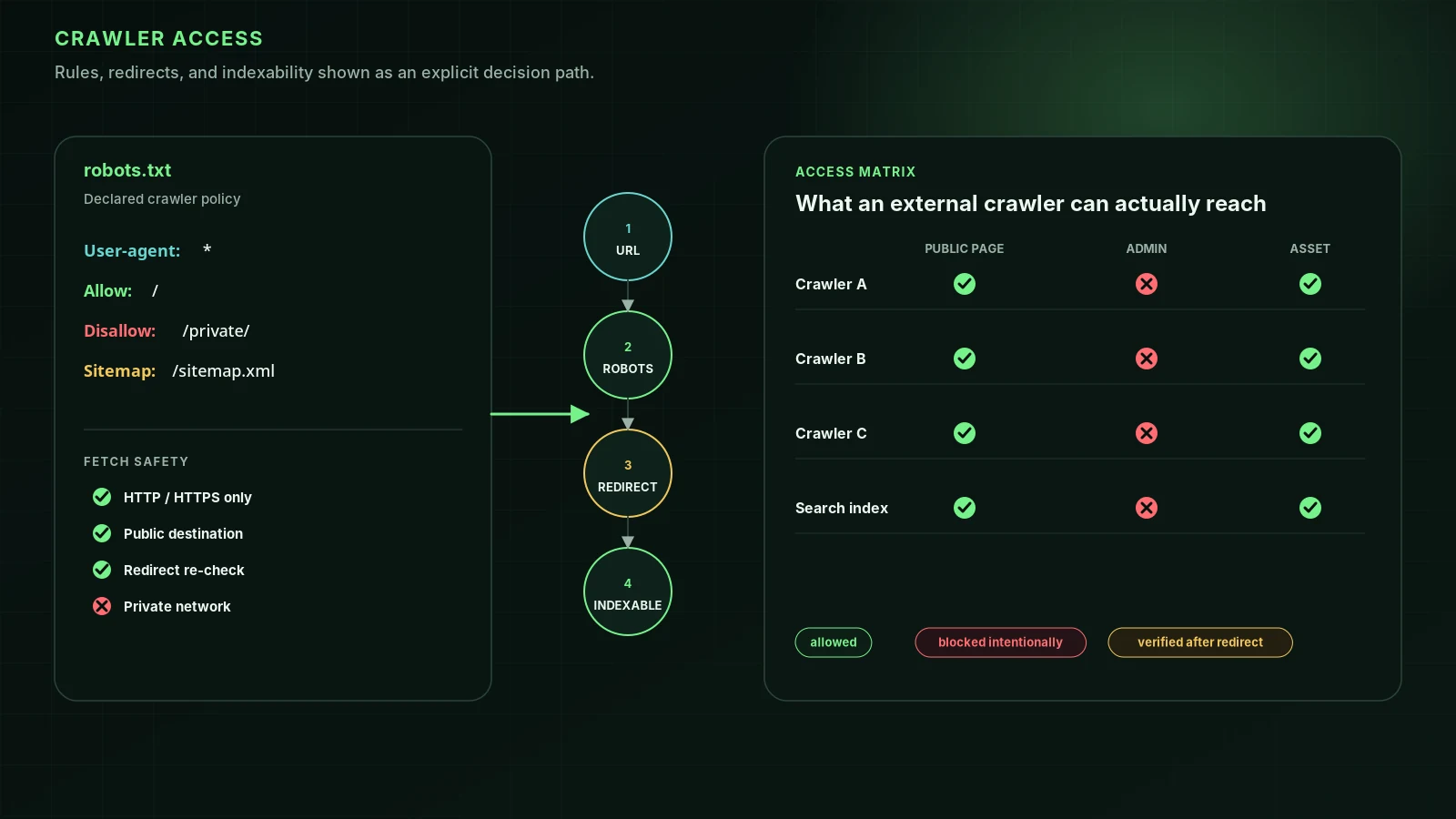
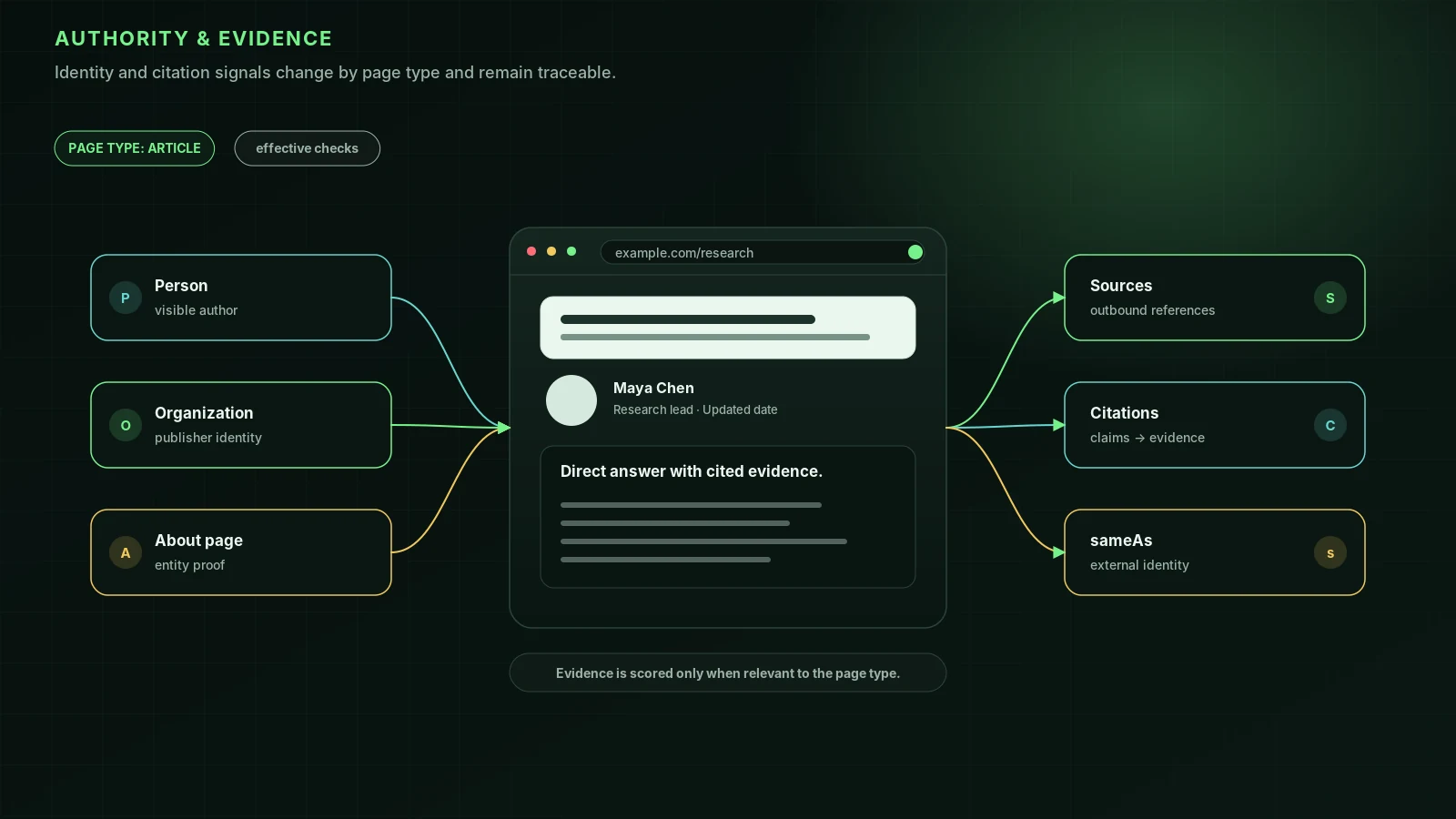
Metadata only matters once a crawler can reach the page: check robots.txt and CDN access first. And a consistent URL is one half of identity; the other half is a visible author and publisher.
SEO·AEO·GEO checks the pieces you can see from outside: Canonical (3 Retrieval points), Title tag, Meta description length, and whether og:title, og:description and og:image are set. Run a free audit on the URL you want credited; the methodology shows how little most of these weigh and why.
FAQ
Should og:url always match the canonical?+
Yes. The Open Graph protocol defines og:url as the canonical URL of the object, used as its permanent ID. If the two differ, link previews and search engines are told two different things. Make both the HTTPS, parameter-free URL on your preferred host.
Does a canonical tag decide which URL AI engines cite?+
For Google it is a strong signal, not a command: Google can choose a different canonical, and Search Console’s URL Inspection tool shows which one it picked. ChatGPT, Claude and Perplexity don’t document how they choose a URL. Making every signal point at one URL is the only approach that works for all of them.
Do AI engines use the meta description?+
Google says it mainly builds snippets from page content and may use the meta description when it describes the page better. Other engines don’t say. Write it as a plain answer of 50 to 160 characters, which is also the range SEO·AEO·GEO’s Meta description check accepts.
What about Twitter or X tags?+
twitter:title and twitter:description affect previews on X. Copy the Open Graph title and description unless you have a real reason not to; a third version of the title is one more place for the story to drift.
Sources
- How to specify a canonical URL with rel="canonical" and other methods — Google Search Central
- What is URL canonicalization — Google Search Central
- Influencing title links in Google Search — Google Search Central
- Control your snippets in search results — Google Search Central
- Define a favicon to show in search results — Google Search Central
- The Open Graph protocol — ogp.me
- The rise of the AI crawler — Vercel and MERJ (2024-12-17)
- Google’s Guide to Optimizing for Generative AI Features on Google Search — Google Search Central (May 2026, updated July 2026)
Run it on your domain
See this lens as a finding, not a lecture.
Free technical GEO audit. Evidence-traced scores, LLM-ready export, no login.
Audit your website