AuthorityUpdated 7 min read
E-E-A-T for AI Search: Bylines, sameAs and What the Evidence Shows
Google’s systems reward pages that make it clear who wrote them and why they can be trusted. The AI-specific evidence is thinner than most guides admit, and the strongest of it points off your site.

Founder, SEO·AEO·GEO
Builds SEO·AEO·GEO and writes the crawler, schema, and citation research published here.
Key takeaways
- No large study has isolated bylines, author bios or Person schema as AI-citation factors; treat claims that they “get you cited” as unproven.
- Google says E-E-A-T isn’t a specific ranking factor, but its systems look for content where it is clear who created it, and its AI features are rooted in those systems.
- The on-page authority signal with the best evidence is freshness: visible, accurate publication and update dates.
- The strongest correlates of AI visibility are off your site: genuine brand mentions, YouTube above all.
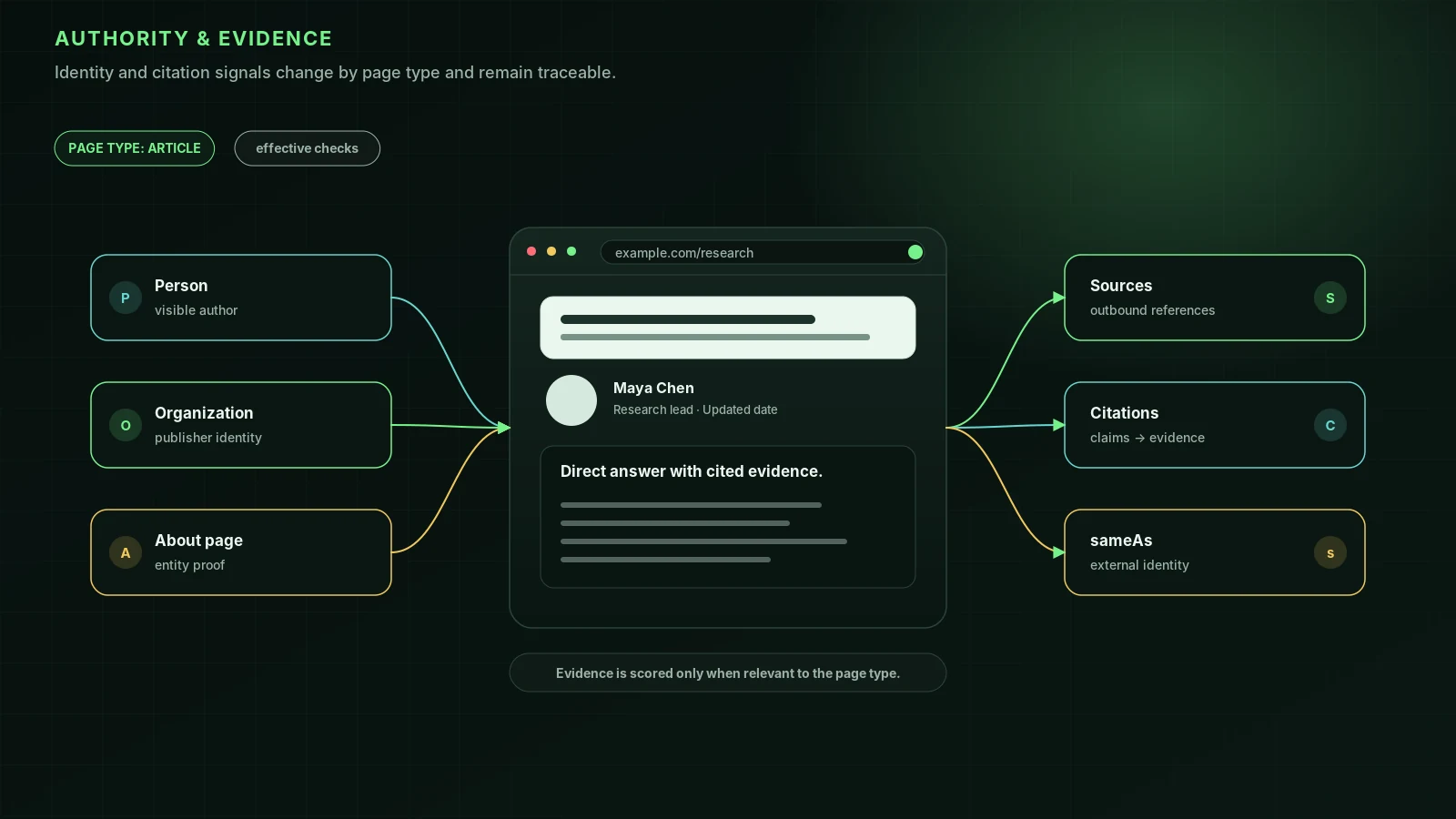
- Keep identity consistent and checkable: a visible byline, an author page, an About page, and sameAs links that resolve.
No study has shown that a byline, an author bio or Person schema makes AI engines cite a page more often. Author attribution is unstudied as an AI-citation factor, and Google says no special schema is needed for its AI features. Do the work anyway, for a different reason: Google’s quality systems, which AI Overviews and AI Mode are built on, look for content where it is clear who created it and why it can be trusted. Then put most of your authority effort where the evidence is stronger: accurate dates on the page, and genuine mentions of your brand on other sites.
What Google says about E-E-A-T
While E-E-A-T itself isn't a specific ranking factor, using a mix of factors that can identify content with good E-E-A-T is useful.
Google’s self-assessment questions are concrete. Under “Who”, it asks: “Is it self-evident to your visitors who authored your content? Do pages carry a byline, where one might be expected?” Elsewhere it asks whether content shows “clear sourcing, evidence of the expertise involved, background about the author or the site that publishes it, such as through links to an author page or a site's About page.”
Its generative-AI guide (May 2026, updated July 2026) adds the AI angle: its AI features are “rooted in our core Search ranking and quality systems”, and it asks for “unique, expert-led content that provides value beyond common knowledge”, giving a first-hand review as the example of a perspective a summary can’t copy. That is E-E-A-T in practice. It is a reason to make expertise visible, not proof that a byline earns a citation.
What the evidence does and doesn’t show
| Signal | Evidence | Our grade |
|---|---|---|
| Visible author or byline | No large study isolates it as an AI-citation factor | Unstudied |
| Person schema | Google says no special schema is needed; adding JSON-LD showed no lift in a controlled test | Myth, as a citation lever |
| About and Contact pages | Proxies for a real organisation; not tested on their own | Unstudied |
| Publication and update dates | AI assistants cited content 25.7% fresher than organic results across 17 million citations; ChatGPT’s citations were 458 days newer. Injected dates reversed LLM preferences by up to 25% in a controlled test. AI Overviews showed no freshness preference. | Moderate |
| Citing external sources | Helped in the 2024 GEO lab study (KDD 2024); the 2025 C-SEO Bench benchmark found most such content tactics largely ineffective | Weak |
| Off-site brand mentions | Across 75,000 brands, YouTube mentions correlated with AI visibility at about 0.737 and branded web mentions at 0.66–0.71 | Strong (correlational) |
The grades come from our methodology, which lists the sources for each. The pattern is clear: the parts of authority you can mark up are the least proven, and the parts with evidence are either dates or things that happen on other people’s sites.
An identity people and parsers can check
Three things, all visible, all consistent with each other:
| Element | On the page | In structured data (optional) |
|---|---|---|
| Person | Byline next to the headline, short bio, link to an author page | Person with name, jobTitle, worksFor and sameAs |
| Organization | Publisher name, logo, About page, a way to contact you | Organization with name, logo, url and sameAs |
| Evidence | Named sources, quotes with attribution, data tables, a Sources list | Nothing required; the visible links are the evidence |
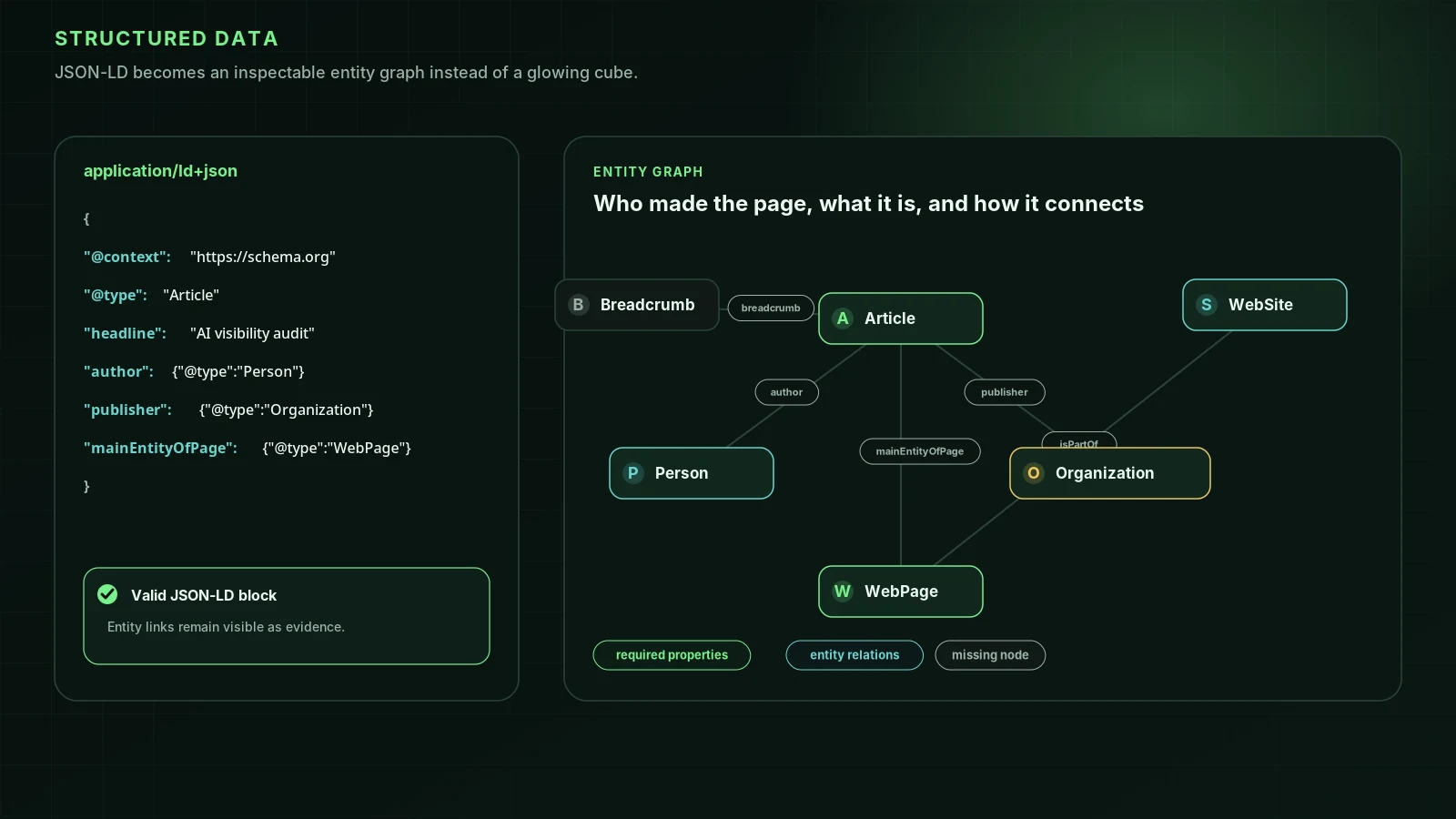
Google says it “can make general use of the sameAs property”, which is the closest thing to official guidance on why those links matter: they tie your name to profiles elsewhere. That only helps if they resolve. A sameAs that 404s is worse than none, because anyone who checks it, person or parser, finds a dead end where your identity should be.
However, seeking inauthentic "mentions" across the web isn't as helpful as it might seem. Our core ranking systems focus on high-quality content while other systems block spam; our generative AI features depend on both.
Read that carefully. Google isn’t saying mentions don’t matter; the same section says its AI features “can show what's being said about products and services across the web.” It is saying manufactured ones don’t work. Genuine mentions are the strongest correlate of AI visibility in the data we have.
Make the author visible, not just declared
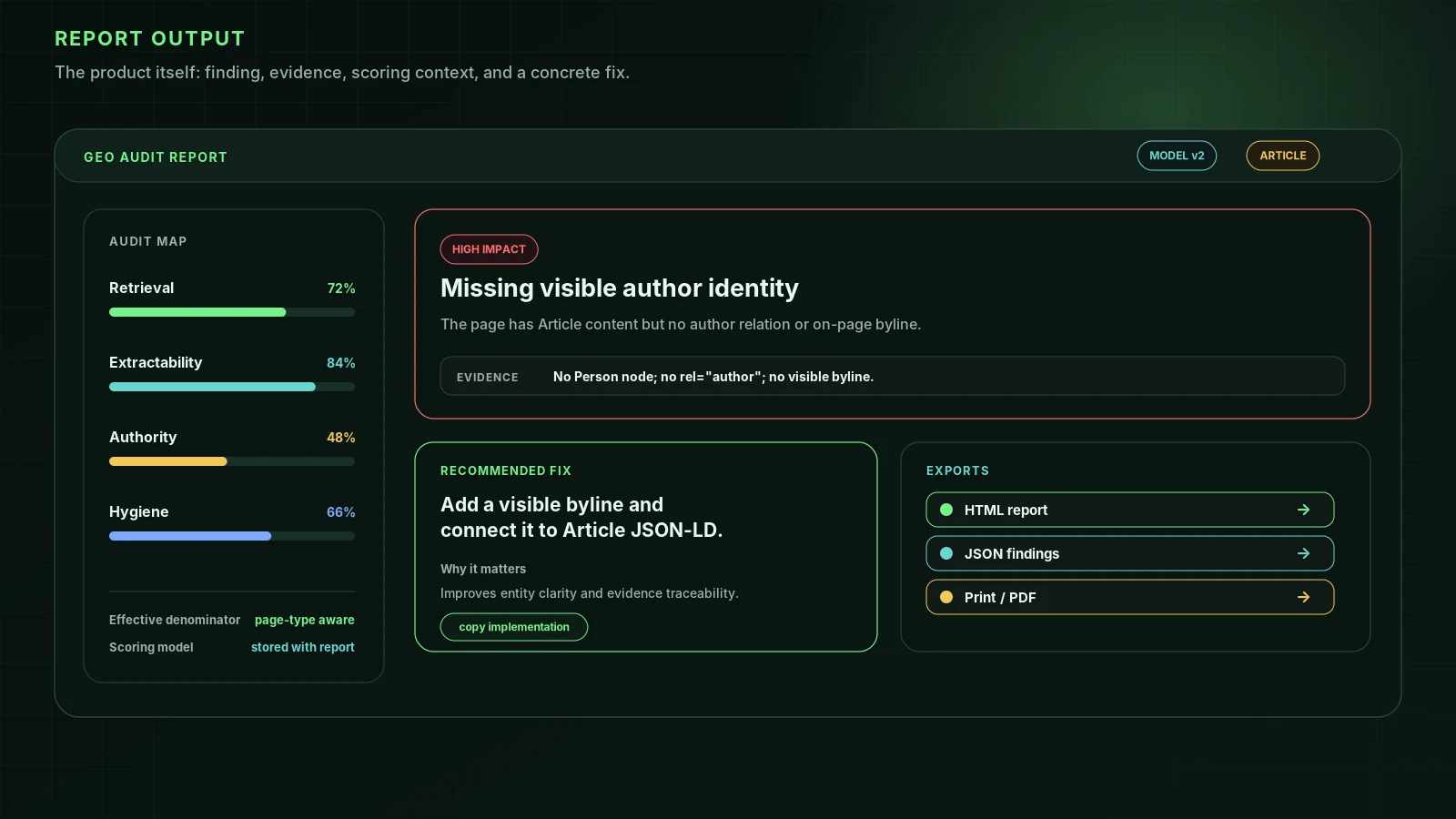
A common gap is an article template whose JSON-LD names an author while the page prints no name at all. Readers never meet that person, and neither does any parser that reads only the HTML. SEO·AEO·GEO’s Author attribution check, worth 6 Authority points on articles, looks for an author in the page’s JSON-LD, a meta author tag or a byline element, and fails when none of them names anyone. It is scored for the reason Google gives, not because bylines are a proven citation factor.
- Put the name next to the headline as text, not only as an avatar’s alt text.
- Link it to an author page that exists and is indexable.
- Use the same name string in the byline, the author page and any Person markup.
- Add sameAs links only to profiles a stranger can open (LinkedIn, ORCID, a company page, GitHub, whatever is real) and check that they resolve.
- Show both the published and the updated date. Of everything in this list, this is the item with evidence behind it.
Experience is not cosplay
Google asks for a unique, first-hand perspective. For technical topics that means your own measurements, your own logs and screenshots, named examples, or a method section. Rewriting a vendor’s GPTBot explainer without adding anything of your own is the commodity content the AI guide tells you not to publish.
Our GPTBot and OAI-SearchBot guide quotes OpenAI’s crawler documentation and Cloudflare’s announcements because they are the primary sources. A version written by a site owner should go further and show their own robots.txt and their own CDN logs. That is experience a summary can’t copy.
Most authority is built off your site
The best-evidenced drivers of AI visibility are things a page edit can’t change: how often your brand is mentioned on other sites and in YouTube videos, whether you appear on review sites, in forums and in “best of” lists, and whether you already rank. A one-page audit can’t measure those, ours included; the methodology says so plainly. What a page can do is make sure that when someone looks you up, the name, the publisher and the profiles all agree.
What to do this week
- Pick the five pages that matter most. Add a visible byline linked to an author page, and a clear publisher name.
- Create or fix an About page and a contact route, so the organisation behind the site is real to readers. SEO·AEO·GEO scores both on every page type.
- Show published and updated dates, and update them when the facts change, not as a cosmetic refresh.
- Add a Sources section to articles, linking to primary documents.
- Point sameAs only at profiles that resolve, and remove the dead ones. The JSON-LD guide has a minimal graph to copy.
- Remove ghost authors and stock “experts” who don’t exist anywhere else on the web.
- Run a free audit and read the Authority findings; how to read an SEO·AEO·GEO report explains what each one measured.
FAQ
Do I need a well-known author to get cited by AI?+
There is no evidence either way: no large study has isolated author fame or bylines as an AI-citation factor. What helps readers and Google’s quality systems is a real person they can check. What correlates most with AI visibility is how often your brand is genuinely mentioned on other sites.
Is E-E-A-T a ranking factor?+
Google says E-E-A-T itself isn’t a specific ranking factor, but that its systems use a mix of factors that identify content with good E-E-A-T, and give it more weight on topics that affect health, money or safety. Bylines, sources, dates and a clear publisher are the parts a page can show.
Does Person schema help with AI citations?+
Not on the evidence available. Google says no special schema is needed for its AI features, and a controlled test of 1,885 pages that added JSON-LD found no citation lift. Keep Person markup if you use it, and make sure it matches the byline the page visibly shows.
Which authority signal has the best evidence?+
On the page, freshness: AI assistants cite newer content than organic search does, and a controlled test showed dates changing which sources language models prefer. The effect is strongest for ChatGPT and was not seen in AI Overviews. Off the page, genuine brand mentions correlate far more strongly than anything else measured.
Should every page cite sources?+
Articles that make factual claims should. SEO·AEO·GEO’s External links check is worth 3 points on every page type, and its evidence grade is weak: citing sources helped in a lab study, but a later benchmark found most such tactics largely ineffective. Link to primary sources because readers can then check you.
Sources
- Creating helpful, reliable, people-first content — Google Search Central
- Google’s Guide to Optimizing for Generative AI Features on Google Search — Google Search Central (May 2026, updated July 2026)
- Introduction to structured data markup in Google Search — Google Search Central
- New Study: AI Assistants Prefer to Cite “Fresher” Content (17 Million Citations Analyzed) — Ahrefs (2025-07-28)
- Do Large Language Models Favor Recent Content? A Study on Recency Bias in LLM-Based Reranking — Fang et al., arXiv
- Top Brand Visibility Factors in ChatGPT, AI Mode, and AI Overviews (75k Brands Studied) — Ahrefs
- We Tracked 1,885 Pages Adding Schema. AI Citations Barely Moved. — Ahrefs (2026-05-11)
- GEO: Generative Engine Optimization — Aggarwal et al., KDD 2024
- C-SEO Bench: Does Conversational SEO Work? — Puerto et al., arXiv
- Person — Schema.org
Run it on your domain
See this lens as a finding, not a lecture.
Free technical GEO audit. Evidence-traced scores, LLM-ready export, no login.
Audit your website