SchemaUpdated 7 min read
JSON-LD and AI Citations: What Schema Markup Does and Doesn’t Do
Schema is not a citation lever. It is a machine-readable restatement of facts your page already shows, and in 2026 that is worth having for rich results and entity clarity, not for AI answers.

Founder, SEO·AEO·GEO
Builds SEO·AEO·GEO and writes the crawler, schema, and citation research published here.
Key takeaways
- Google’s generative-AI guide (May 2026, updated July 2026) says structured data isn’t required for AI search and there is no special schema.org markup to add.
- Ahrefs tracked 1,885 already-cited pages that added JSON-LD: no platform showed a citation lift, and AI Overview citations fell 4.6% against matched controls.
- Google stopped showing FAQ rich results from 7 May 2026 and has removed the documentation, so FAQPage markup earns nothing visible in Search.
- Schema still helps with other rich results and with Google’s understanding of entities, so keep one valid graph that repeats what the page visibly says.
- Cited pages carry more schema because well-run sites do many things well at once; that correlation is not a reason to expect a lift.
No: on the evidence available in 2026, adding schema markup does not make AI engines cite a page more often. The only large before-and-after test found no lift on Google AI Overviews, AI Mode or ChatGPT, and Google says structured data isn’t required for its AI features. Schema still does the job it was built for: rich results in Google Search and helping Google understand which people, organisations and products a page is about. Keep it valid and truthful. Don’t buy it as an AI tactic.
Many GEO checklists still sell FAQPage and “AI schema” as a top fix. Below is what Google actually says, what the controlled data shows, and the small graph that is still worth shipping.
What Google actually says
Structured data isn't required for generative AI search, and there's no special schema.org markup you need to add. However, it's a good idea to continue using it as part of your overall SEO strategy, as it helps with being eligible for rich results on Google Search.
Google’s structured-data introduction gives the other half of the reason to keep it: Google uses the markup “to understand the content of the page, as well as to gather information about the web and the world in general.” That is entity understanding and rich-result eligibility. Neither is the same as being quoted in an AI answer, which is why our methodology reports schema but gives it no points.
FAQ rich results are gone
On 8 May 2026 Google added a deprecation notice to its FAQ rich result documentation: the feature “will no longer appear in Google Search starting May 7, 2026.” In June it removed the documentation altogether, because the FAQ rich result “is no longer shown in Google Search results.”
So FAQPage markup now earns nothing visible in Google. It was never documented as an AI Overviews factor, and the correlational data doesn’t favour it for ChatGPT either: in SE Ranking’s dataset, pages with FAQ schema averaged 3.6 ChatGPT citations against 4.2 for pages without. A visible FAQ is still fine when readers use it. Keep it as plain HTML, and don’t plan around the markup.
The Ahrefs study, read carefully
Louise Linehan and Xibeijia Guan of Ahrefs (11 May 2026) started with about 6 million URLs and found that pages cited by AI were almost three times more likely to have JSON-LD than pages that weren’t. Because that could easily be correlation, they then isolated 1,885 pages that added JSON-LD between August 2025 and March 2026, matched each with control pages (4,000 in all), and compared citations in the 30 days before and after using a difference-in-differences test.
| Platform | Effect | Ahrefs’ verdict |
|---|---|---|
| Google AI Overviews | −4.6% | Small but statistically significant decline; both groups were already falling |
| Google AI Mode | +2.4% | Statistically indistinguishable from zero |
| ChatGPT | +2.2% | Statistically indistinguishable from zero |
Why cited pages still have more schema
Ahrefs’ own explanation is the right one: schema tends to live on better-maintained, more technically sophisticated sites, and those sites also publish stronger content and earn more authority. Publishers with real authors, dates, logos and a sensible site structure mark them up because they have them. The markup rides along with that maturity; it doesn’t cause it.
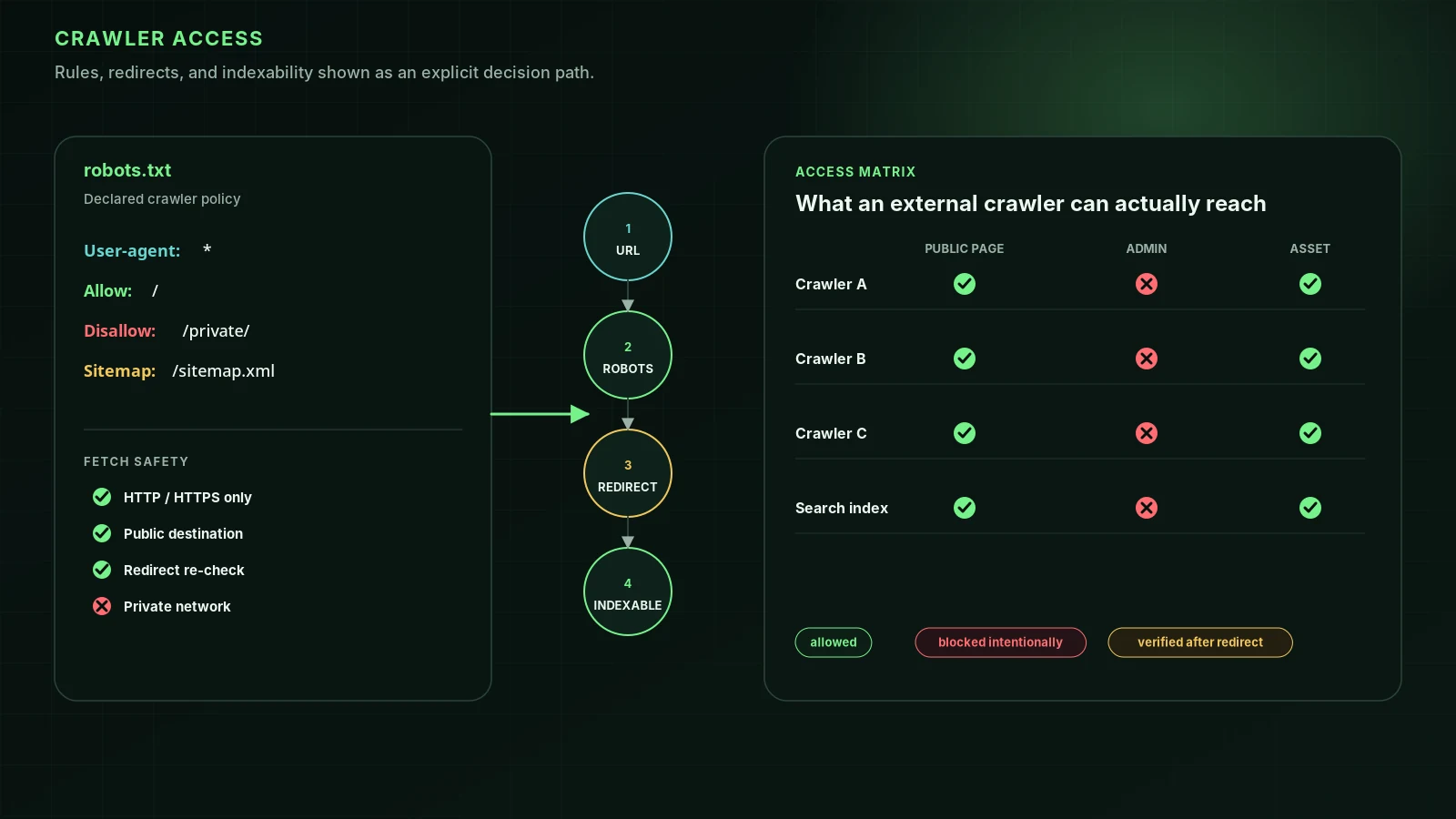
The signals with stronger evidence behind them sit elsewhere. Crawler access is mechanical: a blocked OAI-SearchBot cannot cite anything. Off-site presence correlates far more strongly than anything on the page: in Ahrefs’ 75,000-brand study, YouTube mentions correlated with AI visibility at about 0.737 and branded web mentions at 0.66–0.71. Both are correlations, not proof, but they dwarf anything measured for markup.
What answer engines actually read
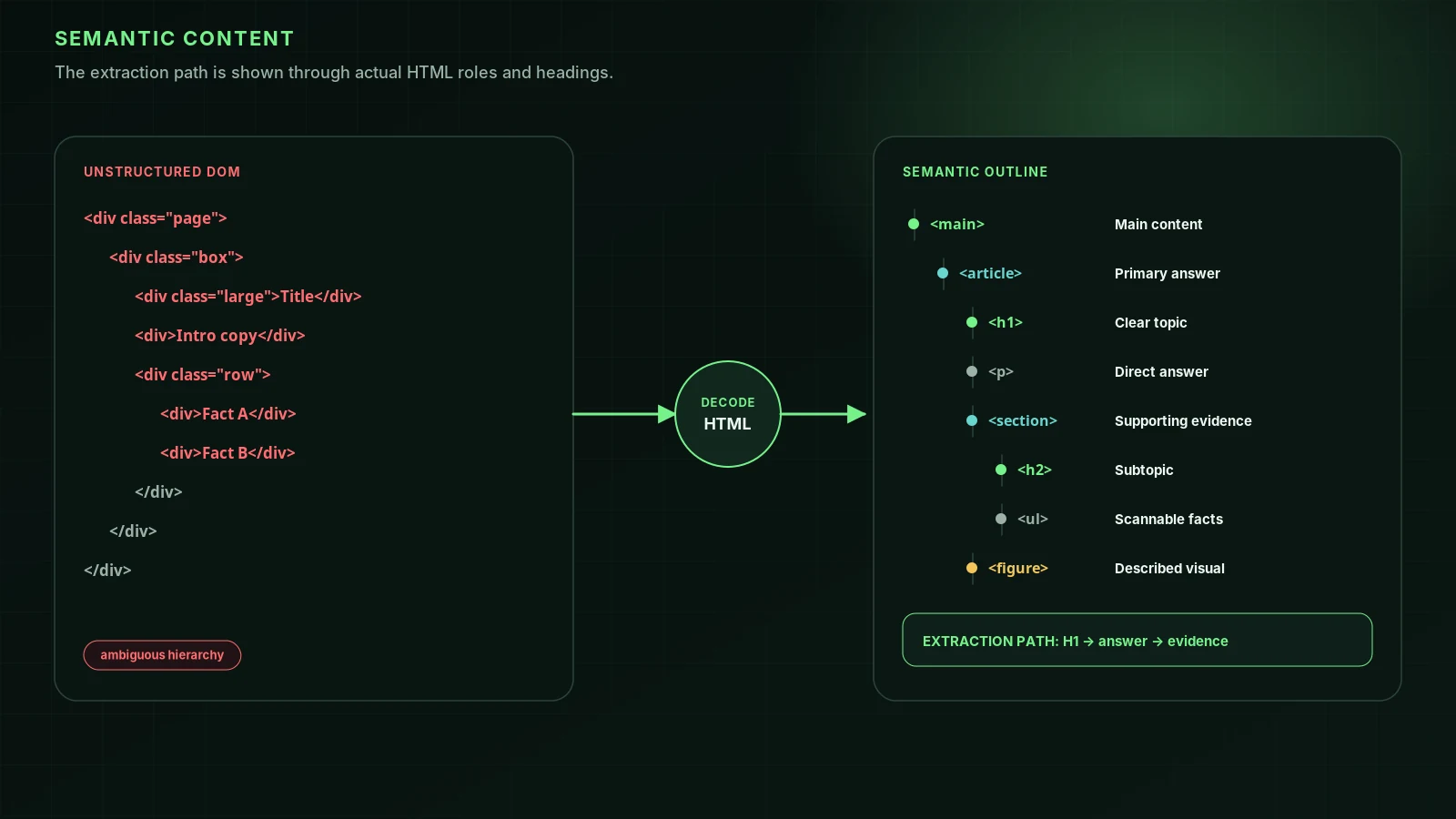
There is little public testing of whether ChatGPT, Claude or Perplexity use JSON-LD at all, and what exists is small. searchVIU built one test page with prices placed in different ways (December 2025). ChatGPT and Gemini returned prices that were in the visible HTML, but neither returned a price that existed only in JSON-LD. Treat that as a warning, not a law: if a fact matters, it belongs in the visible text, structured as a heading, list or table a parser can lift.
Where the markup is injected matters too. The OpenAI, Anthropic and Perplexity crawlers that Vercel and MERJ tested don’t run JavaScript, so JSON-LD added by a tag manager after load may never reach them. Ahrefs notes that AI crawlers appear to treat HTML-embedded and JavaScript-injected schema differently.
The graph worth shipping in 2026
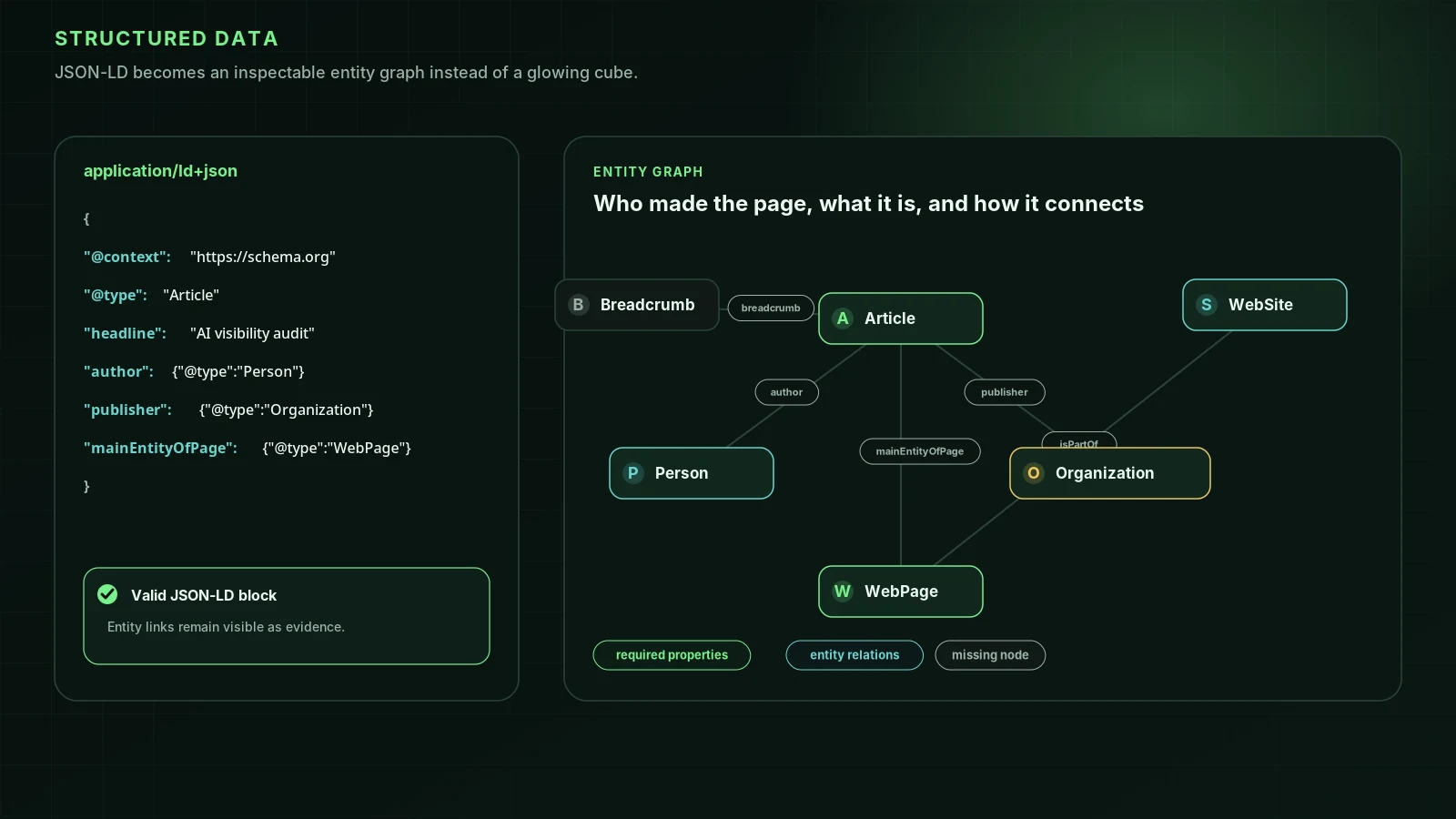
Connect the types with @id so a parser sees one graph rather than five disconnected blocks, and only state what the page already shows:
| Type | Why it exists | Do not |
|---|---|---|
| Organization | Publisher identity: name, logo, URL, and sameAs links to profiles that resolve | Claim awards or profiles that don’t exist |
| Person | The author the page visibly names, with jobTitle and worksFor | Invent an author the page does not show |
| Article / BlogPosting | Headline, datePublished, dateModified, author, publisher | Mark a product or category page as an article |
| WebPage + BreadcrumbList | Where the page sits in the site | Put breadcrumbs only in JSON-LD with nothing visible |
| FAQPage | Nothing visible in Google Search since 7 May 2026 | Add it expecting a rich result or an AI lift |
{
  "@context": "https://schema.org",
  "@graph": [
    {
      "@type": "Organization",
      "@id": "https://example.com/#org",
      "name": "Example",
      "url": "https://example.com/",
      "logo": "https://example.com/logo.png",
      "sameAs": ["https://www.linkedin.com/company/example"]
    },
    {
      "@type": "Person",
      "@id": "https://example.com/authors/maya-chen#person",
      "name": "Maya Chen",
      "jobTitle": "Research lead",
      "worksFor": { "@id": "https://example.com/#org" },
      "sameAs": ["https://www.linkedin.com/in/your-profile"]
    },
    {
      "@type": "BlogPosting",
      "@id": "https://example.com/blog/post#article",
      "headline": "Visible title that matches the H1",
      "datePublished": "2026-08-30T09:00:00+00:00",
      "dateModified": "2026-10-13T09:00:00+00:00",
      "author": { "@type": "Person", "@id": "https://example.com/authors/maya-chen#person", "name": "Maya Chen" },
      "publisher": { "@id": "https://example.com/#org" },
      "mainEntityOfPage": "https://example.com/blog/post"
    }
  ]
}
Two details in that example are deliberate. The author reference repeats the name, because some parsers don’t follow @id links to another node. And the Person’s sameAs points at a profile a stranger can open; the E-E-A-T post covers why links that 404 do more harm than good.
Match the markup to the page
Google’s structured-data guidelines are blunt: “Don’t mark up content that is not visible to readers of the page.” If your JSON-LD says Maya Chen wrote the article and the template prints “Staff”, you haven’t helped any engine. You have created a contradiction, and Google can drop rich results or treat the markup as spam.
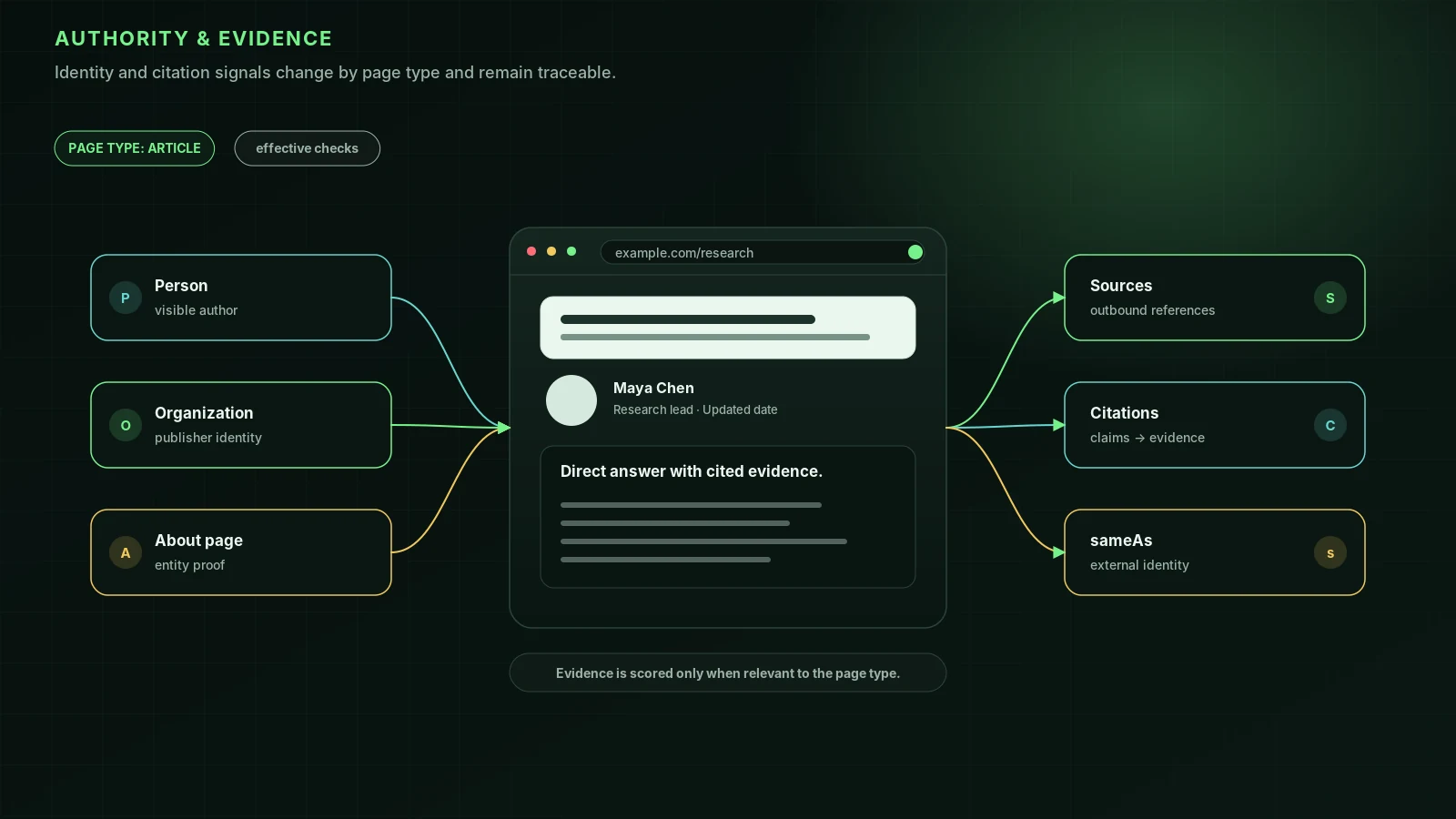
SEO·AEO·GEO lists the JSON-LD types it finds and flags blocks that aren’t valid JSON. It does not score schema and does not compare the graph against the visible page; use Google’s Rich Results Test for that. What it does score are the facts the markup is meant to describe: on articles, a named author and publication and update dates; on every page, a canonical that points at itself. Run a free audit to see those on your own page.
A practical order of operations
- Make the author, publisher, dates and canonical visible in the HTML first.
- Add one @graph that repeats those facts and nothing else.
- Validate with Google’s Rich Results Test and the Schema Markup Validator, and fix errors before adding types.
- Drop any plan that depends on FAQ rich results. Keep a visible FAQ only if readers use it.
- Don’t expect a citation change. Spend the saved time on crawler access, freshness and earning mentions on other sites.
That is the unglamorous version of “structure machines can trust”. It is also the version that matches Google’s documentation and the only large public before-and-after test we have.
FAQ
Does FAQPage schema get you into Google AI Overviews?+
No. Google says there is no special schema needed for its AI features, and it never documented FAQPage as an AI Overviews factor. Google also stopped showing FAQ rich results from 7 May 2026 and removed the documentation in June, so the markup now earns nothing visible in Google Search.
Should I remove schema because of the Ahrefs study?+
No. The study looked at pages that were already heavily cited, over a 30-day window, with all schema types pooled together. Ahrefs itself lists good reasons to keep JSON-LD: rich results, voice assistants, knowledge graphs and entity recognition. Just don’t expect it to raise AI citations.
Do ChatGPT and Perplexity read JSON-LD?+
The evidence is thin and points to no. In a single-page test published in December 2025, searchVIU found ChatGPT and Gemini picked up prices from the visible HTML but not a price that existed only in JSON-LD. Put every fact you want quoted in the visible text.
JSON-LD, Microdata or RDFa?+
Google says all three are equally fine when valid, and recommends the one that is easiest to implement and maintain, which in most cases is JSON-LD. One graph in a single script block, with @id links between Article, Person and Organization, is the simplest to keep correct.
Does SEO·AEO·GEO score schema markup?+
No. SEO·AEO·GEO lists the JSON-LD types it finds and flags blocks that are not valid JSON, but gives structured data zero points, because the best controlled test found no citation effect. Use Google’s Rich Results Test to check rich-result eligibility.
Sources
- We Tracked 1,885 Pages Adding Schema. AI Citations Barely Moved. — Ahrefs (2026-05-11)
- Google’s Guide to Optimizing for Generative AI Features on Google Search — Google Search Central (May 2026, updated July 2026)
- Latest Google Search documentation updates (FAQ rich result deprecation) — Google Search Central (2026-05-08)
- Introduction to structured data markup in Google Search — Google Search Central
- General structured data guidelines — Google Search Central
- Schema Markup and AI in 2025: What ChatGPT, Claude, Perplexity & Gemini Really See — searchVIU (2025-12-02)
- The rise of the AI crawler — Vercel and MERJ (2024-12-17)
- How to Optimize for ChatGPT (129,000 domains, correlational) — SE Ranking
- Top Brand Visibility Factors in ChatGPT, AI Mode, and AI Overviews (75k brands) — Ahrefs
Run it on your domain
See this lens as a finding, not a lecture.
Free technical GEO audit. Evidence-traced scores, LLM-ready export, no login.
Audit your website