Research 6 min read
Who Blocks Meta's AI Crawlers? 99 Big Sites Shut Out OpenAI's and Left Meta's Open
Meta says site owners who object to its crawling should use robots.txt. Most big sites already have a line for OpenAI's training crawler. Far fewer have one for Meta's.

Founder, SEO·AEO·GEO
Builds SEO·AEO·GEO and writes the crawler, schema, and citation research published here.
Key takeaways
- 9.8% of live sites in the top 5,000 block Meta-ExternalAgent in robots.txt, against 11.6% for GPTBot and 10.6% for ClaudeBot.
- 111 sites blocked OpenAI's training crawler but left Meta-ExternalAgent open on 13 October; re-checked on 17 October, 99 of the 107 we could still read were unchanged, including CNN, ESPN, TechCrunch, CBS News and the LA Times.
- Meta runs four crawlers. Meta-ExternalAgent is the one whose stated uses include training foundation models; Meta-WebIndexer is the one that lets Meta AI cite and link pages.
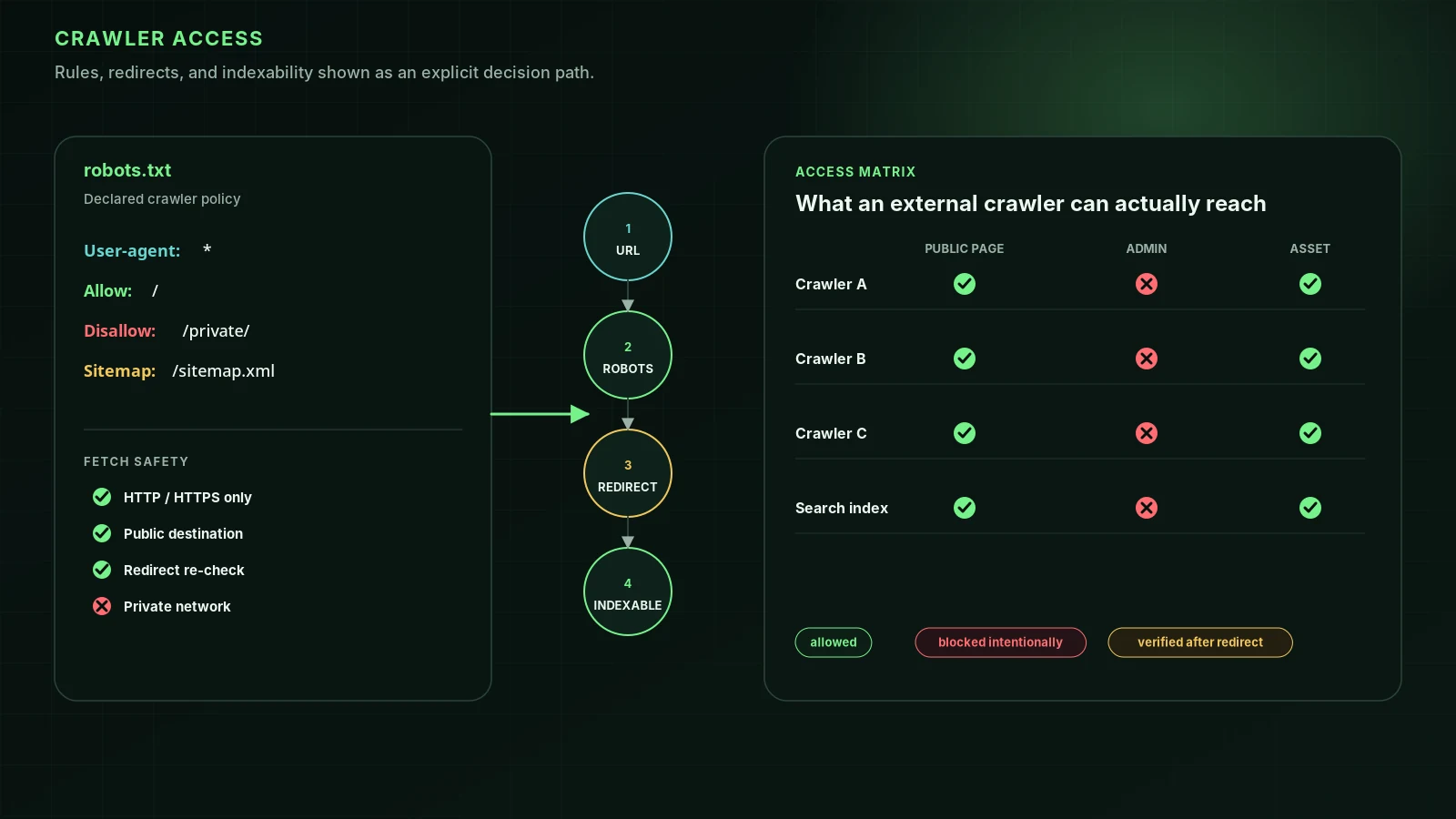
- Meta's spokesperson pointed content owners to robots.txt after its new business terms drew criticism. Each crawler needs its own group: a GPTBot rule does nothing to Meta's crawlers.
Among the 2,976 live sites in the world's top 5,000 whose robots.txt we could read on 13 October 2026, 9.8% block Meta-ExternalAgent, Meta's crawler for training foundation models and indexing content for its products. That's fewer than block OpenAI's GPTBot (11.6%) or Anthropic's ClaudeBot (10.6%). And 111 sites blocked GPTBot while leaving Meta-ExternalAgent open. We re-read their robots.txt on 17 October: 99 of the 107 we could still fetch hadn't changed, among them CNN, ESPN, TechCrunch, CBS News, the LA Times and Harvard Business Review.
Why this matters this month
Meta's updated Commercial Terms take effect on 30 October 2026. According to Unite.AI and Nieman Lab, a version of the terms let Meta crawl websites linked to business accounts on Facebook, Instagram and WhatsApp and use the content to “provide, develop, improve, research, train”. On 16 October the News/Media Alliance's chief executive, Danielle Coffey, called the terms “outrageous and probably illegal”. Meta then removed the training wording, and its spokesperson Andy Stone said “content owners can use robots.txt flags to indicate their preferences”, adding that “there was no change to how Meta uses web crawlers”.
So, by Meta's own account, robots.txt is the lever. We already had every top-5,000 site's robots.txt from our October crawler study, parsed for 31 AI crawlers including all four of Meta's.
Meta's four crawlers, and what each one does
| robots.txt token | What Meta says it does | Follows robots.txt? | Live sites blocking it |
|---|---|---|---|
| Meta-ExternalAgent | Crawls for uses such as training foundation models or improving products by indexing content directly | Yes | 9.8% (291) |
| Meta-WebIndexer | Improves Meta AI search so it can cite and link content in its answers | Yes | 5.0% (150) |
| Meta-ExternalFetcher | Fetches individual links a user asks for, including for Meta's agents | May bypass it | 6.3% (187) |
| Meta-ExternalAds | Crawls for advertising and other business products | Yes | 3.1% (92) |
Most of those blocks are deliberate: 211 sites name Meta-ExternalAgent in their own group. The rest fall under a rule for all crawlers. Meta-ExternalAds is almost never named (3 sites), so its 3.1% comes from sites that block every unnamed crawler. Of the 291 sites that block Meta-ExternalAgent, 144 still allow Meta-WebIndexer: they've opted out of training while staying citable in Meta AI.
The gap: OpenAI blocked, Meta not
A robots.txt group applies only to the crawler it names (RFC 9309). A site that writes `User-agent: GPTBot` and `Disallow: /` has said nothing to Meta-ExternalAgent, which falls back to the rule for all crawlers, usually “allow”. On 13 October, 111 live sites were in that position. On 17 October we fetched their robots.txt again and ran it through the same parser our audit uses: 107 answered, and 99 still blocked GPTBot while allowing Meta-ExternalAgent.
| Site | Rank | Blocks GPTBot | Blocks Meta-ExternalAgent |
|---|---|---|---|
| yahoo.com | 62 | Yes | No |
| cnn.com | 198 | Yes | No |
| espn.com | 405 | Yes | No |
| claude.ai | 430 | Yes | No |
| techcrunch.com | 650 | Yes | No |
| cbsnews.com | 707 | Yes | No |
| lefigaro.fr | 834 | Yes | No |
| hbr.org | 903 | Yes | No |
| latimes.com | 923 | Yes | No |
| repubblica.it | 967 | Yes | No |
| webmd.com | 1,006 | Yes | No |
| pbs.org | 1,074 | Yes | No |
| skysports.com | 1,116 | Yes | No |
| jstor.org | 1,352 | Yes | No |
| aljazeera.com | 1,438 | Yes | No |
This doesn't mean any of these publishers wants Meta to train on its pages. Most AI blocklists were written in 2023 and 2024, when GPTBot, CCBot and Google-Extended were the names everyone copied. Meta-ExternalAgent arrived later and simply isn't in many of them. The reverse also happens: 57 sites block Meta-ExternalAgent but not GPTBot.
What to add to robots.txt
If you want out of Meta's model training but would still like Meta AI to be able to cite you, block Meta-ExternalAgent and leave Meta-WebIndexer alone:
# Meta: no training, keep Meta AI citations
User-agent: Meta-ExternalAgent
Disallow: /

# Everyone else, including Meta-WebIndexer
User-agent: *
Allow: /
Meta says crawlers may cache robots.txt for up to 24 hours, so allow a day for the change. To write a file covering every AI crawler at once, use the AI robots.txt generator; for exact user-agent strings to look for in your logs, see the AI crawler list. Then run a free audit to check that your CDN or firewall agrees with the file.
FAQ
How do I block Meta's AI crawler?+
Add a robots.txt group for Meta-ExternalAgent with Disallow: /. That is the crawler Meta says may be used to train foundation models. A rule for GPTBot or ClaudeBot doesn't apply to it: under RFC 9309 a crawler follows the group that names it, otherwise the rule for all crawlers.
Will blocking Meta-ExternalAgent remove me from Meta AI answers?+
Meta's documentation gives Meta-ExternalAgent two jobs: training foundation models and indexing content for Meta products. Meta-WebIndexer is the crawler it describes as helping Meta AI cite and link content, so you can block Meta-ExternalAgent and keep Meta-WebIndexer. Meta hasn't said exactly which products lose access when Meta-ExternalAgent is blocked.
Does Meta-ExternalFetcher obey robots.txt?+
Not always. Meta says it fetches individual links at a user's request and may bypass robots.txt for that reason, the same position most assistants take on user-triggered fetches.
What changed in Meta's business terms?+
Reporting by Unite.AI and Nieman Lab says a version of Meta's Commercial Terms, due to take effect on 30 October 2026, let Meta crawl websites linked to business accounts and use the content to train AI. After the News/Media Alliance objected on 16 October, Meta removed the training wording, and its spokesperson said content owners can use robots.txt to indicate their preferences.
Sources
- Meta rewrites web crawling clause in pending commercial terms — Unite.AI (2026-10-17)
- Meta's new commercial terms will allow the scraping of news sites, legal experts say — Nieman Lab
- Meta Web Crawlers — Meta for Developers
- RFC 9309: Robots Exclusion Protocol — IETF
- Overview of OpenAI crawlers — OpenAI
Run it on your domain
See this lens as a finding, not a lecture.
Free technical GEO audit. Evidence-traced scores, LLM-ready export, no login.
Audit your websiteContinue the atlas
Robots.txt Says Yes, the Firewall Says No: AI Search-Bot Access on the Top 5,000 Websites (October 2026)
Meta-WebIndexer, Meta-ExternalFetcher and Amzn-SearchBot: The New AI Crawlers in Your Logs, and Whether to Allow Them
GPTBot vs OAI-SearchBot: What to Block and What to Allow in 2026