PerformanceUpdated 7 min read
AI Crawlers and Page Speed: Timeouts, Redirects and Raw HTML
A green Lighthouse score won’t help if a firewall refuses the crawler or the content only exists after JavaScript runs. Speed matters most at the slow extreme.

Founder, SEO·AEO·GEO
Builds SEO·AEO·GEO and writes the crawler, schema, and citation research published here.
Key takeaways
- Speed is a weak AI-visibility factor: a large study of pages in AI Overviews and AI Mode found only weak correlations with Core Web Vitals, concentrated among the slowest pages.
- The things that actually stop an AI crawler are firewall and CDN refusals, content that only exists after JavaScript runs, redirects that end on an error, and origins slow enough to time out.
- AI crawlers do not fetch llms.txt before your pages: in server logs from 137,000 domains, 97% of llms.txt files got no requests at all in a month.
- No AI vendor publishes a crawler timeout, so aim for HTML delivered in about a second and keep redirects to one hop.
- Core Web Vitals measure people’s browsers. Keep fixing them for users, but don’t expect them to move AI citations.
Page speed is a weak factor in AI visibility. The largest study we know of, about 107,000 pages appearing in Google AI Overviews and AI Mode, found only weak correlations with Core Web Vitals, concentrated among the slowest pages. What actually stops an AI crawler from reading your page is more basic: a CDN or firewall rule that refuses it, content that only appears after JavaScript runs, redirects that end on an error, or an origin so slow the request times out. Fix those first and treat speed as hygiene, not a citation lever.
What the speed evidence says
Search Engine Land’s January 2026 analysis tested the common assumption that good Core Web Vitals should go with strong AI visibility. Across roughly 107,000 pages in AI Overviews and AI Mode, it found no reliable advantage for pages that were already acceptable; the weak relationship that did exist came from extremely slow outliers. Our methodology grades load time “weak” for that reason and gives it 3 of the 67 Retrieval points.
SE Ranking’s ChatGPT dataset points the other way: pages with a First Contentful Paint under 0.4 seconds averaged 6.7 citations, against 2.1 for pages slower than 1.13 seconds. But First Contentful Paint is a browser metric no AI crawler measures, and fast sites tend to be well-funded sites that also do everything else well. Both findings are correlational. Neither supports treating speed as a citation lever.
| Metric | Who experiences it | What it means for AI crawlers |
|---|---|---|
| LCP, INP, CLS (Core Web Vitals) | People, in their browsers | Indirect. Fix them for users; the AI-visibility correlation is weak. |
| Server response time (TTFB) | Every HTTP client | Matters at the slow extreme: a response that misses the client’s timeout returns nothing. |
| Redirect hops | Every crawler | Each hop is another request. Chains that end on a 404, a login page or a loop fail. |
| JavaScript execution | Browsers and Googlebot | The AI crawlers tested don’t do it at all, so client-rendered content is missing. |
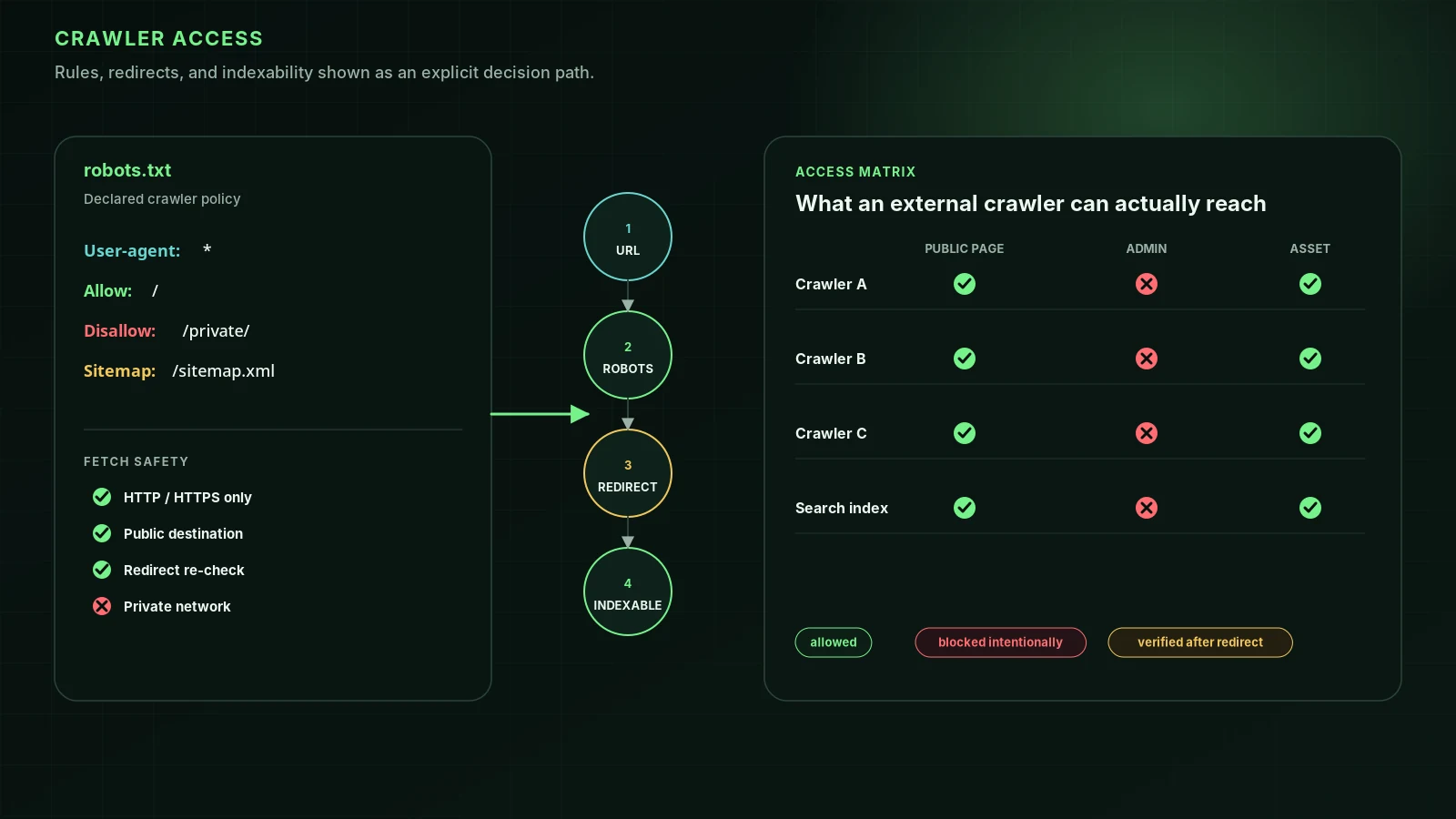
| Firewall or bot rules | Whoever the rule targets | A refused request is the most complete failure there is, and it never shows in robots.txt. |
What actually stops a fetch
- A CDN, WAF or bot rule refuses the request with a 403, a 402 (Cloudflare’s pay per crawl) or a challenge page. Cloudflare changed its default for new domains on 1 July 2025 and added separate Search, Agent and Training settings in 2026; the robots.txt and CDN guide covers what to allow.
- robots.txt disallows the crawler, or robots.txt itself fails. Under RFC 9309, a robots.txt that is unreachable because of a server error means the crawler “MUST assume complete disallow”, so a 5xx on that one file closes the whole site to compliant crawlers.
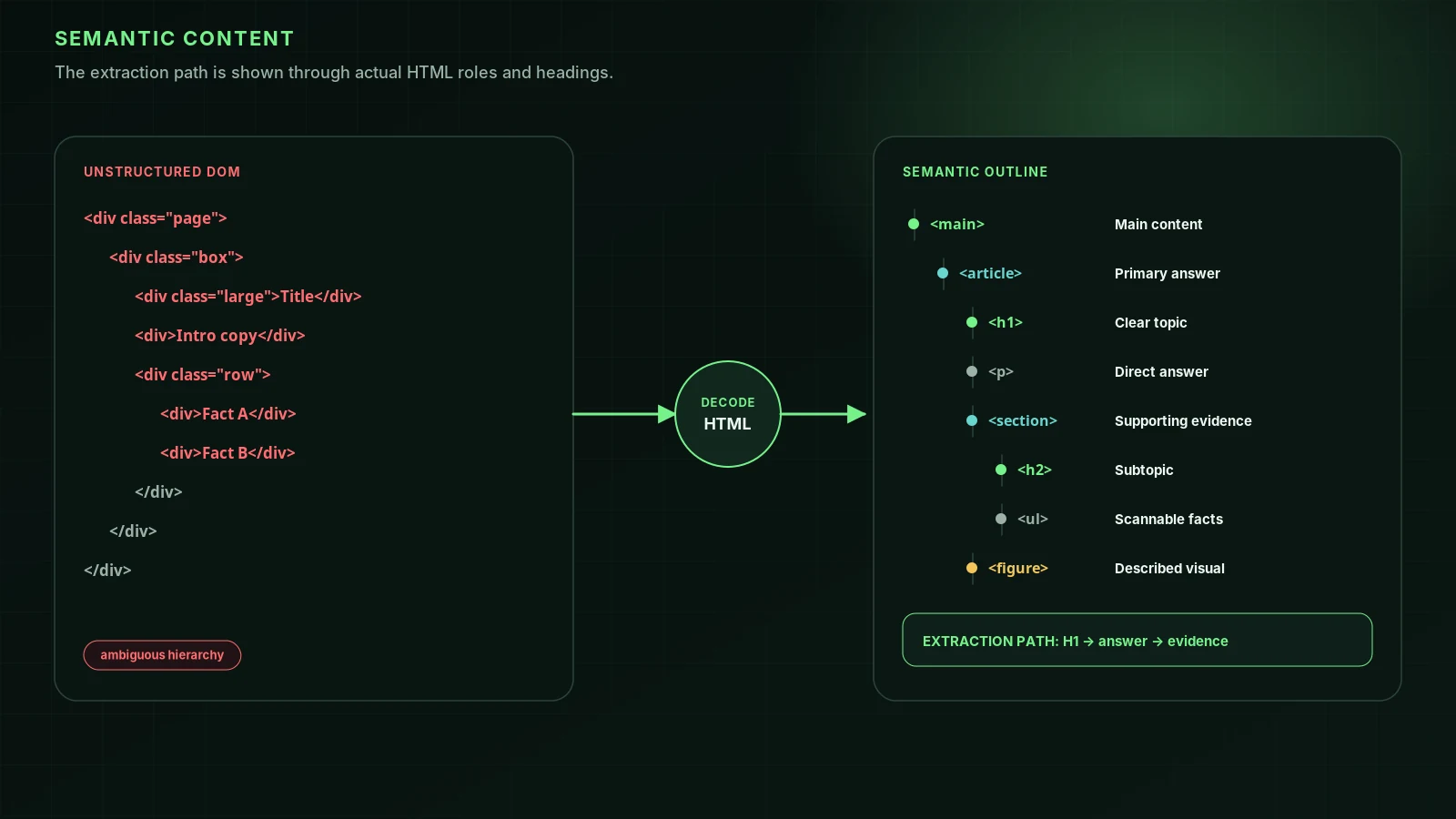
- The content isn’t in the raw HTML. Vercel and MERJ found none of the major AI crawlers rendered JavaScript; see how AI crawlers read your HTML.
- Redirects end somewhere broken. The same Vercel data showed ChatGPT’s crawler spending 34.82% of its fetches on 404 pages and 14.36% following redirects, against 8.22% and 1.49% for Googlebot.
- The origin is too slow. No AI vendor publishes its timeout, so the only safe answer is a fast one: cache the HTML at the edge and keep server work before the first byte small.
llms.txt is not in the chain
Compliant crawlers read robots.txt before crawling a site, and sitemaps help them discover URLs. llms.txt plays no part in either. Ahrefs analysed the server logs of 137,000 domains: 97% of llms.txt files received zero requests in May 2026, and no AI bot ever requested an llms.txt file that didn’t exist. Google’s generative-AI guide (May 2026, updated July 2026) says Google Search doesn’t use these files and that keeping one “will neither harm nor help” your visibility in Google Search.
So an llms.txt file can’t slow your pages down or speed them up for AI crawlers. If coding agents are pointed at your developer docs, it may be useful to them; otherwise leave it alone. SEO·AEO·GEO reports whether you have one and scores it zero either way.
How SEO·AEO·GEO measures this
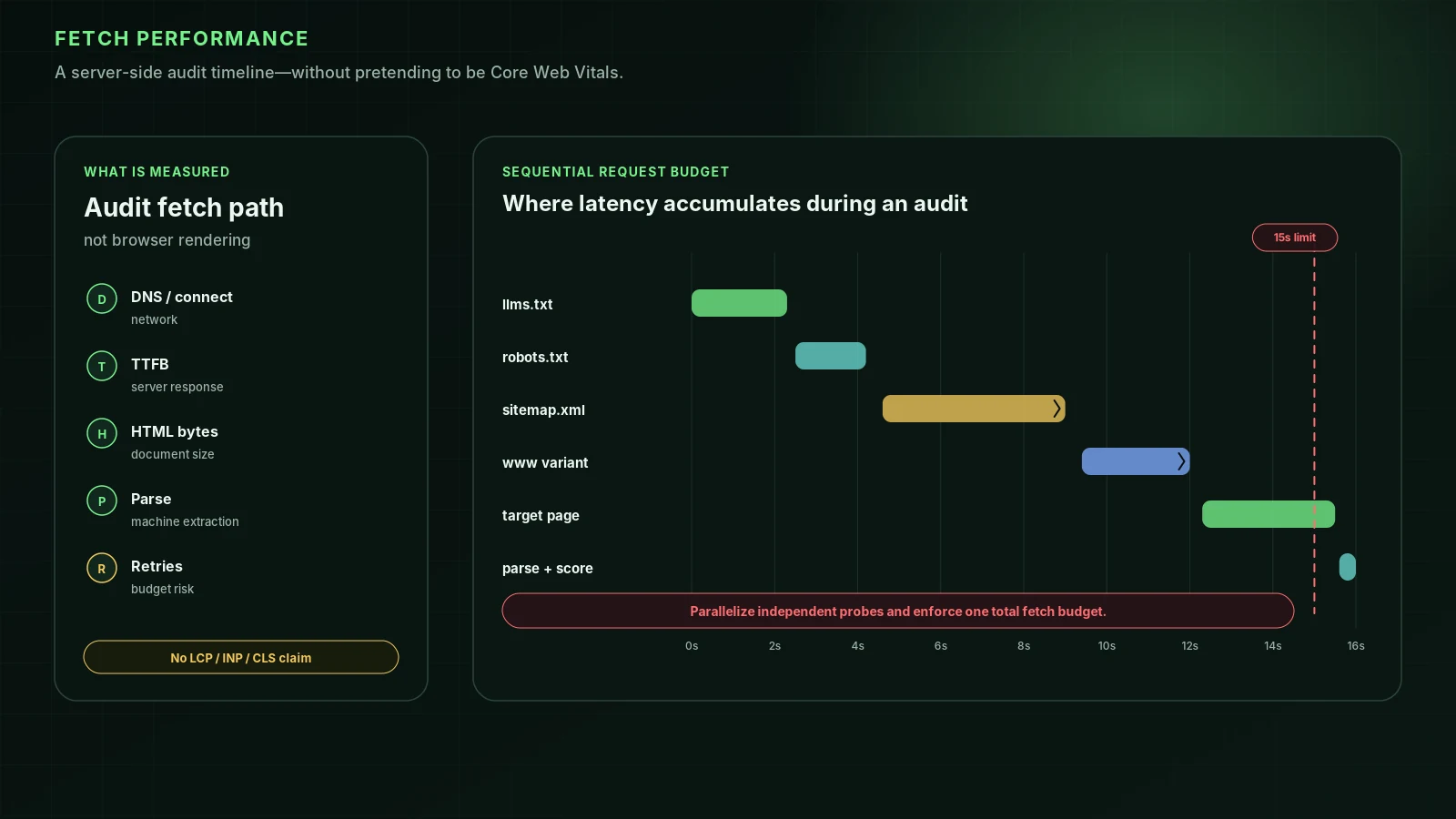
The engine requests the page, robots.txt and llms.txt in parallel, then runs the crawler-identity probes and the remaining lookups alongside each other. The whole audit has a 20-second deadline, set by our hosting runtime rather than by any crawler, and the page request follows up to five redirects, checking each hop. Those are properties of our auditor, not published crawler limits.
- Load time (Retrieval, 3 points): how long the HTML took to arrive, measured server to server, not a browser render. Under one second passes, one to three seconds scores partly, three seconds or more warns.
- Edge access (Retrieval, 4 points): the page requested as OAI-SearchBot, PerplexityBot and Claude-SearchBot, compared with a browser request. Simulated, because real crawlers are verified by IP.
- Raw HTML visibility (Retrieval, 15 points, can cap the score): the words in the HTML before any JavaScript runs.
- robots.txt AI rules (Retrieval, 10 points, can cap the score): including a robots.txt that answers with a server error.
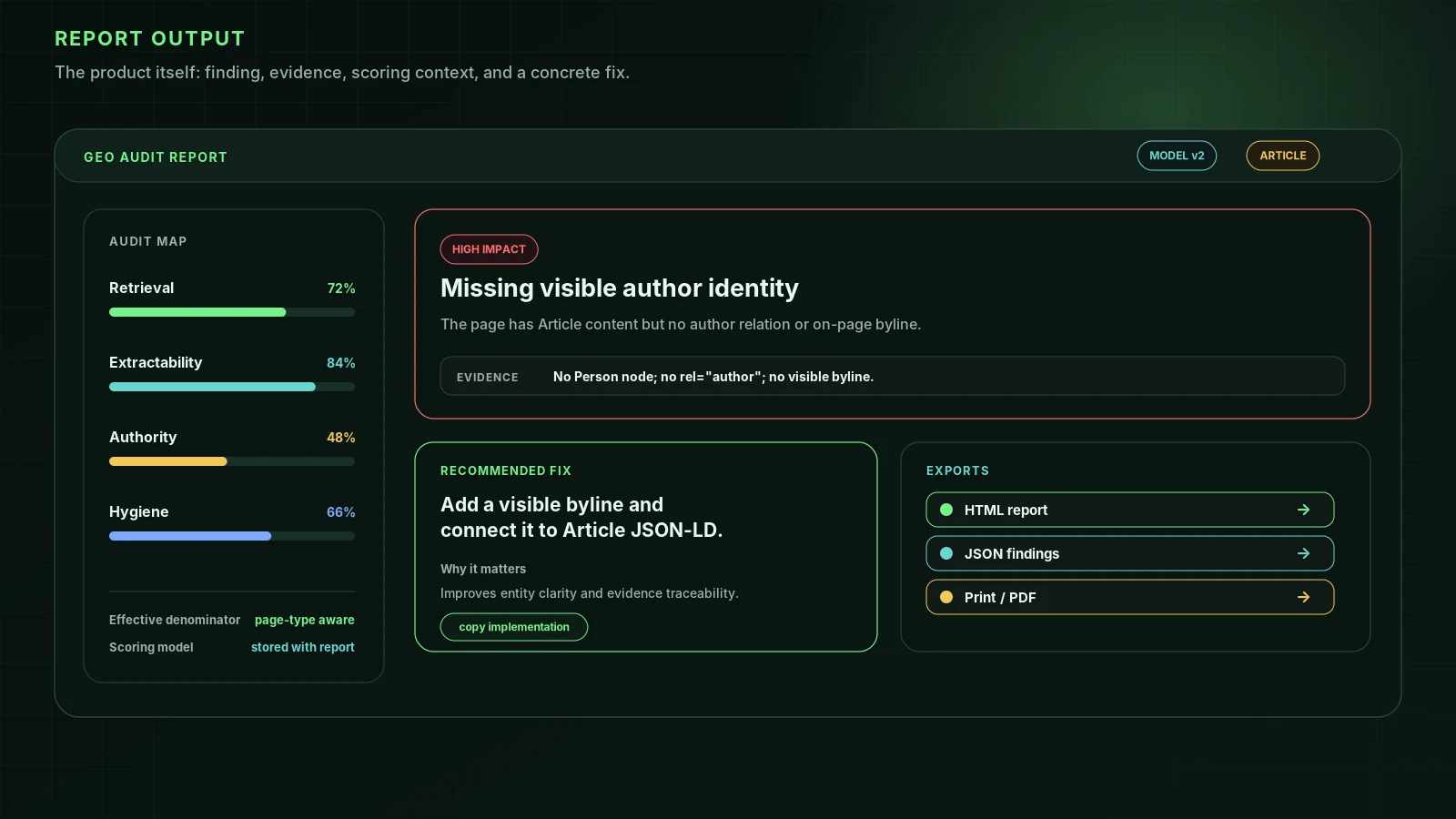
Each finding in the report carries what was measured, such as the HTML delivery time in milliseconds or the HTTP status each simulated crawler received; how to read and export an SEO·AEO·GEO report explains the fields.
Fixes that change whether a crawler gets the page
- Allow verified AI search crawlers at the CDN or WAF, then confirm in your logs that they receive 200 responses.
- Server-render the main content so it is complete in the first HTML response.
- Redirect old URLs in one hop to the final HTTPS address, and point canonicals and internal links straight at it (see canonical URLs and Open Graph).
- Make robots.txt answer 200 with your rules, or 404 if you have none. Never a 5xx.
- Cache HTML at the edge so the first byte arrives quickly for any client.
- Log AI user agents separately. A bot challenge shows up as 403s, or response times far above what a normal visitor gets.
Then keep improving Core Web Vitals for the people who visit. Run a free audit to see Load time, Edge access and Raw HTML visibility for any page.
FAQ
If my Core Web Vitals are good, am I fast enough for AI crawlers?+
Almost certainly. Core Web Vitals measure what real users’ browsers experience; AI crawlers fetch the HTML and don’t render the page. If you have an AI visibility problem, check crawler access and whether your content is in the raw HTML before you look at speed.
Does page speed affect AI Overviews?+
Weakly at most. A January 2026 analysis of about 107,000 pages appearing in AI Overviews and AI Mode found only weak correlations with Core Web Vitals, concentrated at the slow extreme. Google’s guide includes reducing latency as part of a good page experience, not as an AI-specific factor.
Do AI crawlers read llms.txt?+
Rarely. Ahrefs’ server logs from 137,000 domains showed 97% of llms.txt files received zero requests in May 2026, and no AI bot requested an llms.txt file that didn’t exist. Google says Search doesn’t use them. Keeping one is harmless; it doesn’t change how your pages are crawled.
How fast does my server need to respond?+
No AI vendor publishes a timeout, so there is no official number. Delivering the HTML in under a second is comfortably safe for any client, and is where SEO·AEO·GEO’s Load time check passes. Responses that take several seconds start to risk timeouts.
Do AI crawlers follow redirects?+
Yes. In Vercel and MERJ’s data, ChatGPT’s crawler spent 14.36% of its fetches following redirects. The problem is chains that end on a 404, a login page or a loop. Redirect old URLs in one hop to the final HTTPS address.
Sources
- Core Web Vitals and AI search visibility (107,000 pages) — Search Engine Land (2026-01)
- How to Optimize for ChatGPT (216,524 pages, correlational) — SE Ranking
- The rise of the AI crawler — Vercel and MERJ (2024-12-17)
- We Analyzed 137K Sites: 97% of llms.txt Files Never Get Read — Ahrefs (2026-06-15)
- RFC 9309: Robots Exclusion Protocol — IETF
- Content Independence Day: no AI crawl without compensation! — Cloudflare Blog (2025-07-01)
- Your site, your rules: new AI traffic options for all customers — Cloudflare Blog (2026-07-01)
- Google’s Guide to Optimizing for Generative AI Features on Google Search — Google Search Central (May 2026, updated July 2026)
Run it on your domain
See this lens as a finding, not a lecture.
Free technical GEO audit. Evidence-traced scores, LLM-ready export, no login.
Audit your website