Strategy 10 min read
How to Choose a GEO Audit Tool: 8 Checks Before You Trust the Score
There are now dozens of GEO, AEO and AI-visibility tools, and they often contradict each other. Most of the disagreement comes from a handful of avoidable errors. Here is how to spot them in a few minutes.

Founder, SEO·AEO·GEO
Builds SEO·AEO·GEO and writes the crawler, schema, and citation research published here.
Key takeaways
- A useful GEO audit gets the crawler facts right: GPTBot is training, OAI-SearchBot decides ChatGPT search, and Google-Extended does not affect AI Overviews.
- Reading robots.txt is not enough; firewalls and CDNs refuse AI crawlers that robots.txt allows, and only a live request can show it.
- A tool that awards points for llms.txt or FAQ schema is scoring something no AI search engine has said it uses to choose sources.
- Prompt trackers measure a sample of answers that varies run to run, while page audits diagnose causes; you may need both, but not to pay twice for the same thing.
- The best test of any tool is whether it tells you exactly what to change, where, and how to verify that the change worked.
Choose a GEO audit tool by checking how it reaches its verdicts, not how many checks it lists. Run one page you know well through it and look for eight things: correct crawler facts, a live test of crawler access, a view of the HTML without JavaScript, no points for llms.txt or schema, a score you can trace to evidence, honest handling of AI answer variance, use of the free first-party data, and fixes you can act on and verify. Tools that fail several of these will send you chasing changes that don't matter.
First, know which kind of tool you're looking at
“GEO tool” now covers four different products. They answer different questions, and comparing a prompt tracker's number with a page audit's score is comparing a thermometer with a stethoscope.
| Kind of tool | What it measures | Examples and entry price | What it can't tell you |
|---|---|---|---|
| Prompt and mention trackers | How often your brand or URLs appear in answers to prompts you choose, sampled over time | Otterly.AI from $29/month for 15 prompts; HubSpot AEO $50/month for 25 prompts; Semrush AI Visibility $99/month per domain; Ahrefs Brand Radar AI from $199/month | Why you're missing, or which change on your site would help |
| Page audits | Whether a page can be fetched, read and quoted: crawler access, rendering, structure, trust signals | Several, including ours; many run a free audit with no login | How often you're actually cited; what other sites say about you |
| Agent skills and scripts | Whatever the skill instructs your coding agent to check, run inside Claude Code, Cursor or Codex | Mostly free and open source; you pay for the agent's tokens | Consistency: a score written by a language model can change between runs |
| First-party reports | Your real impressions in Google's AI features and citations in Bing's | Search Console and Bing Webmaster Tools, free | Anything about ChatGPT, Claude or Perplexity, or why a page is missing |
The rest of this guide is about the second and third kinds, the ones that claim to tell you what to fix. For tracking, see how to measure AI visibility without fooling yourself.
1. Does it get the crawler facts right?
Every AI vendor now runs separate crawlers for separate jobs, and the most common error in GEO tools is treating them as one. Check any tool's crawler advice against these documented facts:
- OpenAI: GPTBot collects training data; OAI-SearchBot decides whether a site appears in ChatGPT search; ChatGPT-User fetches pages when a user asks. Blocking GPTBot does not remove you from ChatGPT search (OpenAI).
- Anthropic: ClaudeBot is for training, Claude-SearchBot indexes for Claude's search, and Claude-User fetches on a user's request (Anthropic).
- Perplexity: PerplexityBot indexes for Perplexity's answers, and Perplexity-User fetches on request (Perplexity).
- Google: AI Overviews and AI Mode use the normal Googlebot index. Google-Extended controls Gemini training and grounding outside Search, and is not a Search ranking or inclusion signal (Google).
A tool that tells you to “allow Google-Extended to appear in AI Overviews”, or warns that blocking GPTBot removes you from ChatGPT search, has the basics wrong. The full breakdown is in GPTBot vs OAI-SearchBot.
2. Does it test access live, or only read robots.txt?
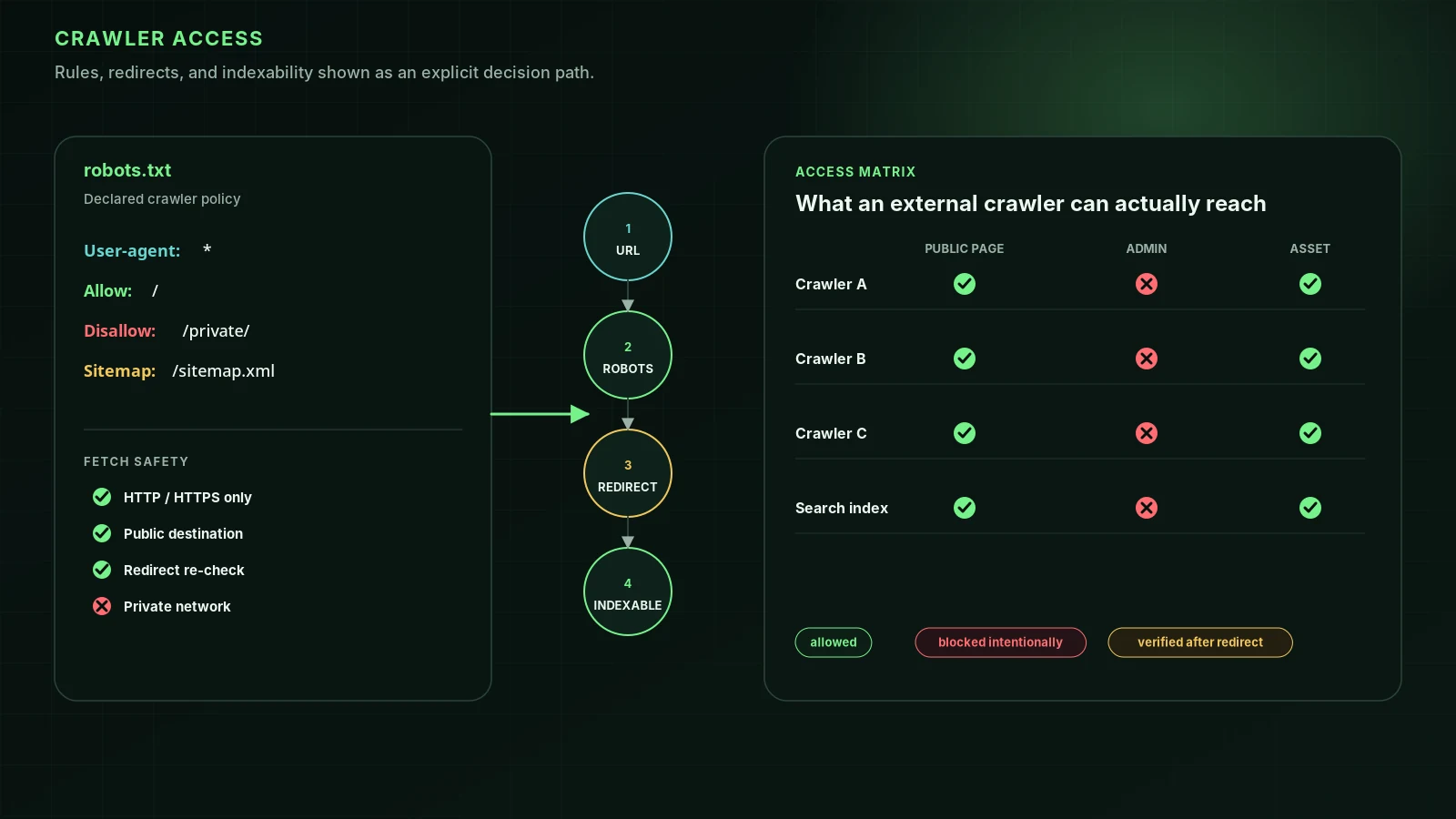
robots.txt states a policy. A CDN, firewall or bot-management product enforces one, before robots.txt is consulted, and when the two disagree the firewall wins. In our study of the top 5,000 sites, 2,672 sites allowed OAI-SearchBot, PerplexityBot and Claude-SearchBot in robots.txt and answered all three requests. Of those, 263 (9.8%) still turned at least one away, and 77 (2.9%) did so in a way aimed at AI crawlers by name.
A tool that only parses robots.txt can't see any of that. Look for one that requests the page with each AI crawler's user agent and compares the answer with a normal browser request. Look also for honesty about the limit: real crawlers are verified by IP address or signed requests, so a request that only borrows a crawler's name can be treated differently. A good tool labels this result as a simulation, not a verdict.
3. Does it look at the page without JavaScript?
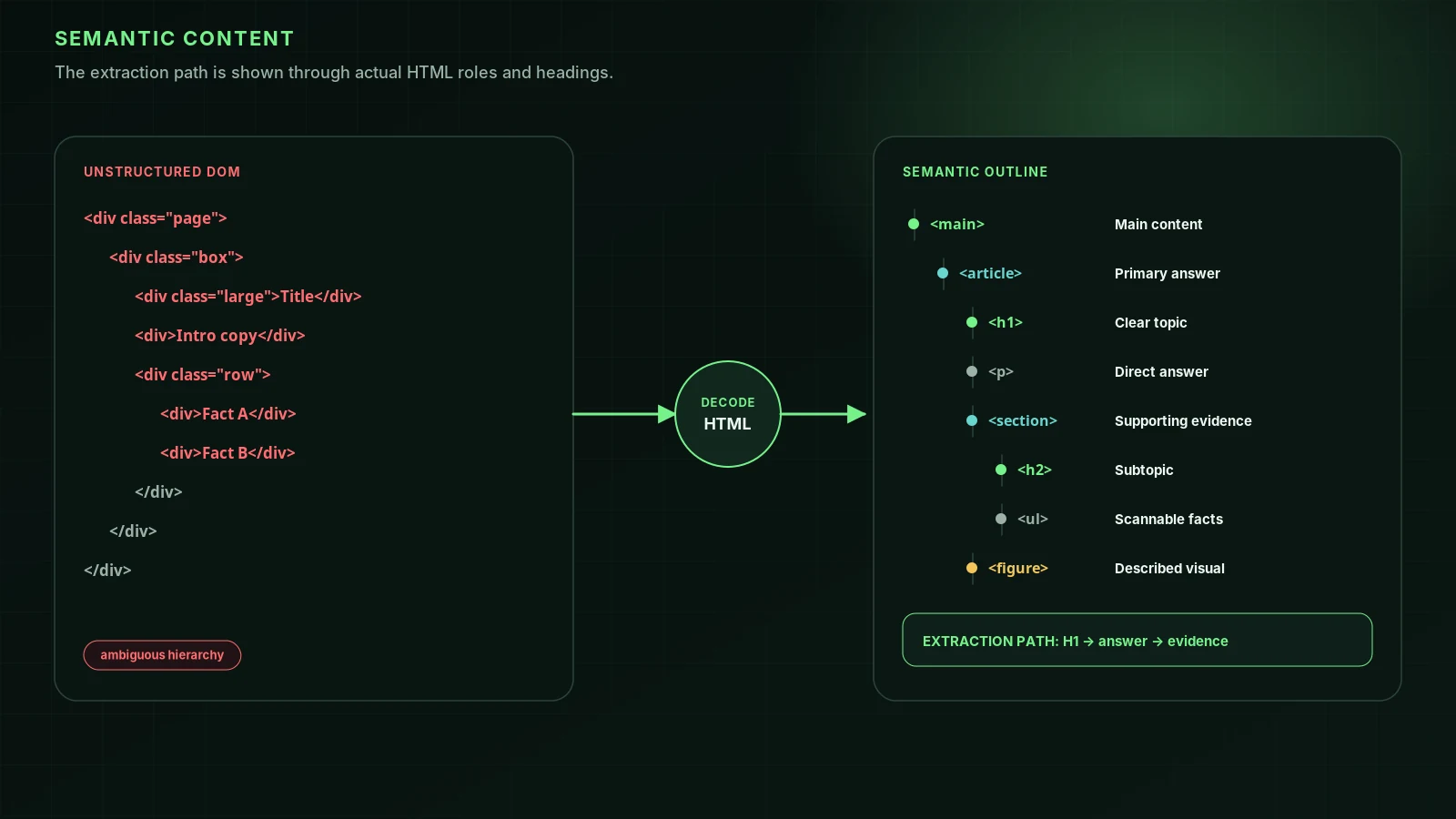
The crawlers behind ChatGPT, Claude and Perplexity read the HTML your server returns; Vercel and MERJ's analysis of crawler traffic found no evidence that OpenAI's or Anthropic's crawlers execute JavaScript (Vercel). A page that builds its text in the browser can look complete to you and nearly empty to them. If a tool audits pages in a full browser and never compares that with the raw HTML, it's reporting what you see, not what the crawler gets. See can ChatGPT, Claude and Perplexity read your website?
4. Does it award points for llms.txt or schema?
Google's own guide to its AI features says you don't need an llms.txt file, special schema.org markup or AI-specific files to appear in them, and that optimizing for generative AI search is still SEO (Google). No AI search engine has said it uses llms.txt to choose which pages to cite. Structured data still matters for rich results and for describing entities clearly, but no controlled test has shown that adding it changes which pages AI answers cite.
So a tool whose top recommendations are “create llms.txt” and “add FAQPage schema” is spending your attention on the cheapest things to measure, not the things most likely to matter. It's fine for a tool to report them; it's a red flag when they move the score. The evidence for each is graded in GEO myths, graded.
5. Can you trace the score back to evidence?
A composite score is only as good as its weights. Ask three questions of any “GEO score” or “AI readiness score”:
- What is each point based on? Look for a public methodology that lists every check, its weight and its source.
- Does a page-killing problem cap the score? A page set to noindex, or one AI crawlers can't fetch, shouldn't score 80 because its headings are tidy.
- What happens when something can't be measured? A timed-out request should be reported as unverified, not as a failure that drags the score down.
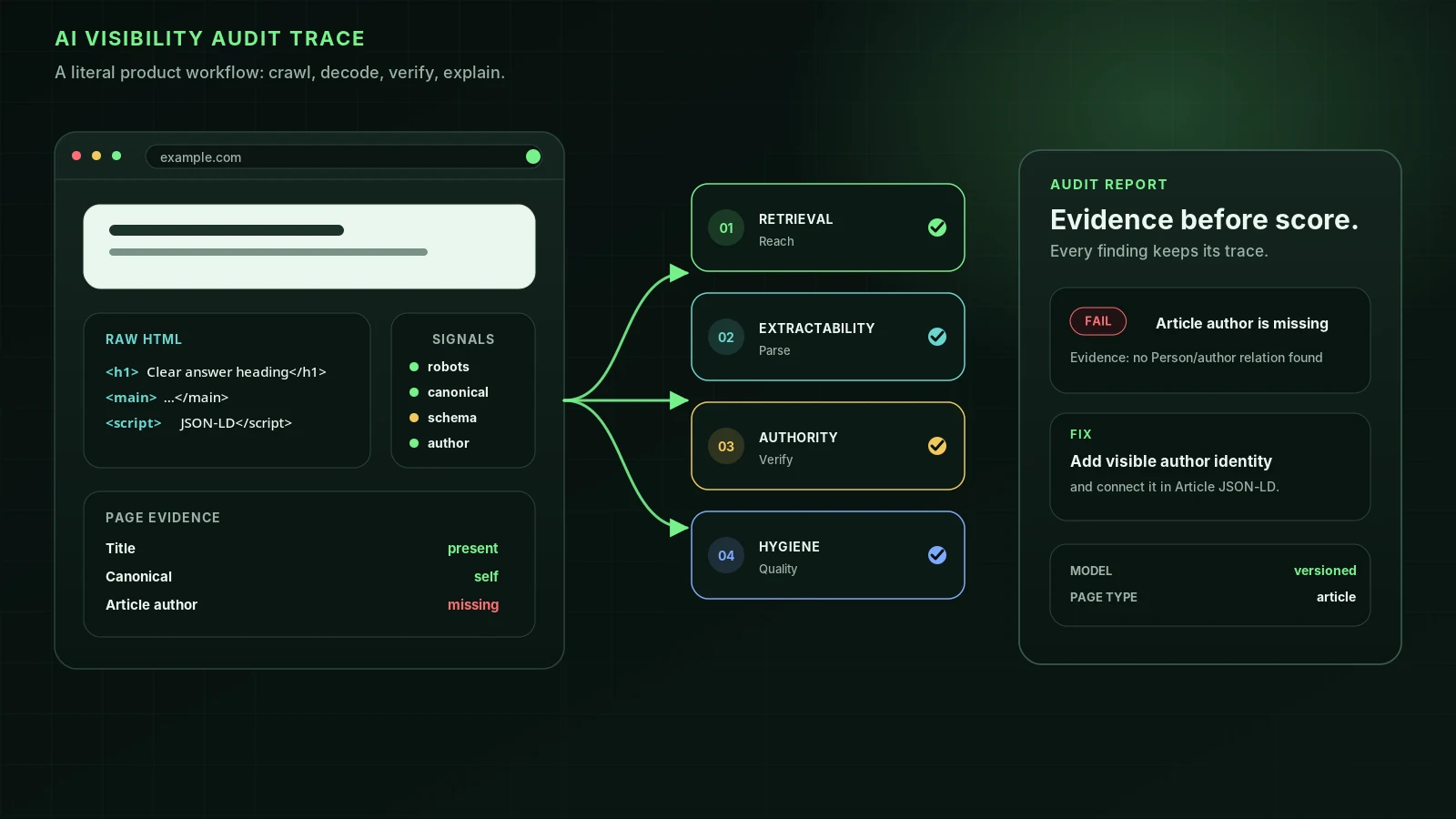
If the score is written by a language model reading your page, run the same page twice. If the number moves without the page changing, treat it as an opinion, not a measurement. Our own weights and evidence grades are on the methodology page.
6. Does it treat AI answers as samples?
AI answers change from run to run. A vendor study by Otterly.AI that collected 252,407 answers found brand mentions noticeably more stable than the specific pages cited (Otterly.AI, vendor study). That means any single “are you cited?” check is one draw from a distribution. Good tools report how many runs, prompts and engines sit behind a number, show the actual answers and cited URLs, and separate what was observed from what was inferred. Be wary of a tool that turns one run into a rank.
7. Does it use the data Google and Bing now give you free?
Since 31 August 2026, Search Console's generative AI performance report has shown every verified site its impressions in Google's AI features, by page, country and device, though without queries or clicks (Search Console Help). Bing Webmaster Tools' AI Performance report shows citations, cited pages and sampled grounding queries for Copilot and Bing's AI summaries (Bing). A tool that ignores these, or sells you a modelled estimate of the same thing, is asking you to pay for less accurate data. Setup guides: Search Console and Bing.
8. Does it tell you what to change, where, and how to verify it?
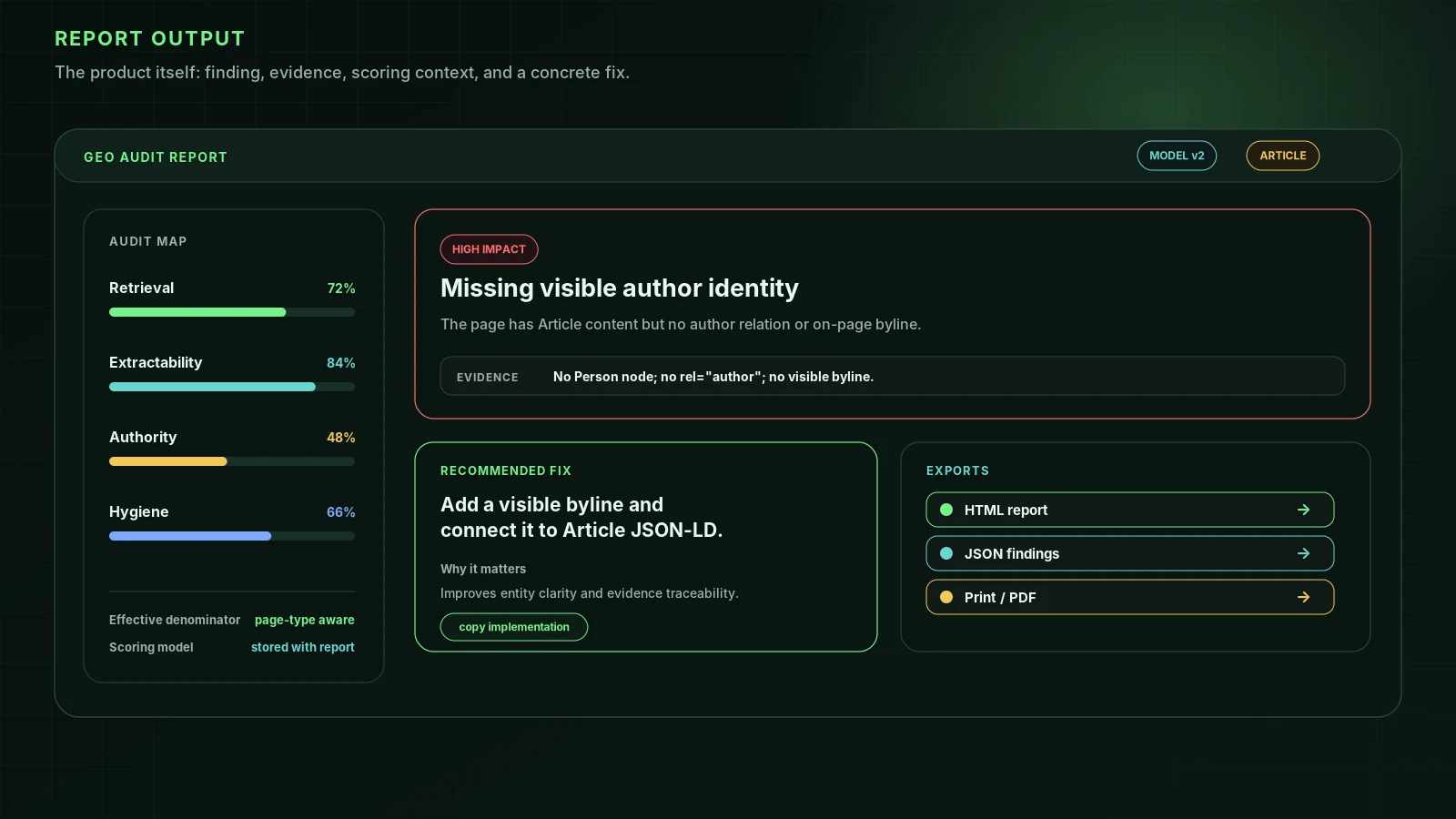
This is the check that separates a report from a tool. Industry surveys keep finding that teams buy AI-visibility data and then struggle to act on it. Look for findings that say what was measured, what to change, where the change lives (a template, a robots.txt rule, a CDN setting) and how to confirm it worked. Settings that live outside your code, like a firewall rule, should be called out as such rather than handed to a developer. And the tool should make re-checking a page trivial, so “fixed” means verified, not assumed.
On rewriting tools specifically: the original GEO study found that adding citations, quotations and statistics raised visibility in a test environment (Aggarwal et al.), and AutoGEO found that engines consistently prefer specific, well-structured, neutral and current content (AutoGEO). Neither supports promises of a fixed percentage lift on your site. Ask any tool claiming one for the controlled comparison behind it.
A 10-minute scorecard you can run on any tool
| Check | Pass if… | Red flag |
|---|---|---|
| Crawler facts | Separates training, search and user crawlers per vendor | “Allow Google-Extended for AI Overviews”; GPTBot = ChatGPT search |
| Live access | Requests the page as AI crawlers and compares with a browser | Reads robots.txt only |
| No-JavaScript view | Shows how much content is in the raw HTML | Audits only a fully rendered page |
| llms.txt and schema | Reported, not scored, or scored with cited evidence | Top fixes are llms.txt and FAQ schema |
| Score | Public methodology, caps for blockers, unverified ≠ fail | Unexplained number; changes between identical runs |
| AI answers | Shows runs, prompts and cited URLs; trends over time | One run presented as a rank |
| First-party data | Uses or points you to Search Console and Bing | Sells modelled estimates of the same numbers |
| Fixes | What, where, how to verify; settings flagged for humans | Generic advice with no way to confirm |
Start with one important page. Run a free audit here and in any other tool you're considering, compare the findings against this table, and keep the one that tells you the truth about your site, even when the truth is “this part is fine, the problem is elsewhere”.
FAQ
What is a GEO audit tool?+
A tool that checks whether AI search systems such as ChatGPT search, Perplexity, Claude and Google's AI Overviews can reach, read and cite your pages. Some audit pages for causes; others track how often your brand appears in sampled AI answers.
Do I need a prompt tracker or a page audit?+
They answer different questions. A tracker estimates how often you appear in answers to chosen prompts; an audit finds what on your site stops crawlers or makes pages hard to quote. If you can only start with one, fix the page-level blockers first, because a page a crawler can't fetch can't be cited at all.
Why do two GEO tools give my site very different scores?+
Because they score different things. Some count llms.txt, schema types or the presence of an RSS feed; others weight crawler access and content the crawler can actually read. Ask each tool what its points are based on and whether the evidence is controlled.
Can any tool guarantee my business will be recommended by ChatGPT?+
No. AI answers vary from run to run and depend heavily on what other sites say about you. A tool can remove technical reasons you can't be cited and measure trends; anyone guaranteeing placement is overselling.
Are free GEO tools good enough?+
Often, yes, for a first diagnosis. Google Search Console and Bing Webmaster Tools now report AI performance for free, and several audits are free to run. Pay when you need monitoring over time, many sites, or client-ready reports.
Sources
- Google's guide to optimizing for generative AI features on Google Search — Google Search Central (2026-07-10)
- AI features and your website — Google Search Central
- Overview of OpenAI Crawlers — OpenAI
- Does Anthropic crawl data from the web, and how can site owners block the crawler? — Anthropic
- Perplexity Crawlers — Perplexity
- The rise of the AI crawler — Vercel and MERJ (2024-12-17)
- Your site, your rules: new AI traffic options for all customers — Cloudflare Blog (2026-07-01)
- GEO: Generative Engine Optimization (Aggarwal et al., KDD 2024) — arXiv
- AutoGEO: automatically learning generative engine preferences (ICLR 2026) — arXiv
- AI Search Visibility: How Stable Are Brand Mentions and Citations? — Otterly.AI (vendor study)
- Search Console generative AI performance report — Google Search Console Help
- AI Performance — Bing Webmaster Tools
- Otterly.AI pricing — Otterly.AI (2026-10-16)
- AI Visibility Toolkit — Semrush Knowledge Base (2026-10-16)
- Ahrefs pricing — Ahrefs (2026-10-16)
- HubSpot AEO — HubSpot (2026-10-16)
Run it on your domain
See this lens as a finding, not a lecture.
Free technical GEO audit. Evidence-traced scores, LLM-ready export, no login.
Audit your website