Strategy 13 min read
GEO Myths, Graded: llms.txt, Schema, FAQ Pages and 15 More
Most GEO advice repeats the same checklist. We graded 18 of its claims against what the platforms document and what the tests actually found.

Founder, SEO·AEO·GEO
Builds SEO·AEO·GEO and writes the crawler, schema, and citation research published here.
Key takeaways
- llms.txt is a myth as an AI visibility lever: Google says Search ignores it, and 97% of files in a 137,000-site log study were never requested.
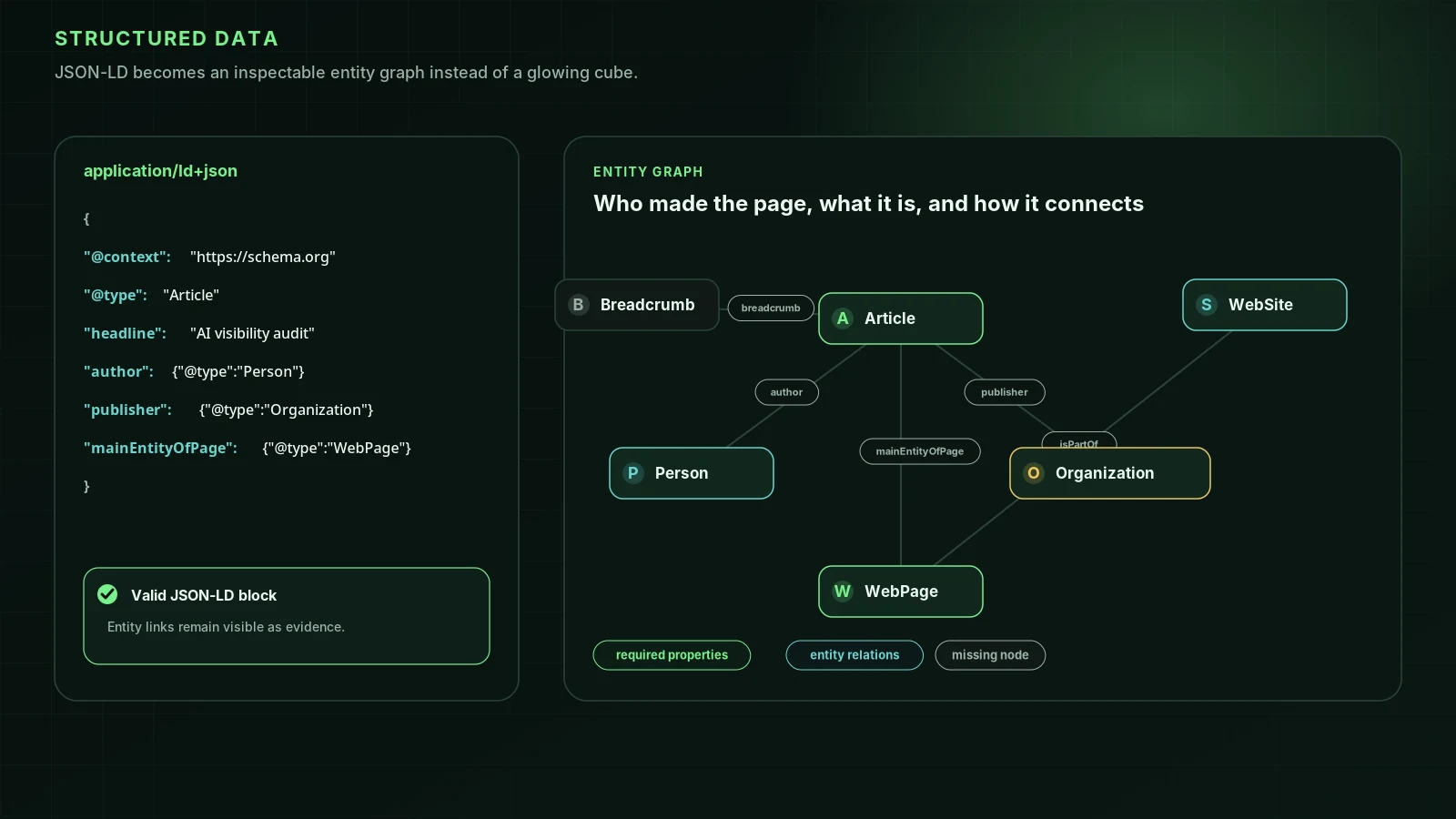
- Schema and FAQ markup didn’t lift AI citations in a controlled test of 1,885 pages; keep structured data for rich results, not for citations.
- Blocking GPTBot or Google-Extended doesn’t remove you from ChatGPT search or AI Overviews, but Cloudflare’s stricter Block setting can stop Googlebot and Bingbot.
- AI answers have no stable rank, citations aren’t recommendations, and recommendations aren’t traffic; measure each one separately.
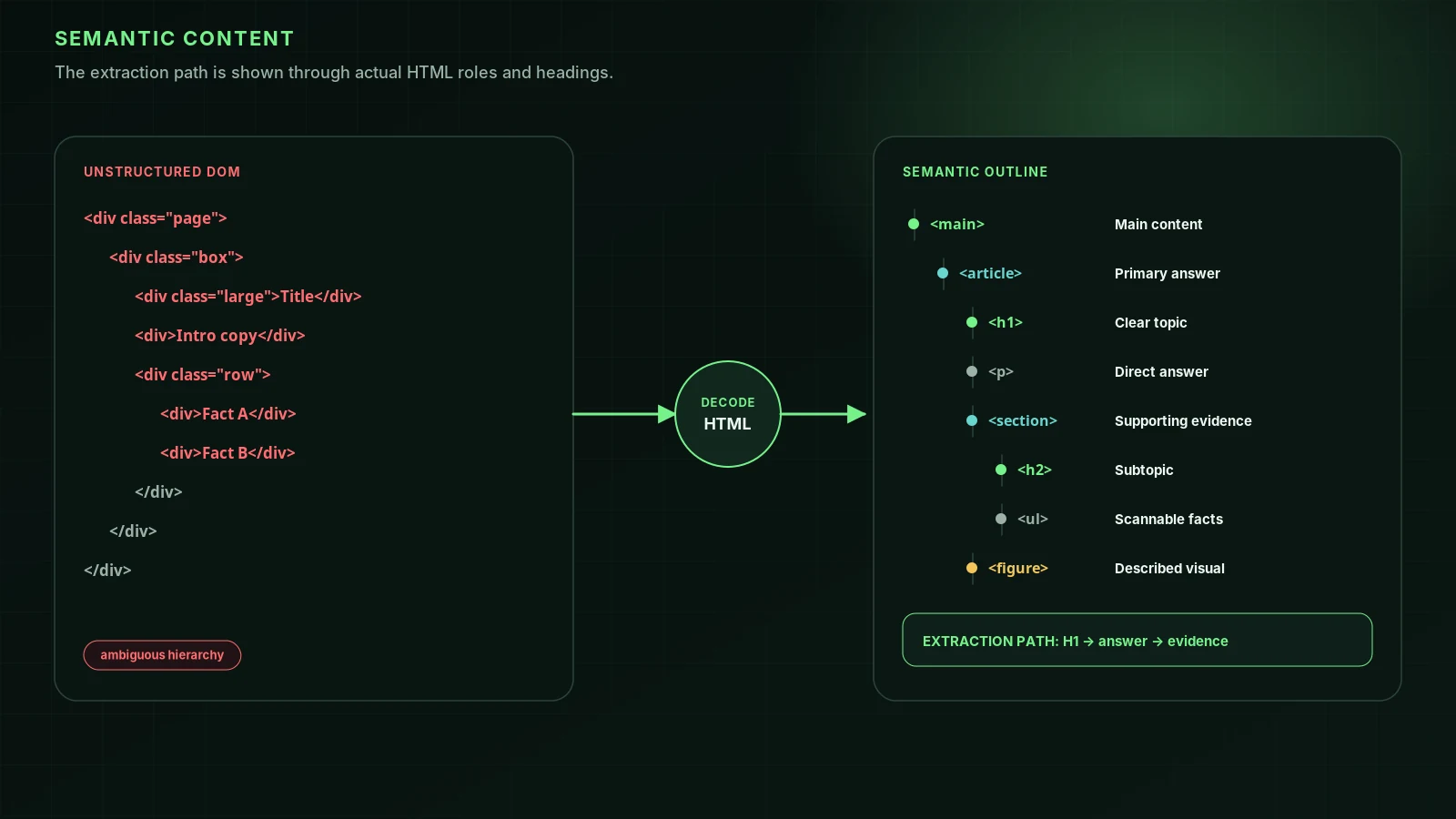
- What the evidence supports is crawler access, server-rendered HTML, Google indexing, freshness, answer-first pages and mentions on sites you don’t own.
No, llms.txt doesn’t help: Google says its Search ignores the file, and server logs from 137,000 sites show 97% of llms.txt files were never requested in a month. Schema and FAQ markup don’t buy citations either; a controlled test of 1,885 pages found no meaningful lift, although structured data still matters for rich results. GEO itself isn’t a scam, but most tactics sold under the name are unproven, and the ones with evidence are unglamorous: let AI search crawlers in, serve content in plain HTML, be indexed and snippet-eligible on Google, keep pages fresh, and earn mentions on sites you don’t own. Below are 18 common claims, each with a grade, the evidence and what to do instead.
How we grade
We use the same seven grades as our methodology, applied here to each claim as people actually make it:
- official: the platform says so in its own documentation.
- strong: a direct mechanism, or consistent results across large studies.
- moderate: supported by several studies, with real caveats.
- weak: little support, or small and inconsistent effects.
- unstudied: plausible, but nobody has measured it.
- practice: standard web practice, low stakes on its own.
- myth: platform guidance or a controlled or direct test says it doesn’t work as claimed.
Where the evidence file behind our audit already grades a tactic, the grade here matches it. Where it doesn’t, we grade conservatively: a claim is only called a myth if a platform’s own documentation or a direct test contradicts it; otherwise the lowest it gets is weak. Most studies in this field are run by vendors and are correlational, and we say so each time.
The scorecard
| # | Claim | Grade | Verdict |
|---|---|---|---|
| 1 | Add llms.txt so AI can find you | myth | Google ignores it; 97% of files are never requested |
| 2 | Schema or FAQ markup gets you cited | myth | No lift in a controlled test; keep schema for rich results |
| 3 | Rewrite pages into short Q&A blocks | myth | Google says no need; longer sections are cited more |
| 4 | Submit your business to ChatGPT | myth | No route for sites; applications exist only for product feeds |
| 5 | ChatGPT just uses Bing | weak | Bing helps, but OpenAI runs its own search crawler |
| 6 | Blocking GPTBot or Google-Extended removes you | myth | Separate bots, separate settings |
| 7 | We rank #1 in ChatGPT | myth | Brand lists rarely repeat between runs |
| 8 | The Google 3-pack carries over to AI | weak | Partly true for Google’s AI only |
| 9 | More reviews means AI picks you | weak | Rating looks like a threshold; volume is unproven |
| 10 | Publish a “best X” list with yourself at #1 | weak | Often cited without you in the answer |
| 11 | Seed Reddit to get into ChatGPT | weak | Reddit is policing it; citation share fell |
| 12 | AI Overviews killed SEO | myth | AI features run on core ranking; clicks are down, not gone |
| 13 | A visibility tool shows what customers see | weak | Tools sample; answers vary by person and run |
| 14 | ChatGPT ads get you into the answers | myth | OpenAI: ads don’t influence answers |
| 15 | ChatGPT shopping reads Merchant Center | myth | It uses its own feeds, Shopify Catalog and Etsy |
| 16 | Tell ChatGPT about your business and it will recommend you | myth | Memory only affects your own account |
| 17 | Ask the AI why it skipped you | weak | Models can’t reliably report their own retrieval |
| 18 | Cited = recommended = traffic | myth | Three different outcomes, measured apart |
Files, markup and formatting
1. “Add an llms.txt file so AI can find you” — myth
Google’s guide is explicit: “You don’t need to create new machine readable files, AI text files, markup, or Markdown to appear in Google Search”, and such files will “neither harm nor help” because “Google Search ignores them.” Usage data agrees. Ahrefs’ June 2026 analysis of server logs from 137,000 sites found 97% of llms.txt files received zero requests, and no AI bot went looking for the file where none existed; SE Ranking found no correlation with AI citations across about 300,000 domains. Two nuances. Google’s Lighthouse now has an llms.txt audit, which marks a missing file “Not Applicable”. And Shopify serves /llms.txt on every store by default: when we checked four large Shopify stores on 13 October, three returned one, so adoption counts increasingly measure platform defaults, not intent. Do instead: nothing, unless you publish developer docs that coding agents read.
2. “Schema or FAQ markup gets you cited” — myth
As a citation lever, the best test available says no. Ahrefs tracked 1,885 pages that added JSON-LD between August 2025 and March 2026 against 4,000 matched controls: citations moved +2.4% in AI Mode and +2.2% in ChatGPT, both “statistically indistinguishable from zero”, and fell 4.6% in AI Overviews. A searchVIU test found AI chatbots “exclusively extract visible HTML content” when they fetch a page. Google says “there’s no special schema.org markup you need to add”, and FAQ rich results stopped appearing in Google Search on 7 May 2026. Do instead: keep structured data for rich results and to describe your organisation clearly, and put the answer in visible text. Our schema evidence review goes deeper.
3. “Rewrite pages into short Q&A blocks and FAQ sections” — myth
Google: “There’s no requirement to break your content into tiny pieces for AI to better understand it”, and “You don’t need to write in a specific way just for generative AI search.” The largest correlational dataset points the same way: SE Ranking found pages averaging 120–180 words between headings drew 4.6 ChatGPT citations on average, against 2.7 for sections under 50 words. In C-SEO Bench, a NeurIPS 2025 benchmark, most rewriting tactics were “largely ineffective” and often hurt ranking once several sites used them; the much-quoted “up to 40%” gain comes from a 2024 simulator, not live engines. Do instead: lead with a real answer in the first paragraph (moderate evidence: citations cluster near the top of pages), then write sections as long as the topic needs. An FAQ that answers real customer questions is fine for readers; just don’t expect it to win citations.
Access and inclusion
4. “Submit or list your business on ChatGPT” — myth
There is no submission form for websites or local businesses. OpenAI’s documented route into ChatGPT search is its crawler: “To help ensure your site appears in search results, we recommend allowing OAI-SearchBot in your site’s robots.txt file.” Local data also arrives through partners: Yelp’s August 2026 filing says its ratings and reviews “recently began powering ChatGPT’s local experience in relevant categories”, even though Yelp’s robots.txt blocks OAI-SearchBot from its business pages (we checked on 13 October). The one real application is for products: merchants apply at chatgpt.com/merchants, and Shopify and Etsy catalogs are already included. Our evidence file has no entry for this claim; we call it a myth because crawling is the only route OpenAI documents for websites. Do instead: allow OAI-SearchBot, then get listed where the data comes from (see our local guide and products guide).
5. “ChatGPT just uses Bing, so optimise for Bing” — weak
OpenAI runs its own search crawler, OAI-SearchBot, which it says “is used to surface websites in search results in ChatGPT’s search features”, and it doesn’t document any single outside engine. Third-party analyses describe a blend of OpenAI’s own index and external providers; none is official, and we couldn’t verify their figures. Bing indexing still helps (Copilot runs on it, and it may feed ChatGPT), so the claim isn’t worthless, just incomplete. Our evidence file doesn’t grade it; we put it at weak because no platform confirms it and the one official signal points elsewhere. Do instead: be crawlable by OAI-SearchBot and indexed by both Bing and Google.
6. “Blocking GPTBot or Google-Extended removes you from AI answers” — myth
Each is a separate control. OpenAI: “Each setting is independent of the others”; GPTBot governs training, OAI-SearchBot governs ChatGPT search. Google: “Google-Extended does not impact a site’s inclusion in Google Search nor is it used as a ranking signal in Google Search”, and AI Overviews and AI Mode are part of Search. Google’s real opt-out is the Search Console Search generative AI control, rolled out “to all websites worldwide” by 31 August 2026, or the nosnippet rule. The reverse mistake is real, though: Cloudflare’s stricter Block setting for AI training will “stop Applebot, Bingbot, and Googlebot from reaching your site — search included.” GPTBot vs OAI-SearchBot has the full matrix.
Rankings, reviews and recommendations
7. “We rank #1 in ChatGPT” — myth
AI answers don’t have stable positions. In SparkToro and Gumshoe’s test, hundreds of volunteers ran 12 recommendation prompts 2,961 times across ChatGPT, Claude and Google’s AI, and there was less than a 1-in-100 chance that ChatGPT or Google’s AI returned the same list of brands twice. The study isn’t peer-reviewed and Gumshoe sells AI tracking, but repeating the same prompt is exactly the test this claim needs, and the claim fails it. Microsoft’s 2026 Bing guidelines also say GEO doesn’t guarantee citations, as Search Engine Journal reported. Do instead: report the share of answers that mention you across many runs, per engine. How to measure AI visibility shows how.
8. “If I’m in the Google 3-pack, AI will recommend me” — weak
Partly true for Google’s own AI: Google says Business Profiles “can help your products and services to be visible in both AI responses and other Google Search results.” Much less true elsewhere. In SOCi’s 2026 study of more than 350,000 locations, “ChatGPT recommends just 1.2% of brand locations, compared to an average 35.9% appearance rate in Google’s local 3-Pack.” SOCi is a vendor and its sample is multi-location brands. Do instead: treat Google, Apple Maps, Bing and Yelp as four separate listings, and find which directories each assistant cites in your city.
9. “More reviews means AI will pick you” — weak
Reviews matter, but the data supports rating more than volume. Locations ChatGPT recommended averaged 4.3 stars in SOCi’s data, which looks like a threshold rather than a race to the biggest count. In forum threads, owners regularly describe losing to newer rivals with fewer reviews but more press and community coverage. No controlled study has isolated review count. Do instead: keep a steady flow of recent reviews on Google and your industry’s main platform, reply to all of them, and work on coverage beyond reviews.
10. “Publish your own ‘best X’ list with yourself at #1” — weak
It gets you cited more than it gets you recommended. Lily Ray tracked 100 B2B “best [category]” queries in Google’s AI Overviews at three dates between April and June 2026 and found that when a self-promoting brand’s own listicle was cited, the brand was left out of the recommendation “roughly two-thirds (69%) of the time.” It is observational, one researcher and Google’s surfaces only, hence weak rather than myth. Do instead: earn places on lists other people write, and keep comparison pages honest.
11. “Seed Reddit to get into ChatGPT” — weak
Genuine Reddit discussion does show up in AI answers; manufactured threads are a poor bet. Reddit said in July 2026 that its own AI catches about 25,000 spammy posts a day. Promptwatch’s tracking showed reddit.com falling from 3.83% of ChatGPT search citations (18 July to 7 August 2026) to 0.52% (14 to 17 August), a drop Promptwatch itself calls provisional. Google says “seeking inauthentic ‘mentions’ across the web isn’t as helpful as it might seem.” Do instead: answer questions in your field under your real name, and leave astroturfing alone.
12. “AI Overviews killed SEO” — myth
Google’s guide answers this directly. Is SEO still relevant? “In short, yes!”, because its generative AI features “are rooted in our core Search ranking and quality systems.” What changed is clicks. Pew’s analysis of 900 US adults’ browsing found people clicked a traditional result in 8% of visits to search pages with an AI summary, against 15% without one, and clicked a link inside the summary in 1%. So SEO is the foundation of AI visibility, and each ranking sends less traffic than it used to. Both are true.
Tools, ads and shopping
13. “A visibility tool shows what customers see” — weak
Tools sample prompts, usually logged out and from one location. Real answers shift with location, wording, memory and account history, and they vary run to run (see 7). Google warns: “Be wary of third-party tools that promise ranking success or claim to use ‘internal’ Google metrics. No third-party tool has access to our internal ranking or AI systems.” Trackers are useful for trends across many prompts, not as a window into customers’ screens. Do instead: pair any tracker with first-party data (Search Console, Bing AI Performance, GA4) and a “How did you hear about us?” question.
14. “Paying for ChatGPT ads will get us into the answers” — myth
OpenAI’s ads principles, published 16 January 2026, say: “Ads do not influence the answers ChatGPT gives you. Answers are optimized based on what’s most helpful to you. Ads are always separate and clearly labeled.” Its product-feed spec treats ad eligibility as “independent of search eligibility”, and its crawler documentation says OAI-AdsBot “only visits pages submitted as ads.” Ads buy a labelled placement, not a place in the answer.
15. “ChatGPT shopping pulls from Google Merchant Center” — myth
OpenAI’s merchant pages describe its own Agentic Commerce Protocol feeds, Shopify Catalog and Etsy. Its feed spec accepts a Google-compatible file format, but “only after OpenAI confirms it for your registered feed”; it doesn’t read your Merchant Center account. Shopify’s routing shows the split: ChatGPT and Copilot get products through Shopify Catalog, Google AI Mode and Gemini through Merchant Center. A related belief is out of date: since 24 March 2026, ChatGPT sends shoppers to the merchant’s own checkout by default rather than Instant Checkout. Details are in getting products into ChatGPT shopping.
Asking the AI, and what counts as success
16. “Tell ChatGPT about your business and it will recommend you to others” — myth
Memory and custom instructions are personal settings. OpenAI’s Memory FAQ places them under Settings > Personalization in your own account, where they shape your answers and nobody else’s. (OpenAI’s help centre blocks automated requests, so we read that page through its search-indexed text; our evidence file doesn’t cover this, and the grade rests on how the feature is documented.) The side effect is worse than useless: an owner who has told ChatGPT about their business sees it recommended in their own chats and assumes it’s working. Do instead: test logged out or in a temporary chat.
17. “Ask the AI why it didn’t recommend you, and it will tell you” — weak
A model will offer a plausible reason, but it has no reliable view of its own retrieval. Research on chain-of-thought explanations (Turpin et al., NeurIPS 2023) showed that models’ stated reasons can be systematically unfaithful to what actually drove their answers. The trustworthy evidence is external: the sources an answer cites, and Bing Webmaster Tools’ grounding queries, which Microsoft describes as “the key phrases the AI used when retrieving content that was referenced in AI-generated answers.” Do instead: read the citations and grounding queries, then fix those pages or get onto them. Why ChatGPT recommends your competitor walks through it.
18. “Cited means recommended means traffic” — myth
These are three outcomes, and studies measure the gaps directly. Cited isn’t recommended: in Lily Ray’s data, self-promoters were cited but left out of the recommendation 69% of the time. Cited isn’t traffic: Pew found users clicked a link inside Google’s AI summary in 1% of visits, and Bing’s AI Performance report counts citations without any click data. Do instead: measure mentions, citations, AI-referred sessions and leads separately, and judge GEO work on the last two.
What the evidence does support
These are the grades our audit uses for the same factors. They are less exciting than a file you can upload, and they work across every engine.
| Factor | Grade | Why |
|---|---|---|
| AI search crawlers allowed in robots.txt and at the CDN | official | OAI-SearchBot, Claude-SearchBot and PerplexityBot obey robots.txt; a site that blocks them isn’t shown in their answers |
| Indexed and snippet-eligible on Google | official | Google’s stated requirement for AI Overviews and AI Mode |
| Content in the server-rendered HTML | strong | The main AI crawlers don’t run JavaScript (Vercel and MERJ) |
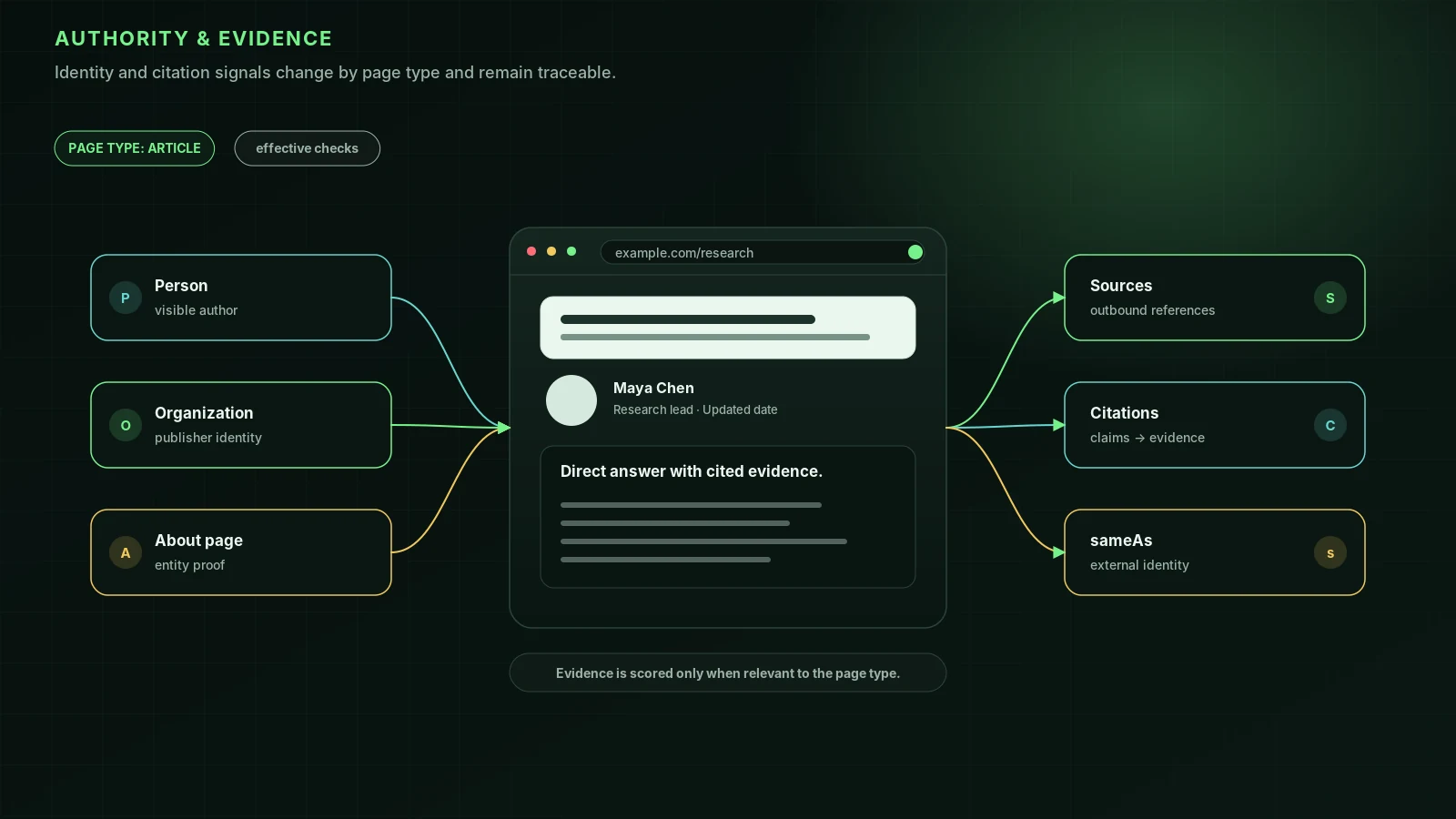
| Mentions on other sites, reviews and third-party lists | strong | Strongest correlates of AI visibility; YouTube mentions about 0.74 in Ahrefs’ 75,000-brand study (correlational) |
| Freshness and visible dates | moderate | A controlled test plus large observational data; strongest for ChatGPT, absent in AI Overviews |
| Answer first | moderate | Citations cluster near the top of pages (Growth Memo); position is one of the more reproducible effects |
Our methodology lists what our audit deliberately doesn’t score (llms.txt, schema and FAQ markup as citation levers, chunking and rewriting for AI) with the sources behind each decision.
So is GEO a scam?
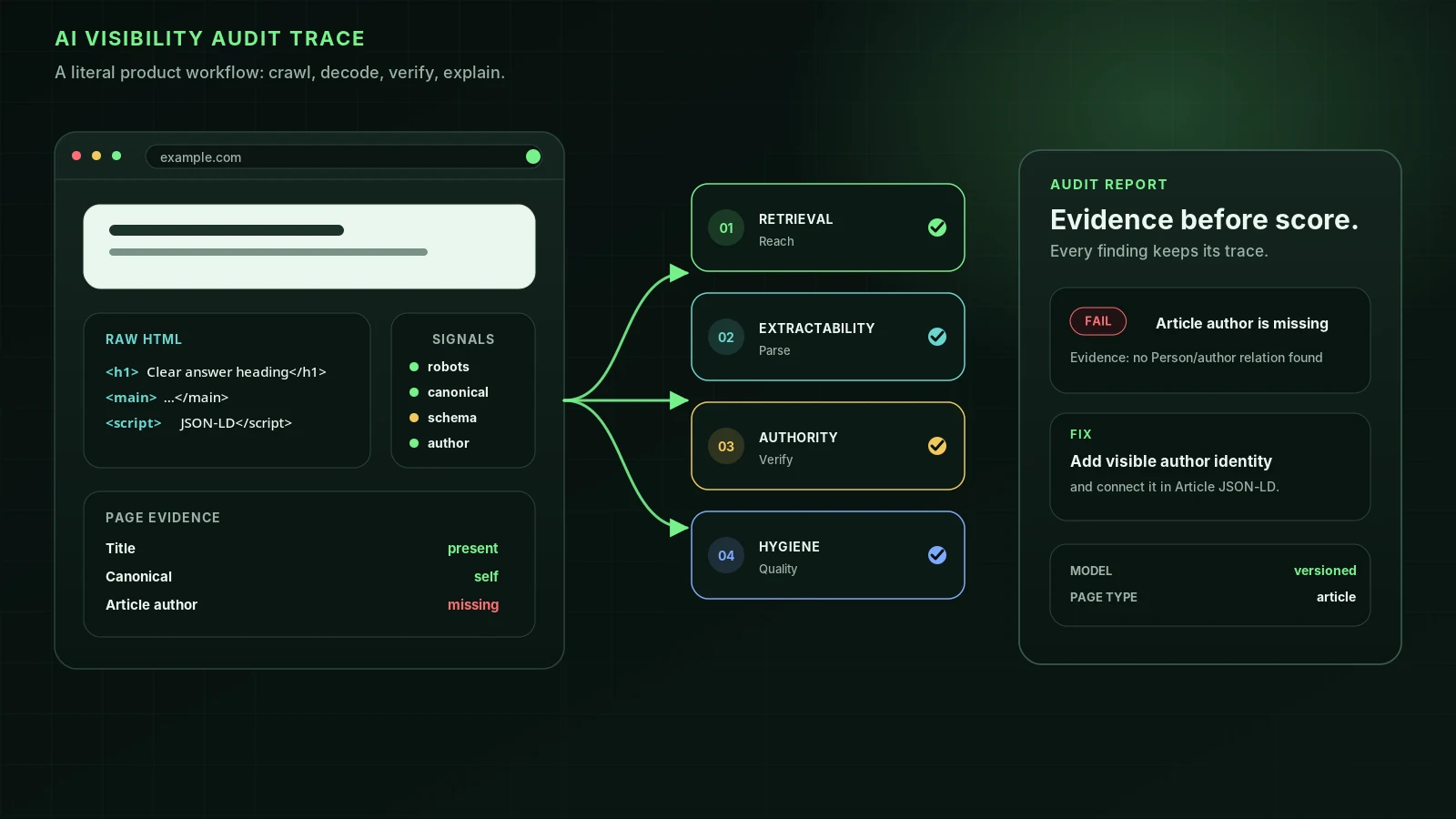
No, but a lot of what is sold as GEO is. The useful part overlaps heavily with good SEO and digital PR: let the right crawlers in, serve real content in HTML, keep it current, and get talked about on sites you don’t control. Google puts it bluntly: optimizing for generative AI search “is optimizing for the search experience, and thus still SEO.” The snake oil is the part that guarantees placement, sells llms.txt and FAQ schema as fixes, or reports a ChatGPT “rank”. One test works on any proposal: ask for the source behind each recommendation. For a start that checks only what has evidence, run a free audit, then see how to get ChatGPT to recommend your business for the off-site work.
FAQ
Does llms.txt work?+
Not for AI visibility. Google says Google Search ignores llms.txt files, and Ahrefs’ analysis of server logs from 137,000 sites found 97% of the files received zero requests in a month. It can still be useful as documentation for developer tools and coding agents.
Is GEO a scam?+
GEO itself isn’t, but much of what is sold under the name is unproven. The parts with evidence overlap with good SEO and PR: crawler access, real content in HTML, freshness and earned mentions. Be wary of anyone who guarantees placement or sells llms.txt and FAQ schema as fixes.
Does schema markup help AI citations?+
Not measurably. In Ahrefs’ controlled test of 1,885 pages that added JSON-LD, citations didn’t rise in AI Mode or ChatGPT and dipped slightly in AI Overviews. Structured data is still worth keeping for rich results and to describe your organisation clearly.
Do FAQ pages help ChatGPT cite you?+
An FAQ that answers real customer questions helps readers, but there is no evidence it earns citations. Google says content doesn’t need to be broken into small pieces, FAQ rich results stopped showing on 7 May 2026, and ChatGPT-cited pages tend to have longer sections.
Can I submit my website to ChatGPT?+
No. There is no URL submission for ChatGPT search. Allow OAI-SearchBot in robots.txt and make sure your pages are indexable. The only application OpenAI runs is for merchants who want to share product feeds.
Does blocking Google-Extended remove me from AI Overviews?+
No. Google says Google-Extended does not affect inclusion in Google Search, and AI Overviews and AI Mode are part of Search. To opt out, use the Search generative AI control in Search Console or the nosnippet rule.
Sources
- Optimizing your website for generative AI features on Google Search — Google Search Central (2026-07-10)
- We Analyzed 137K Sites: 97% of llms.txt Files Never Get Read — Ahrefs (2026-06-15)
- LLMs.txt: we analyzed 300,000 domains — SE Ranking (correlational)
- Lighthouse: llms.txt audit — Chrome for Developers (2026-05-05)
- Shopify Catalog and product discovery for agentic storefronts — Shopify Help Center
- We Tracked 1,885 Pages Adding Schema. AI Citations Barely Moved. — Ahrefs (2026-05-11)
- Schema Markup and AI in 2025: What ChatGPT, Claude, Perplexity & Gemini Really See — searchVIU (2025-12-02)
- Search Central documentation updates (FAQ rich result deprecation) — Google Search Central (2026-05-08)
- How to optimize for ChatGPT (citation factors study) — SE Ranking (correlational)
- C-SEO Bench: Does Conversational SEO Work? — Puerto et al., NeurIPS 2025 Datasets & Benchmarks
- GEO: Generative Engine Optimization — Aggarwal et al., KDD 2024
- Overview of OpenAI Crawlers — OpenAI
- Yelp Inc. Form 10-Q for the quarter ended June 30, 2026 — Yelp / U.S. SEC (2026-08-07)
- Power product discovery in ChatGPT (merchant page) — OpenAI
- Overview of Google crawlers and fetchers (Google-Extended) — Google Search Central (2026-07-14)
- Search generative AI control — Google Search Console Help (2026-08-31)
- Have it both ways: stay discoverable in search while disallowing AI training — Cloudflare Blog (2026-09-15)
- AIs are highly inconsistent when recommending brands or products — SparkToro (with Gumshoe.ai)
- AI recommendations change with nearly every query: SparkToro — Search Engine Journal
- Bing adds GEO to official guidelines, expands AI abuse definitions — Search Engine Journal
- In AI-Driven Discovery, Few Brands Are Chosen, Most Disappear (2026 Local Visibility Index) — SOCi (vendor study) (2026-01-28)
- Why calling yourself “the best” could backfire in AI search — Lily Ray (2026-06-17)
- Reddit fights AI marketing ‘slop’ with its own AI — The Next Web (2026-07-06)
- Reddit’s ChatGPT citation drop (Promptwatch data) — Relevant Audience
- Google users are less likely to click on links when an AI summary appears in the results — Pew Research Center (2025-07-22)
- Our approach to advertising and expanding access to ChatGPT — OpenAI (2026-01-16)
- File upload: Products (feed specification) — OpenAI Developers
- Selling on ChatGPT — Shopify Help Center
- Memory FAQ (read via search-indexed text; the page blocks automated requests) — OpenAI Help Center
- Language Models Don’t Always Say What They Think: Unfaithful Explanations in Chain-of-Thought Prompting — Turpin et al., NeurIPS 2023
- Introducing AI Performance in Bing Webmaster Tools (Public Preview) — Microsoft Bing Webmaster Blog (2026-02-10)
- Top brand visibility factors in ChatGPT, AI Mode and AI Overviews (75k brands) — Ahrefs (correlational)
- Do AI assistants prefer to cite fresh content? (17M citations) — Ahrefs
- Controlled test: dates shift LLM source choice — arXiv 2509.11353
- The science of how AI pays attention — Growth Memo (Kevin Indig) (2026-02-16)
- The rise of the AI crawler — Vercel (with MERJ)
Run it on your domain
See this lens as a finding, not a lecture.
Free technical GEO audit. Evidence-traced scores, LLM-ready export, no login.
Audit your website