Ecommerce 10 min read
How to Get Your Products Into ChatGPT Shopping and Google AI Mode
Shopping assistants read feeds, not prose. Most of the confusion comes from rules that changed in March 2026, and documentation that hasn’t caught up.

Founder, SEO·AEO·GEO
Builds SEO·AEO·GEO and writes the crawler, schema, and citation research published here.
Key takeaways
- Shopify and Etsy catalogs are already integrated into ChatGPT; other merchants apply at chatgpt.com/merchants and share a product feed through the Agentic Commerce Protocol.
- Google AI Mode, AI Overviews and Gemini shopping run on Merchant Center; UCP-powered checkout inside Google is open to select merchants in the US, Canada and Australia.
- Since 24 March 2026 ChatGPT sends shoppers to the merchant’s own checkout by default, with no fees on those purchases, though one OpenAI developer page still describes Instant Checkout.
- Removing Shopify Catalog access doesn’t hide products from AI, because assistants can still find them by crawling; Shopify’s only complete hide is the Unlisted status.
- Complete, current feed data and server-rendered product pages do the work; schema, llms.txt and paid “feed submission” apps don’t replace them.
Shopping assistants choose products from feeds, so getting in is mostly plumbing. If you sell on Shopify or Etsy, your catalog is already integrated with ChatGPT and no application is needed; other merchants apply at chatgpt.com/merchants to share a product feed, and shopping is live for US users only. Google’s AI Mode, AI Overviews and Gemini read Merchant Center, Copilot takes Shopify stores through Shopify Catalog, and Perplexity runs a free merchant program with PayPal checkout. After that, what gets you picked is complete and current product data, product pages crawlers can read, and reviews.
We checked every claim below against the platforms’ own pages on 13 October 2026. These programs change monthly, and where two official pages disagree, we say so rather than pick one.
Where each platform stands (13 October 2026)
| Platform | How products get in | Where the sale happens | Status we could verify |
|---|---|---|---|
| ChatGPT | Shopify and Etsy catalogs automatically; other merchants apply to share a feed via the Agentic Commerce Protocol (ACP); web pages via OAI-SearchBot | Your own site or app by default, opened in ChatGPT’s in-app browser or a new tab | Live for US users; applicants join a waitlist; a self-serve merchant platform is promised “later this year” |
| Google AI Mode, AI Overviews, Gemini | Merchant Center feeds (Shopify stores via the Google & YouTube channel) | Your site, or checkout inside Google via the Universal Commerce Protocol (UCP) for select merchants | UCP checkout limited to select merchants with US, Canadian or Australian eligibility |
| Microsoft Copilot | Shopify Catalog for Shopify stores; partner retailers | Copilot Checkout inside the chat (launched January 2026), retailer stays merchant of record | Shopify: direct checkout on by default, US customers only |
| Perplexity | Free Merchant Program for larger retailers (November 2024); PayPal store sync | Instant Buy with PayPal inside Perplexity (November 2025), retailer stays merchant of record | No 2026 update from Perplexity found |
| Meta surfaces such as Muse | Facebook and Instagram by Meta sales channel (Shopify) | Shopify-powered direct checkout where activated | Listed by Shopify; we found no Meta documentation for non-Shopify stores |
ChatGPT: what changed in March 2026, and what didn’t
On 24 March 2026 OpenAI rebuilt shopping around product discovery, extended the Agentic Commerce Protocol to carry product feeds and promotions, and said why it was stepping back from checkout:
We’ve found that the initial version of Instant Checkout did not offer the level of flexibility that we aspire to provide, so we’re allowing merchants to use their own checkout experiences while we focus our efforts on product discovery.
The merchant page now promises to “send shoppers to your site or app by default, with no fees for purchases made on your site or app,” and says: “If you sell through Shopify or Etsy, your catalog is already integrated, and no additional setup or application is required.” Everyone else fills in an application form, and if you’ve already applied, OpenAI says “you’re on the waitlist.” Shopping is “currently live for ChatGPT users in the U.S.”
Two widely repeated claims are now wrong. Forum threads earlier in 2026 argued about a “4% fee”; Shopify’s ChatGPT help page now says “There are no fees associated with selling in ChatGPT. You pay only your standard payment processing fees.” And ChatGPT shopping does not run on Google Merchant Center (see the last section).
If you’re not on Shopify or Etsy: the ACP product feed
Approved merchants send a structured feed. OpenAI says “it is generally recommended to provide the entire feed once a day via file upload, and then send updates throughout the day via the API”, and promotions can only go through the API. The stable file spec has nine required fields: item_id, title, description, url, brand, seller_name, image_url, availability and price. This is OpenAI’s own minimal example:
{ "item_id": "MUG-350-BLUE", "title": "Blue ceramic mug, 350 mL", "description": "Dishwasher-safe glazed ceramic mug with a handle.", "url": "https://example.com/products/mug-blue", "brand": "Northline", "seller_name": "Northline Home", "image_url": "https://example.com/images/mug-blue.jpg", "price": "18.00 USD", "availability": "in_stock" }Three details catch people out. Availability must be explicit (in_stock, out_of_stock, pre_order, backorder or unknown); an empty value rejects the row. Each variant needs its own row with a shared group_id. And search eligibility “does not guarantee display.” Optional data helps: OpenAI’s key-concepts page says recommended attributes “like rich media, reviews, and performance signals—improve ranking, relevance, and user trust,” and the spec accepts review_count and star_rating aggregates for each product.
OpenAI’s best-practices page also suggests adding a parameter such as utm_medium=feed to product URLs so feed clicks can be separated in analytics. ChatGPT links normally arrive tagged utm_source=chatgpt.com; what utm_source=chatgpt.com means explains what that tag catches and misses.
Shopify: what’s on by default, and how to turn it off
Shopify’s help centre says “Agentic storefronts is active by default for eligible stores.” Products reach AI channels through Shopify Catalog, except Google AI Mode and Gemini, which use the Google & YouTube sales channel or Merchant Center. The channels behave differently:
| Channel | Where the buyer pays | What you can switch off | Requirements Shopify lists |
|---|---|---|---|
| ChatGPT | Your online store checkout, in ChatGPT’s in-app browser or a new tab | Shopify Catalog access (there is no checkout setting) | Sell to US customers; Catalog-eligible products; store policies completed |
| Google AI Mode and Gemini | Shopify-powered direct checkout in the chat if active, otherwise your store | Direct checkout; products still flow through Merchant Center | Store based in and selling to the US; valid Merchant Center account |
| Microsoft Copilot | Shopify-powered direct checkout (US customers only), otherwise your store | Direct checkout, or Shopify Catalog access | Sell to US customers; Catalog-eligible products |
| Meta surfaces such as Muse | Shopify-powered direct checkout if activated | Per-channel settings | Facebook and Instagram by Meta sales channel |
To remove a channel’s access to your catalog, Shopify’s steps are:
- From your Shopify admin, go to Sales channels > Agentic.
- Deactivate Allow Shopify to manage for me.
- Click the channel, for example ChatGPT.
- Deactivate Shopify Catalog access.
- Click Save. Shopify says it can take up to 7 days before your product data stops being shared.
Opting out is not hiding. Shopify warns that products “might still be displayed or referenced by the AI channel through other external discovery and listing methods, such as web crawling and indexing.” Blocking AI crawlers in robots.txt doesn’t stop Catalog either; it “affects only open-web discoverability.” The only complete hide Shopify offers is setting a product to Unlisted, which also removes it from sitemaps, from search engines such as Google and from your own store search.
Google AI Mode, AI Overviews and Gemini: Merchant Center
Google’s guide to generative AI features says Merchant Center feeds and Business Profiles “can help your products and services to be visible in both AI responses and other Google Search results.” In practice that means a complete Merchant Center feed with free listings turned on. Three 2026 additions matter:
- Checkout inside AI Mode and Gemini through UCP. Merchant Center help says the feature “is available for select merchants at this time”, applies to products eligible in the US, Canada and Australia, and keeps “you the merchant of record.” Only listings with the native_commerce attribute show the Buy button. In September Google said UCP “already enables direct checkout for hundreds of thousands of brands and retailers across Google.”
- Conversational attributes. Google says that in testing with lululemon, attributes submitted by the brand “were incorporated 50% of the time in relevant product recommendations in AI Mode.” That is Google’s own test, not an independent one.
- AI performance insights in Merchant Center, generally available since 16 September 2026 in Australia, Canada, India, New Zealand and the US: share of voice against similar brands across AI Mode, AI Overviews and Gemini, plus an attribute completeness score that flags products missing the specifications shoppers search for.
Copilot and Perplexity
Microsoft launched Copilot Checkout in January 2026 at the NRF retail show. GeekWire reported it rolling out in the US on Copilot.com with PayPal, Shopify and Stripe handling payments, Shopify merchants “automatically enrolled following an opt-out window”, and, per Microsoft, “the retailer remains the merchant of record.” Shopify’s help centre now says Copilot’s direct checkout is active by default for eligible stores, shows only to US customers, and has “no fees associated with selling in Microsoft Copilot’s direct checkout” beyond payment processing.
Perplexity’s Merchant Program, announced in November 2024, is free and aimed at larger retailers that share product specs; Perplexity listed “increased chances of being a ‘recommended product’”, payment integration and a merchant dashboard among the benefits. In November 2025 PayPal began powering Instant Buy inside Perplexity, saying its store sync “makes merchant product catalogs instantly discoverable within Perplexity’s results” and keeps “the retailer in control as the merchant of record.” We found no 2026 update to either program from Perplexity itself, so treat the details as possibly dated.
The product data checklist
Whichever pipe you use, the same data decides whether a product can be matched to a request like “waterproof trail shoes for wide feet under $120”:
- Identifiers: a stable ID per item, GTINs where they exist, and a group ID tying variants together.
- One row per variant, each with its own price, availability, URL and image.
- Explicit availability and current prices. Update the feed when a sale starts or ends; OpenAI’s spec says sale dates don’t schedule changes.
- Factual titles (OpenAI suggests at most 150 characters) and plain-text descriptions (at most 5,000).
- The attributes shoppers filter by: material, size, dimensions, compatibility, colour, use case. Google now scores attribute completeness.
- Shipping cost, return window and a return-policy URL.
- Review count and average rating for the product itself (not your store), matching the product page.
- Legal disclosures within the first 6,000 characters of the description, as Shopify advises for ChatGPT and Copilot.
- Published terms, privacy and returns policies; Shopify requires them for each agentic channel we checked.
- Feed and product page in agreement: the same price, stock and title in both places.
Product pages still matter: crawlers and raw HTML
Feeds aren’t the only route in. Assistants also read the open web, and Shopify notes that products “can still be found in AI channels in the same way that they’re listed in traditional search engines.” So treat product pages like any page you want cited: allow OAI-SearchBot, PerplexityBot, Claude-SearchBot, Googlebot and Bingbot; make sure price, stock status and key specs are in the HTML the server sends, not injected by JavaScript after load; and keep the page quick enough that a crawler with a short timeout gets all of it. AI crawler fetch budgets covers timeouts, and our free AI crawler checker shows what each bot receives.
A test anyone can run: open a product page, choose View Source (not Inspect), and search for the price. If it isn’t there, crawlers that don’t run JavaScript can’t see it either.
Product structured data still earns its place, because it powers Google’s product rich results. What it doesn’t do is lift AI citations: Ahrefs’ controlled test of 1,885 pages that added schema found no meaningful gain in AI Mode or ChatGPT and a small decline in AI Overviews. What schema actually does for AI citations has the detail.
Reviews and off-site proof
Feed data gets a product considered; outside evidence gets it chosen. OpenAI lists reviews among the attributes that improve ranking, and every shopping assistant also draws on what others say: “best X for Y” roundups, YouTube reviews and marketplace ratings. In Ahrefs’ study of 75,000 brands, YouTube mentions had the strongest correlation with AI visibility (about 0.737), ahead of branded web mentions (0.66–0.71). That is correlation, not proof of cause, but it points the same way as the rest of the research: earn coverage from people who aren’t you. The evidence-graded checklist for getting recommended covers that off-site work.
Measuring AI shopping traffic
- Shopify: orders from AI channels show “channel or referrer attribution” in your admin.
- GA4: the AI Assistant channel counts sessions from assistants such as ChatGPT and Copilot since 13 May 2026, but not Google’s AI Overviews or AI Mode. Our GA4 guide has a custom channel group that fills the gaps.
- Merchant Center: AI performance insights for Google’s surfaces.
- Feed URLs: a utm_medium=feed parameter separates feed-driven clicks from organic citations.
What not to pay for
- “ChatGPT feed submission” apps for Shopify or Etsy stores. Your catalog is already integrated; OpenAI says so on its merchant page.
- llms.txt generators. Shopify already serves the file, and Google says its Search ignores such files. GEO myths, graded has the evidence.
- Promises that your Merchant Center feed will put you in ChatGPT. OpenAI doesn’t read Merchant Center accounts. Its spec does accept a Google-compatible file format, but “only after OpenAI confirms it for your registered feed.”
- ChatGPT ads as a way into the answers. OpenAI says “Ads do not influence the answers ChatGPT gives you,” and its feed spec treats ad eligibility as “independent of search eligibility.”
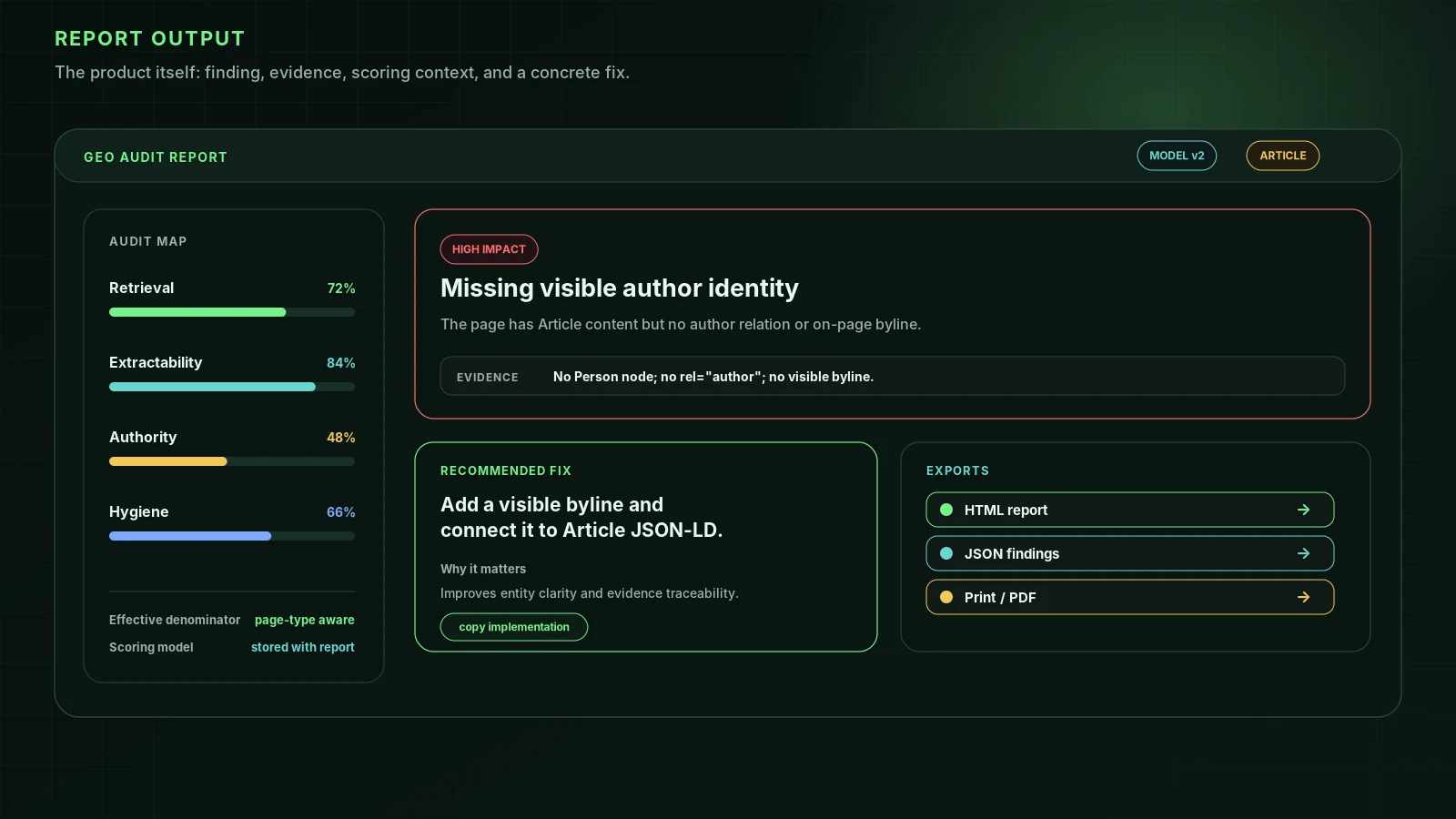
Before you touch the feed, check that your product pages are readable: a free SEO·AEO·GEO audit of one product URL tests crawler access, raw-HTML visibility, CDN blocks and snippet controls. It won’t tell you whether you appear in ChatGPT shopping today; for that, track appearances over weeks as described in how to measure AI visibility.
FAQ
How do I get my products into ChatGPT shopping?+
If you sell through Shopify or Etsy, your catalog is already integrated and no application is needed. Other merchants apply at chatgpt.com/merchants to share a product feed through the Agentic Commerce Protocol; approved partners upload a daily file and send updates through an API. Shopping in ChatGPT is currently live for US users.
Is ChatGPT Instant Checkout still available?+
OpenAI said on 24 March 2026 that it is letting merchants use their own checkout while it focuses on product discovery, and its merchant page now sends shoppers to your site by default. One OpenAI developer page still describes Instant Checkout for approved partners, so its status for existing partners is unclear. New merchants should plan on using their own checkout.
Does ChatGPT use Google Merchant Center?+
No. ChatGPT gets product data from merchants’ own feeds, Shopify Catalog and Etsy, plus pages it finds on the web. OpenAI’s spec accepts a Google-compatible file format for some approved feeds, but it does not read your Merchant Center account. Google AI Mode, AI Overviews and Gemini are the surfaces that use Merchant Center.
How do I turn off the agentic ChatGPT channel on Shopify?+
In your Shopify admin go to Sales channels, then Agentic. Turn off Allow Shopify to manage for me, open ChatGPT, turn off Shopify Catalog access and save. Shopify says it can take up to seven days to stop sharing, and products can still be found through web crawling.
Does selling in ChatGPT cost a fee?+
Shopify says there are no fees for selling in ChatGPT beyond your standard payment processing, and OpenAI’s merchant page says there are no fees for purchases made on your own site or app. Ads in ChatGPT are a separate, paid product.
Why do some of my products appear in AI shopping and others don’t?+
Usually it is the data: unknown availability, variants without their own rows, thin descriptions, missing attributes or reviews, or a prohibited category. Eligibility never guarantees display, and OpenAI’s spec says so directly. Compare a product that appears with one that doesn’t, field by field.
Sources
- Powering Product Discovery in ChatGPT — OpenAI (2026-03-24)
- Power product discovery in ChatGPT (merchant page, fetched 13 October 2026) — OpenAI
- Agentic Commerce Protocol: Get started — OpenAI Developers
- Agentic Commerce Protocol: Key concepts — OpenAI Developers
- File upload: Products (feed specification) — OpenAI Developers
- Commerce best practices — OpenAI Developers
- Our approach to advertising and expanding access to ChatGPT — OpenAI (2026-01-16)
- Agentic storefronts — Shopify Help Center
- Selling on ChatGPT — Shopify Help Center
- Selling on Google AI Mode and Gemini — Shopify Help Center
- Selling on Microsoft Copilot — Shopify Help Center
- Shopify Catalog and product discovery for agentic storefronts — Shopify Help Center
- Optimizing your website for generative AI features on Google Search — Google Search Central (2026-07-10)
- About the Universal Commerce Protocol (UCP) and UCP-powered checkout feature on Google — Google Merchant Center Help
- Boost your holiday sales with these agentic commerce updates — Google (The Keyword) (2026-09-16)
- Insights for AI-powered shopping experiences — Google Merchant Center Help (2026-05-27)
- Shop like a Pro: Perplexity’s new AI-powered shopping assistant — Perplexity (2024-11-18)
- PayPal and Perplexity Launch Instant Buy — PayPal Newsroom (2025-11)
- Microsoft launches Copilot Checkout, joining the AI shopping race — GeekWire (2026-01-08)
- We Tracked 1,885 Pages Adding Schema. AI Citations Barely Moved. — Ahrefs (2026-05-11)
- AI brand visibility correlations (75,000 brands) — Ahrefs (correlational)
- Allbirds /agents.md and /.well-known/ucp (fetched 13 October 2026) — Allbirds (Shopify store) (2026-10-13)
Run it on your domain
See this lens as a finding, not a lecture.
Free technical GEO audit. Evidence-traced scores, LLM-ready export, no login.
Audit your website