Strategy 14 min read
How to Get ChatGPT to Recommend Your Business (Evidence-Graded)
There is no form to fill in and no setting to switch on. There is a short list of things that demonstrably matter, a longer list of things people sell that don’t, and a way to tell them apart.

Founder, SEO·AEO·GEO
Builds SEO·AEO·GEO and writes the crawler, schema, and citation research published here.
Key takeaways
- There is no way to submit or pay your way into ChatGPT’s recommendations, and nobody can guarantee a placement; answers change from run to run.
- ChatGPT recommends the businesses named on the pages it retrieves, so the biggest lever is being on the right lists, directories and review sites.
- First make sure OAI-SearchBot can reach your site through both robots.txt and your firewall, and that your key facts are in plain HTML.
- Skip llms.txt, FAQ schema as a citation tactic and rewriting content “for AI”: the evidence on each is against them.
- Measure with repeated runs, a “how did you hear about us” question, AI referral tracking and the free first-party reports, not single screenshots.
You can’t submit, buy or switch your way into ChatGPT’s recommendations, and nobody can guarantee you a place in them. What works is narrower and more practical: let ChatGPT’s search crawler reach and read your site, make your business impossible to confuse with anyone else, and, most important, get mentioned on the pages ChatGPT reads when someone asks for a business like yours. Those are mostly “best X” lists, directories, review sites, news articles and comparison pages.
The same work helps in Google’s AI Overviews and AI Mode, Perplexity, Claude and Copilot, with differences noted below. Each step carries the evidence grade we use in our methodology, so you can see which advice rests on platform documentation, which on studies, and which on nothing at all.
How ChatGPT decides who to recommend
When a question needs current information, ChatGPT searches. OpenAI says it rewrites the question into one or more targeted queries for search providers. One of those sources is OpenAI’s own index, built by a crawler called OAI-SearchBot; the third-party providers aren’t named. ChatGPT reads a handful of results and writes an answer that cites some of them. When it doesn’t search, it answers from training data; in one measured setup, that happened in 57.8% of repeated runs.
So the businesses it recommends are, mostly, the businesses those retrieved pages recommend. Ahrefs found that 88% of the URLs ChatGPT cites come directly from its search results (1.4 million prompts, vendor study). Your website matters, but as one page among several; the lists and directories that mention you matter as much or more. The detailed version, with every claim graded, is in how ChatGPT chooses its sources.
From Google Search's perspective, optimizing for generative AI search is optimizing for the search experience, and thus still SEO.
Google’s AI features are “rooted in our core Search ranking and quality systems”, so for AI Overviews and AI Mode, good SEO is the foundation. ChatGPT runs a separate pipeline, which is why strong Google rankings don’t guarantee ChatGPT recommendations.
Why isn’t my business showing up in ChatGPT? A ten-minute diagnostic
Before changing anything, find out which of five problems you have. Use a temporary chat or a logged-out window so your own history doesn’t skew the result, and ask three or four questions the way your customers do.
| Check | How to check | If it fails |
|---|---|---|
| 1. Did ChatGPT search? | Look for inline citations and a Sources button under the answer | It answered from training data. Ask it to search; long term, more mentions across the web make you part of what models know |
| 2. Is your site among the sources? | Open Sources and look for your domain, including when you ask about your business by name | Check crawler access and whether your key facts are on your pages (steps 1 and 2) |
| 3. Are you on the third-party pages it cites? | List the lists, directories and review sites in Sources across several runs | That gap is your outreach list (step 4) |
| 4. Does it describe you correctly? | Ask “What is [your business] and where is it?” | Fix inconsistent names, addresses and descriptions (step 3) |
| 5. Can OAI-SearchBot reach you? | Read your robots.txt and test your firewall | Allow it (step 1); robots.txt changes take about 24 hours |
Most businesses fail check 3. The full method for collecting and reading those sources, with a tracking sheet, is in why ChatGPT recommends your competitor.
The evidence-graded checklist
Seven steps, in the order we would do them. The first two are technical and quick. The other five are where recommendations are actually won.
1. Let the AI search crawlers in (Platform docs)
OpenAI says sites opted out of OAI-SearchBot “will not be shown in ChatGPT search answers”. Perplexity recommends allowing PerplexityBot “to ensure your site appears in search results”, and Anthropic says disabling Claude-SearchBot “may reduce your site's visibility and accuracy in user search results”. Training crawlers are a separate decision: blocking GPTBot does not remove you from ChatGPT search. A minimal robots.txt that allows the search crawlers and opts out of OpenAI training looks like this:
User-agent: OAI-SearchBot
Allow: /

User-agent: PerplexityBot
Allow: /

User-agent: Claude-SearchBot
Allow: /

User-agent: GPTBot
Disallow: /
If your file already has a User-agent: * group with other rules, copy those rules into these groups too, because a crawler follows only the most specific group that names it. Then check the firewall, because robots.txt is a request, not a lock. Since 15 September 2026 Cloudflare has two training settings: “Disallow AI Training” keeps Googlebot, Bingbot and Applebot crawling for search, while “Block” stops them entirely, search included (our Cloudflare guide has the details). The GPTBot vs OAI-SearchBot guide covers every OpenAI agent.
2. Be indexable and readable without JavaScript (Platform docs; Strong evidence)
Pages vanish quietly in three ways. A stray noindex tag removes a page from Google, and with it from AI Overviews and AI Mode: Google requires a page to be “indexed and eligible to be shown in Google Search with a snippet”, and your site must also be included in Search generative AI features in Search Console, so check that setting hasn’t been switched to exclude (how the report and setting work). Snippet controls such as nosnippet and max-snippet limit AI Overviews too (eligibility guide). And JavaScript: Vercel’s crawler study found “none of the major AI crawlers currently render JavaScript”, so text that appears only after scripts run may be invisible to GPTBot, ClaudeBot and PerplexityBot.
The test takes a minute. Open your page, choose View Source (not Inspect), and search for your phone number, your prices and the first sentence of your main text. If they aren’t in the source, AI crawlers probably aren’t seeing them. Our semantic HTML guide and the full access test go further.
3. Make your business impossible to confuse (mostly untested; low cost)
Assistants have to work out which business a page is talking about. Make that easy:
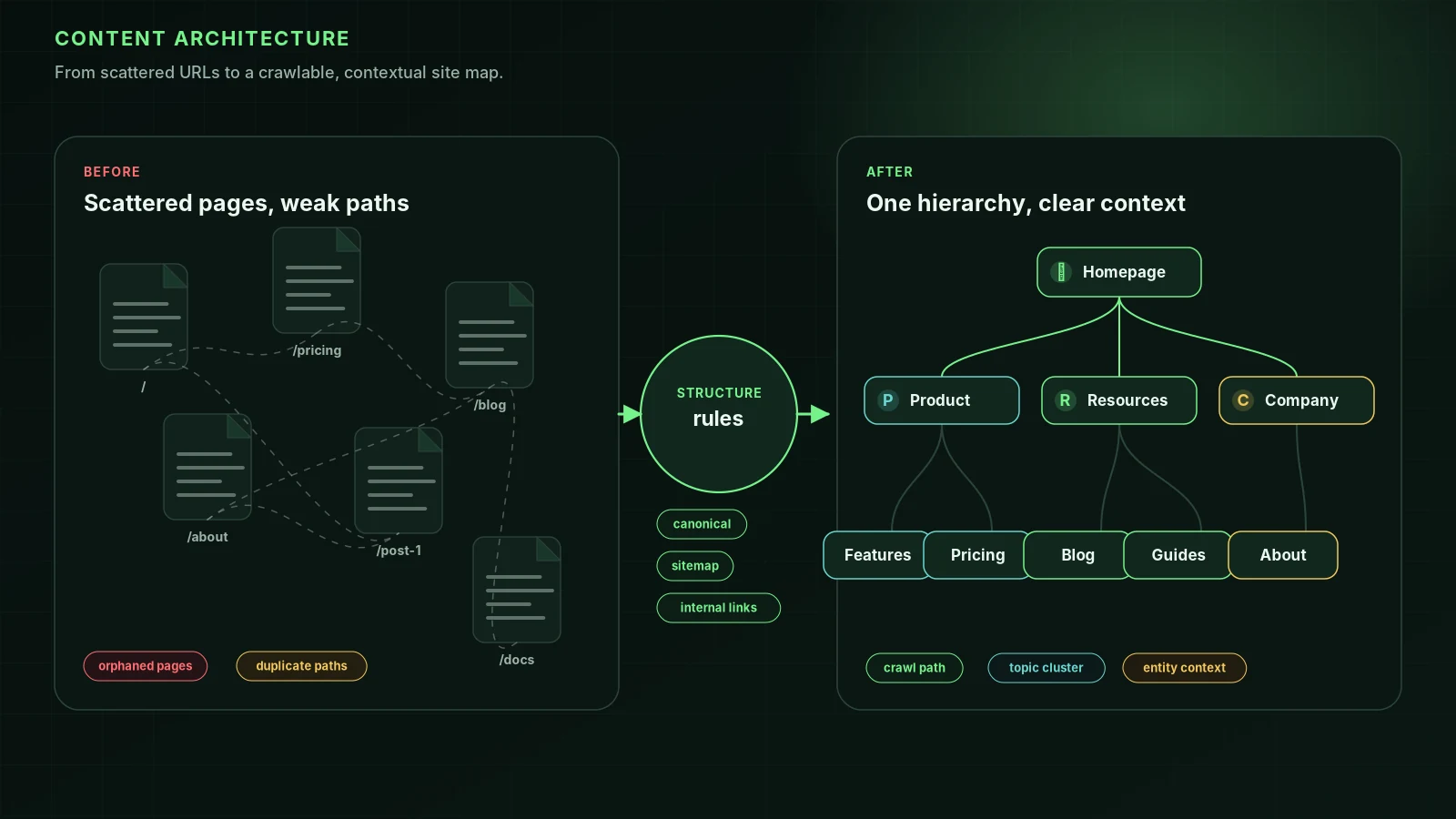
- Write one plain sentence that says what you are, for whom and where (“a family dental practice in Bristol that specialises in nervous patients”) and use it on your homepage, About page, Google Business Profile, directories and social bios.
- Keep your name, address, phone number, hours and categories identical everywhere, including Google Business Profile, Bing Places, Apple Business Connect and your trade directories.
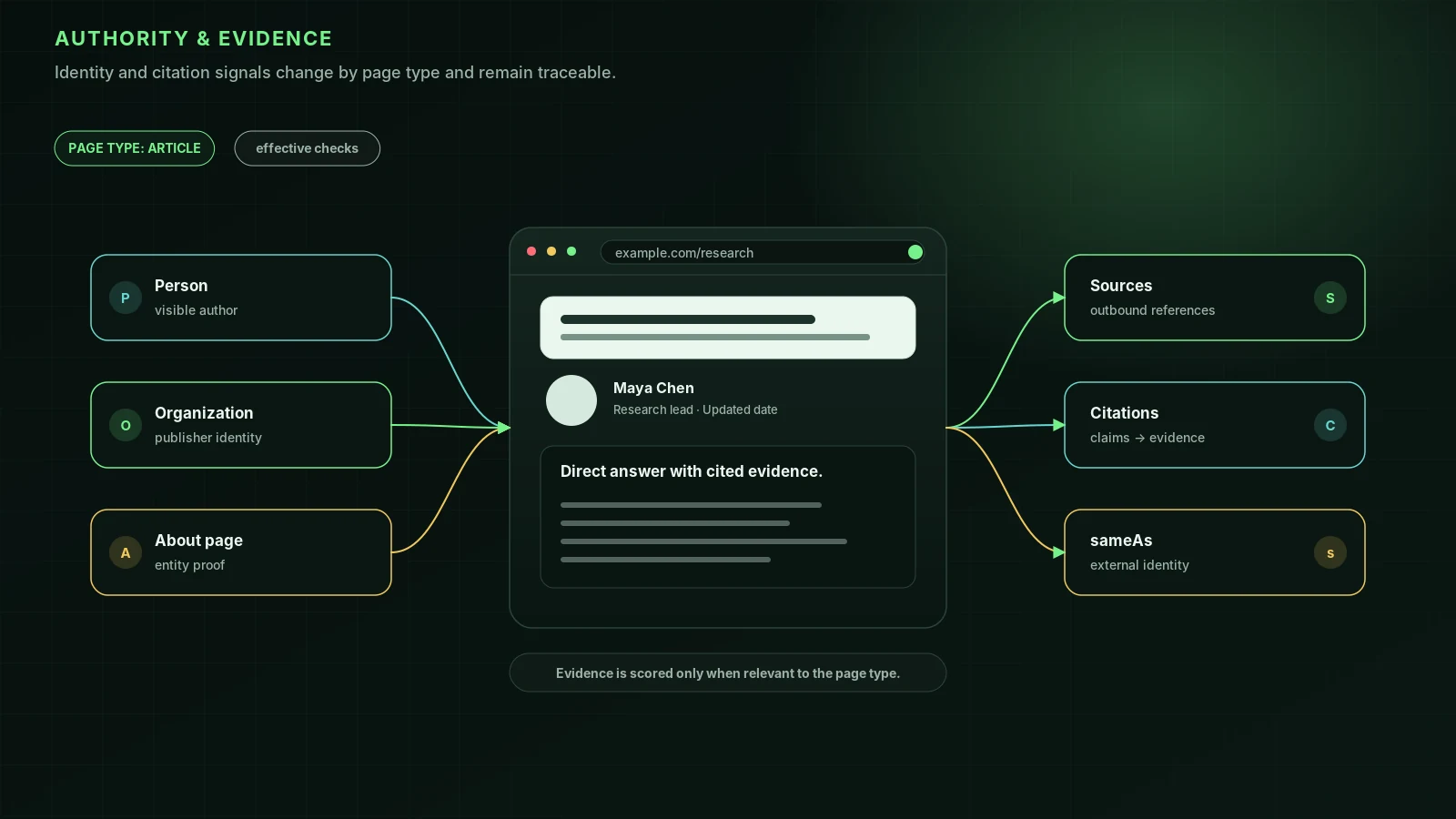
- Publish an About page that says who runs the business, their credentials and how to reach you, and link to every profile you control. Authorship and sameAs markup helps machines connect them.
- Create a Wikidata item only if you meet its notability policy: a Wikimedia sitelink, or an entity “that can be described using serious and publicly available references”. Otherwise, Wikidata says, the data won’t be accepted. We grade a Wikidata entity Moderate evidence, but only as a proxy for genuine off-site presence, not as a shortcut.
Structured data such as Organization or LocalBusiness is worth having for rich results and for stating these facts unambiguously. It is not a citation lever: in Ahrefs’ controlled test, adding JSON-LD moved ChatGPT citations by +2.2%, statistically indistinguishable from zero (our schema review).
4. Get onto the pages ChatGPT reads (Strong evidence, correlational)
This step decides most recommendations. In Ahrefs’ study of 75,000 brands, branded web mentions correlated with ChatGPT visibility at 0.664 and YouTube mentions at about 0.737, while Domain Rating, a backlink measure, managed 0.266. For recommendation prompts, “best X” lists were 43.8% of the page types ChatGPT cited. Correlation isn’t causation, but no on-site factor comes close.
- Collect the URLs ChatGPT cites for your top ten customer questions over a week (diagnostic check 3).
- Sort them: lists you could be added to, directories you can join, review sites, news and blogs, and competitors’ own pages.
- Email each list’s author a short, checkable case: what you do, for whom, since when, with links to independent reviews or coverage. If they list you wrongly, ask for a correction.
- Join every directory that recurs, with complete and identical details.
- Earn coverage that creates new mentions: local press, trade publications, podcasts, YouTube demos or reviews, talks and awards with public pages.
Don’t manufacture mentions. Google’s guide says “seeking inauthentic ‘mentions’ across the web isn't as helpful as it might seem”, and Reddit’s share of ChatGPT citations fell from 3.83% to 0.52% in August 2026 (Promptwatch data, provisional, cause unknown). A channel can stop paying overnight.
5. Collect reviews on more than one platform (Moderate evidence)
Reviews act more like a filter than a ranking signal. SOCi found the locations ChatGPT recommended averaged 4.3 stars, and SE Ranking found domains listed on several review platforms averaged 4.6–6.3 ChatGPT citations, against 1.8 for domains on none. Ask happy customers to review you on the platforms that appear in your Sources list, not only Google, and reply to reviews. Yelp is the odd one out: it licenses reviews and business data to OpenAI (MarTech, July 2026), yet its robots.txt closes business pages to OAI-SearchBot, so that data reaches ChatGPT through the licence rather than crawling. Keep the profile accurate anyway.
6. Publish honest comparison pages (Mixed evidence)
Buyers ask “X vs Y” and “alternatives to X”, and ChatGPT reads the pages that answer. Studies disagree on self-promotion: Ahrefs saw no downside to brands publishing their own “best” lists, while Lily Ray found that when a brand’s own list was cited in Google’s AI Overviews, the brand was left out of the recommendation 69% of the time. The safe version: compare fairly, name competitors accurately, say who each option suits (including when it isn’t you), and never rank yourself first in a list you wrote. Put the answer in the first paragraph, and don’t chop the page into tiny FAQ blocks, which Google says is unnecessary.
7. Keep facts fresh and dated (Moderate evidence)
Freshness is the best-evidenced on-page factor for ChatGPT. Ahrefs found it cited URLs 458 days newer than Google’s organic results, and SE Ranking found pages updated in the past three months averaged 6.0 ChatGPT citations against 3.6 for outdated ones. Keep prices, hours, service areas and team pages current, show a visible “updated” date where it’s true, remove or redirect stale pricing pages and old press releases, and change the date only when the content changes.
| Step | What to do | Evidence grade | Checked by our audit? |
|---|---|---|---|
| 1. Access | Allow OAI-SearchBot, PerplexityBot and Claude-SearchBot; check the firewall | Platform docs | Yes: robots.txt plus a simulated edge test |
| 2. Indexable and readable | No stray noindex; key text in raw HTML | Platform docs; Strong | Yes |
| 3. Unambiguous entity | One description, identical details everywhere | Untested (Wikidata presence: Moderate) | Partly: on-site details and Wikidata |
| 4. Third-party pages | Get onto the lists, directories and coverage ChatGPT cites | Strong (correlational) | No: off-site work |
| 5. Reviews | Reviews on several platforms, with replies | Moderate | No: off-site work |
| 6. Comparisons | Fair “vs” and “alternatives” pages | Mixed | Partly: answer-first structure |
| 7. Freshness | Current facts, honest visible dates | Moderate | Yes |
Notes by business type
Restaurants and cafés
Your Google Business Profile drives Google’s AI answers; Google’s guide says Business Profiles can help “your products and services to be visible in both AI responses and other Google Search results”. For ChatGPT, review and booking platforms matter. On 13 October 2026, Tripadvisor’s robots.txt allowed OAI-SearchBot on restaurant review pages, while Yelp’s closed business pages to it. Keep menus, prices and opening hours on your own site as text, not only as a PDF or an image.
Dentists, doctors and clinics
Health questions lean on directories and reviews. Give each practitioner a page with credentials and registration details, list the practice identically on the health directories used in your country, and write down fees and consultation policies, because when they’re missing assistants fill the gap from third-party pages. Several large medical directories refused our automated test requests, so check those listings by hand. More in our local business guide.
Lawyers
In CLM Sequoia’s study of 3,200 legal prompts (a vendor study), each assistant preferred different directories: Claude cited Avvo in 87.1% of prompts, Google AI Mode cited Super Lawyers in 62.8% and Justia in 60.2%, and ChatGPT cited Avvo in 29.2%. The firms named overlapped between assistants 8.6% of the time at most, so track each assistant separately. Claim and complete every major legal directory, with a page per practice area and per office.
Trades and home services
Plumbers, electricians and roofers are usually recommended from city-specific “best X in [city]” pages and trade directories. In our 13 October check, ThreeBestRated, HomeStars and BBB all allowed the three main AI search crawlers. Find the city pages that recur in your Sources list, get listed, and state your service area and emergency hours on your own site in plain text.
SaaS and software
Software recommendations follow third-party consensus: G2 and Capterra profiles (both open to AI search crawlers when we checked), comparison articles by others, YouTube tutorials and founder posts. Write one quotable positioning line and use it everywhere. Keep pricing pages server-rendered and current; ChatGPT quoting old prices is one of the most frequent complaints we found in our audience research. Publish fair “alternatives” pages.
Ecommerce
Products run through a separate pipeline. OpenAI’s commerce docs say “Onboarding product feeds in ChatGPT is currently available to approved partners”, through an application form, and Google’s guide points merchants to Merchant Center feeds. Complete product data matters more than prose, and price, availability and key attributes should be in the page HTML too. Our AI shopping guide covers each platform.
What not to waste money on
Much of what is sold as “AI optimisation” is the advice with the weakest evidence. GEO myths, graded explains each one in depth.
| Sold as | What the evidence says | Grade |
|---|---|---|
| llms.txt files | Google says “Google Search ignores them”; OpenAI’s crawler docs don’t mention them | Evidence against |
| FAQ or schema markup to get cited | No measurable lift in a controlled test; Google stopped showing FAQ rich results on 7 May 2026 | Evidence against |
| Rewriting or “chunking” content for AI | Google: no need to “break your content into tiny pieces”; SE Ranking found FAQ sections and question headings slightly negative | Evidence against |
| “Submit your business to ChatGPT” | No submission route exists for websites | Evidence against |
| ChatGPT ads to appear in answers | OpenAI says ads don’t influence answers and are shown separately | Platform docs (stated policy) |
| Fake reviews or seeded forum posts | Breaks platform rules; Google says inauthentic mentions aren’t as helpful as they seem | Evidence against |
| “We rank you #1 in ChatGPT” reports | Brand lists change more than 99% of the time; ask for appearance rates instead | Evidence against |
How to know whether it’s working
Because answers vary so much, measure in four layers, from cheapest to most precise. The full plan is in how to measure AI visibility.
- Ask customers. Add “ChatGPT or another AI assistant” to your “How did you hear about us?” question. It catches people who read a recommendation and then typed your name into Google.
- Track referrals. OpenAI says ChatGPT adds utm_source=chatgpt.com to its referral links (what the tag does and misses), and GA4 has had an AI Assistant channel since 13 May 2026, which excludes Google’s AI Overviews and AI Mode (setup guide).
- Use the free first-party reports: Search Console’s generative AI performance report for AI Overviews and AI Mode, and Bing’s AI Performance report for Copilot citations and grounding queries.
- Re-run your fixed list of questions monthly, five or more runs each, and report the share of runs that name you, per assistant.
Expect technical fixes to register quickly and off-site work to take months. Treat any month-to-month change smaller than the run-to-run noise as no change at all.
A 30-day starting plan
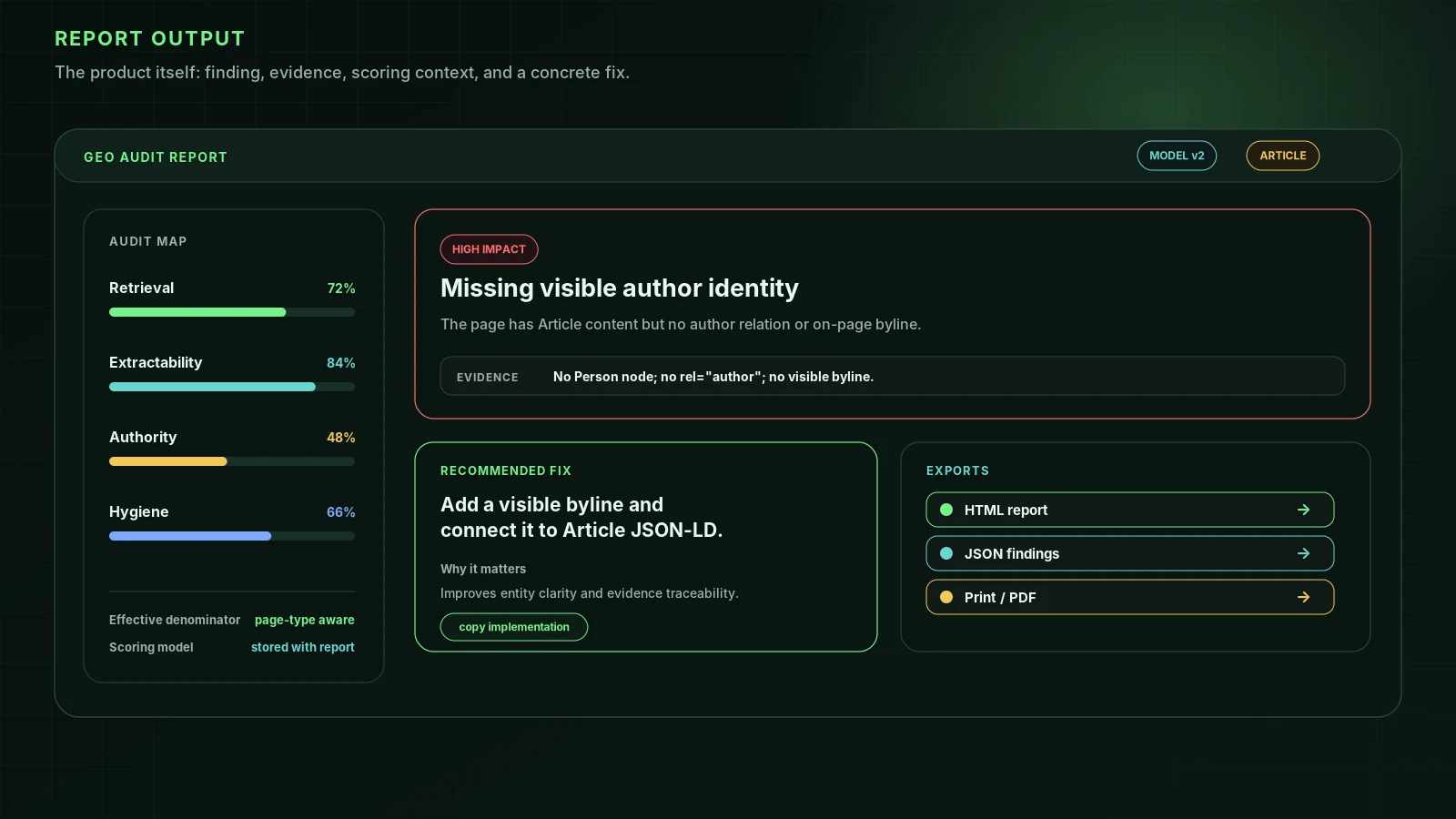
- Week 1: run the diagnostic, fix crawler access and any noindex problems, and run a free audit to check access, raw HTML and freshness in one pass.
- Week 2: write your one-sentence description and make your details identical across your site and every profile.
- Weeks 2 to 4: collect the cited URLs for your top questions, start outreach to lists and directories, and ask recent customers for reviews on the platforms that recur.
- Week 4: publish or fix one honest comparison page, update stale facts, then re-run your questions and record the baseline you will compare against next month.
FAQ
How do I get ChatGPT to recommend my business?+
Make sure OpenAI’s search crawler, OAI-SearchBot, can reach and read your site, keep your business details identical everywhere, and get mentioned on the lists, directories and review sites ChatGPT cites for your kind of business. Then measure across repeated runs. Nobody can guarantee a recommendation.
Why isn’t my business showing up in ChatGPT?+
The most common reason is that the pages ChatGPT reads for your type of question, such as “best X in [city]” lists and directories, don’t mention you. Other causes are a robots.txt or firewall rule blocking OAI-SearchBot, key facts that only load with JavaScript, and inconsistent business details. The Sources panel shows which applies.
Can I submit or list my business on ChatGPT?+
Not for websites or local businesses: OpenAI has no submission form. Allowing OAI-SearchBot is what makes your pages eligible for ChatGPT search. Merchants can apply to provide product feeds for ChatGPT shopping, a separate programme for approved partners.
Do I need to do anything for AI beyond normal SEO?+
For Google’s AI Overviews and AI Mode, Google says the work is still SEO. ChatGPT and other assistants add their own crawlers and lean harder on third-party mentions, so also check AI crawler access and work on lists, directories and reviews. You don’t need llms.txt or special markup.
How long does it take to show up in ChatGPT?+
OpenAI says robots.txt changes take about 24 hours to reach its search systems. Getting onto lists and directories, and having ChatGPT retrieve those pages, usually takes weeks to months and may not happen at all. Track the share of runs that name you each month.
Does this also work for Google AI Overviews, Gemini, Perplexity and Claude?+
Mostly, yes. Google’s AI features draw on Google’s search index and Business Profiles, so classic SEO matters most there. Perplexity and Claude run their own search crawlers, PerplexityBot and Claude-SearchBot, and each assistant prefers different directories, so track them separately.
Sources
- Overview of OpenAI Crawlers — OpenAI Developers
- ChatGPT search (Help Center; read via search snippets, the page blocks automated access) — OpenAI
- Publishers and developers FAQ (utm_source=chatgpt.com; read via search snippets) — OpenAI
- Agentic Commerce: get started (product feeds for approved partners) — OpenAI Developers
- Our approach to advertising and expanding access (read via search snippets) — OpenAI (2026-01-16)
- Optimizing your website for generative AI features on Google Search — Google Search Central (2026-07-10)
- Google Search Central documentation updates (FAQ rich results retired 7 May 2026) — Google Search Central
- Default channel group: AI Assistant channel — Google Analytics Help (2026-05-13)
- Perplexity crawlers — Perplexity
- Does Anthropic crawl data from the web, and how can site owners block the crawler? — Anthropic
- Accountable mixed-use AI crawlers (Disallow AI Training vs Block) — Cloudflare Blog (2026-09-15)
- The rise of the AI crawler (JavaScript rendering) — Vercel (2024-12-17)
- Brand mentions vs AI visibility (75,000 brands, correlational) — vendor study — Ahrefs (2025-12-12)
- Do self-promotional “best” lists boost ChatGPT visibility? (26,283 source URLs) — vendor study — Ahrefs (2025-12-04)
- Why ChatGPT Cites One Page Over Another (Study of 1.4M Prompts) — vendor study — Ahrefs (2026-04-15)
- Do AI assistants prefer to cite fresh content? (17M citations) — vendor study — Ahrefs (2025-07-28)
- Schema and AI citations (1,885 pages, controlled) — vendor study — Ahrefs (2026-05-11)
- ChatGPT ranking factors (129k domains, correlational) — vendor study — SE Ranking (2025-11-24)
- In AI-driven discovery, few brands are chosen and most disappear (350,000 locations) — vendor study — SOCi (2026-01-28)
- Local Consumer Review Survey 2026 — BrightLocal (2026-02-11)
- AI recommendations change with nearly every query (SparkToro and Gumshoe study) — Search Engine Journal (2026-01-30)
- Optimizing Visibility in Generative Engines: A Critical Survey of GEO (2023–2026) — arXiv (Martinez) (2026-07-15)
- Why calling yourself “the best” could cost you AI recommendations (Ahrefs Brand Radar data) — Lily Ray (2026-06-17)
- ChatGPT, Claude and Google AI Mode rarely recommend the same law firms (3,200 prompts) — vendor study — Custom Legal Marketing (CLM Sequoia) (2026-07-29)
- Yelp brings reviews and local leads to ChatGPT — MarTech (2026-07-28)
- Reddit’s ChatGPT citation drop is unexplained (Promptwatch data) — Relevant Audience (2026-08-20)
- Wikidata:Notability — Wikidata
- Introducing AI Performance in Bing Webmaster Tools (Public Preview) — Microsoft Bing Webmaster Blog (2026-02-10)
Run it on your domain
See this lens as a finding, not a lecture.
Free technical GEO audit. Evidence-traced scores, LLM-ready export, no login.
Audit your website