Strategy 12 min read
How Does ChatGPT Choose Its Sources? Documented, Measured, Myth
Most explanations of ChatGPT’s sources blend OpenAI’s own documentation with vendor guesses and forum folklore. We separated the three, graded every claim, and checked the robots.txt files of sites ChatGPT is said to rely on.

Founder, SEO·AEO·GEO
Builds SEO·AEO·GEO and writes the crawler, schema, and citation research published here.
Key takeaways
- ChatGPT only cites web pages when it runs a search; in one measured setup, 57.8% of repeated ChatGPT runs never searched at all.
- When it does search, OpenAI says it rewrites the question into targeted queries for search providers, and its crawler OAI-SearchBot decides whether your site can appear in those answers.
- Ahrefs found 88% of the URLs ChatGPT cites come straight from its general search results, so ranking still matters.
- Which businesses get named depends heavily on third-party pages such as “best X” lists, directories and review sites; off-site mentions correlate with AI visibility far more than backlinks.
- Answers change from run to run, so judge any claim about ChatGPT’s sources by repeated tests, not a single screenshot.
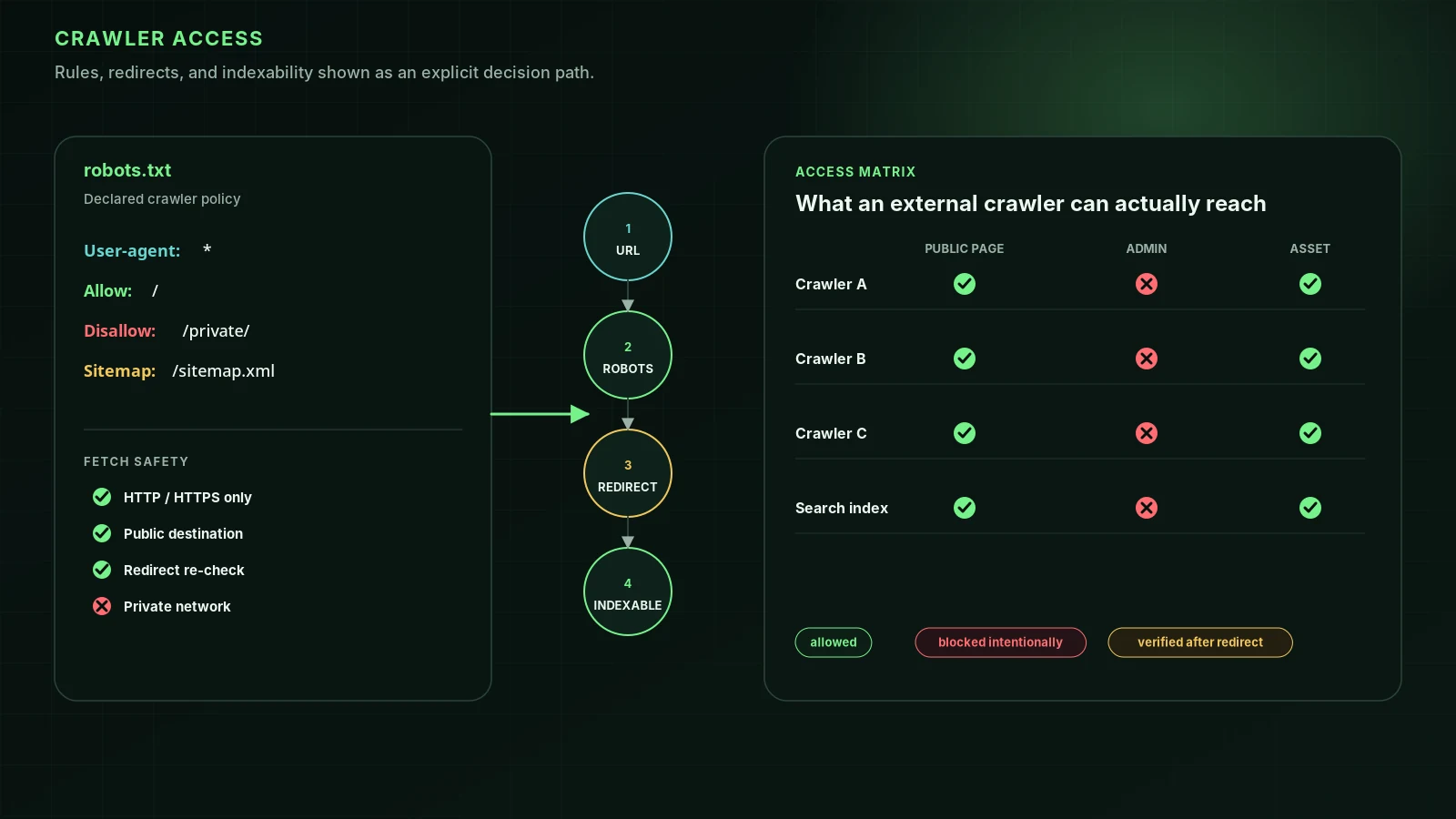
ChatGPT chooses sources in two stages. First it decides whether to search the web at all; if it doesn’t, it answers from what the model learned in training and cites nothing. If it does search, OpenAI says it rewrites your question into one or more targeted queries, sends them to search providers, and cites the retrieved pages that best support its answer. Your site can only be one of those pages if OpenAI’s search crawler, OAI-SearchBot, is allowed to reach it.
Which businesses it names follows the same logic: ChatGPT tends to recommend the businesses that the pages it retrieved recommend. That is why “best X” lists, directories and review sites shape the answer more than your homepage does. Nobody outside OpenAI knows the full ranking logic, and the answer to the same question changes from run to run.
Below, every claim carries one of the evidence grades from our methodology: Platform docs (OpenAI says so), Strong or Moderate evidence (studies agree, with caveats), and Evidence against (tested and not supported). Vendor studies are labelled as vendor studies.
At a glance: what’s documented, measured and myth
| Claim | Grade | Basis |
|---|---|---|
| OAI-SearchBot decides which sites can appear in ChatGPT search | Platform docs | OpenAI crawler documentation |
| Blocking GPTBot does not remove you from ChatGPT search | Platform docs | OpenAI: each setting is independent |
| ChatGPT rewrites your question into queries for search providers | Platform docs | OpenAI Help Center (read via search snippets) |
| Most cited URLs come from ChatGPT’s search results | Moderate evidence | Ahrefs, 1.4M prompts (vendor) |
| Pages matching ChatGPT’s hidden fan-out queries get cited more | Moderate evidence | Ahrefs, 1.4M prompts (vendor) |
| ChatGPT prefers fresher pages than Google’s organic results | Moderate evidence | Ahrefs, 17M citations (vendor); a controlled date test |
| “Best X” lists are the most cited page type for recommendation prompts | Moderate evidence | Ahrefs, 750 prompts (vendor) |
| Off-site brand mentions predict AI visibility better than backlinks | Strong evidence (correlational) | Ahrefs, 75,000 brands (vendor) |
| ChatGPT simply copies Bing (or Google) | Evidence against | OpenAI names no single provider; Peec saw four sources (vendor) |
| You can submit your website to ChatGPT | Evidence against | No submission route exists for websites |
| llms.txt or schema markup gets you cited | Evidence against | Ahrefs controlled schema test; OpenAI’s crawler docs never mention llms.txt |
| There is a stable “#1 rank” in ChatGPT | Evidence against | SparkToro and Gumshoe: brand lists differ more than 99% of the time |
What OpenAI documents (Platform docs)
OpenAI’s crawler page lists four agents. Only one of them decides whether your pages can appear in ChatGPT’s search answers.
| Agent | What it does | What blocking it does |
|---|---|---|
| OAI-SearchBot | Builds the index behind ChatGPT search | Your pages stop appearing in ChatGPT search answers, though they may still show as navigational links |
| GPTBot | Collects content that may be used to train OpenAI’s models | Opts you out of training; no documented effect on search answers |
| ChatGPT-User | Visits a page when a user’s request needs it | OpenAI says robots.txt rules “may not apply”, and this agent isn’t used to decide search inclusion |
| OAI-AdsBot | Checks landing pages submitted as ChatGPT ads | Only visits pages submitted as ads |
Sites that are opted out of OAI-SearchBot will not be shown in ChatGPT search answers, though can still appear as navigational links.
OpenAI also says a robots.txt change can take about 24 hours to reach its search systems, and that its settings are independent: you can allow OAI-SearchBot for search while disallowing GPTBot for training. Our GPTBot vs OAI-SearchBot guide has the exact robots.txt lines.
How a question becomes a search
OpenAI’s Help Center article on ChatGPT search describes the next step. We could only read it through search-result snippets, because the help centre refuses automated requests, so we paraphrase rather than quote. In short: ChatGPT search sometimes works with third-party search providers. When it does, it typically rewrites your prompt into one or more targeted queries, and it may send further, more specific queries after reading the first results. It can share a general location derived from your IP address (not the address itself) to make local results relevant, and with Memory turned on it may use relevant memories to improve the query.
Two consequences follow. People asking the same question in different cities, or with different memories, can trigger different searches and see different sources. And your pages have to match the rewritten queries, not the user’s exact wording. Google describes the same mechanism for its own AI features as query fan-out: “A set of concurrent, related queries generated by the model to request more information”.
What OpenAI doesn’t say
OpenAI does not name its search providers, publish ranking factors, or offer a way to submit a website. Merchants are the one exception: OpenAI’s commerce docs say “Onboarding product feeds in ChatGPT is currently available to approved partners”, through an application form. For everyone else, inclusion runs through OAI-SearchBot and whatever the providers return. OpenAI has also stated, in advertising principles published in January 2026, that ads do not influence ChatGPT’s answers. We could only read that page through search snippets too, so treat it as OpenAI’s stated policy rather than something anyone has tested.
What we checked on 13 October 2026
OpenAI’s crawler page lists OAI-SearchBot at version 1.4 and warns that the version number may change, so match on the token OAI-SearchBot in your logs and firewall rules, never on the full string. The published IP list at openai.com/searchbot.json returned 39 IP prefixes when we fetched it (file created 2 January 2026). The ChatGPT-User list returned 234 prefixes and had been regenerated on 7 October 2026. These files change, so a firewall allow-list should read them rather than hard-code ranges once.
What studies have measured (Strong and Moderate evidence)
Almost every study below was run by a company that sells SEO or AI-visibility software, and almost all are correlational. They are still the best data available. Read them as patterns, not laws.
It has to search before it can cite you
A July 2026 survey of 45 GEO studies on arXiv reports that, in the configuration studied by Schulte et al., 57.8% of repeated ChatGPT runs did not activate web search at all. Those answers came from training data and cited nothing. The same survey reports daily source overlap of only about 0.34–0.42 (Jaccard) across four engines over 45 days. The underlying queries were a small Swiss set, so the exact numbers won’t transfer to your market, but the direction is consistent: whether ChatGPT searches, and what it finds, varies a lot.
Most cited pages come from its search results
Ahrefs analysed 1.4 million ChatGPT prompts (April 2026, vendor study) and found that 88% of the URLs ChatGPT cited were taken directly from its general search results, rather than its news, Reddit or YouTube channels. Their conclusion: “If you want to be cited by ChatGPT, you need to be in that search selection pool—which means your content needs to rank.” The same study found that cited pages had titles closer in meaning to ChatGPT’s behind-the-scenes fan-out queries than pages it retrieved but didn’t cite.
Fresher pages are cited more
Across about 17 million citations, Ahrefs found ChatGPT cited URLs 458 days newer than Google’s organic results (July 2025, vendor study); Google’s AI Overviews showed no such preference. SE Ranking’s 129,000-domain study (November 2025, correlational) found pages updated within the past three months averaged 6.0 ChatGPT citations against 3.6 for outdated pages. A controlled test that injected publication dates into passages reversed language models’ preferences between equally relevant passages by up to 25% (Fang et al., 2025). That combination of observational and controlled evidence is why we grade freshness Moderate.
Lists, directories and mentions decide who gets named
For recommendation prompts, Ahrefs found that “best X” blog lists made up 43.8% of all page types ChatGPT cited (750 prompts, December 2025). In a separate study of 75,000 brands, branded web mentions correlated with ChatGPT visibility at 0.664 and YouTube mentions at about 0.737 (pooled across platforms), while Domain Rating correlated at only 0.266. Ahrefs adds the usual disclaimer: “correlation isn't causation.” SE Ranking found domains listed on several review platforms averaged 4.6–6.3 ChatGPT citations, against 1.8 for domains absent from them.
Put together: ChatGPT recommends the businesses other pages discuss. If three list articles and two directories name your competitor and none name you, the model has nothing to cite for you. Our guide to why ChatGPT recommends your competitor shows how to find those pages for your own market.
The answer changes almost every time
SparkToro and Gumshoe.ai ran 12 brand-recommendation prompts 2,961 times across ChatGPT, Claude and Google’s AI (January 2026). The tools produced a different list of brands more than 99% of the time. Gumshoe sells AI tracking and the study isn’t peer-reviewed, but its finding matches the arXiv survey. How often a brand appeared across many runs was steadier than its position in any one list, which is why “share of answers” is a better metric than “rank”.
It blends several search sources
Peec AI, a vendor, reported in September 2026 that ChatGPT’s server-side events between 21 May and 21 July 2026 carried a result_source field with four values: Labrador, Bright, Oxylabs and SERP. Peec describes Labrador as OpenAI’s own index and the other three as external providers. OpenAI hasn’t confirmed this, so we treat it as unverified, but it fits OpenAI’s own wording about third-party search providers and argues against the idea that ChatGPT is simply Bing.
Two 2026 changes: Reddit fell, Yelp arrived
Reddit. Promptwatch citation data, reported by Relevant Audience on 20 August 2026, showed Reddit’s share of ChatGPT Search citations falling from an average of 3.83% (18 July to 7 August) to 0.52% (14 to 17 August). Promptwatch calls the size of the drop provisional and the cause is unidentified. Neither OpenAI nor Reddit has explained it.
Yelp. MarTech reported on 28 July 2026 that Yelp is licensing its reviews, ratings, photos and other business information to OpenAI, with Yelp’s “Request a Quote” feature planned for ChatGPT. Financial terms weren’t disclosed, and the deal doesn’t stop Yelp licensing to other AI companies.
What the evidence does not support
- “ChatGPT just uses Bing.” OpenAI names no single provider, and the one public analysis of ChatGPT’s search traffic found four sources (vendor, unverified). Being indexed by Bing helps; it isn’t the whole story.
- “Submit your site to ChatGPT.” There is no submission form for websites. Services selling “ChatGPT submission” sell something OpenAI doesn’t offer. Merchants can apply for product feeds, which is a separate shopping programme.
- “Add llms.txt and schema to get cited.” OpenAI’s crawler documentation never mentions llms.txt. In Ahrefs’ controlled test of 1,885 pages that added JSON-LD, ChatGPT citations moved +2.2%, statistically indistinguishable from zero. Structured data still helps with rich results and entity clarity; see our schema evidence review.
- “Ask ChatGPT why it didn’t recommend you.” The model’s explanation is generated text, not a log of what it retrieved. Use the Sources panel instead.
- “Tell ChatGPT about your business and it will recommend you.” Memory shapes the queries for your own account; OpenAI documents nothing that carries it into other people’s answers.
- “We rank #1 in ChatGPT.” With brand lists changing more than 99% of the time, a single position means little. Ask for appearance rates across many runs.
The full list, with grades and sources, is in GEO myths, graded.
How to see which sources ChatGPT used for a question
- Open a temporary chat or a logged-out window, so your memory and past chats don’t shape the search.
- Ask the way a customer would, with the place and the need: “best emergency plumber in Leeds open on Sundays”, not “plumber”.
- Check that it searched. A searched answer carries inline citations and a Sources button beneath the response. No citations means it answered from training data; ask it to search the web and compare.
- Click Sources. OpenAI describes a panel listing the cited sources plus other relevant links. Copy every URL, cited or not.
- Repeat five to ten times over several days, with a few rewordings. The Schulte et al. work summarised in the arXiv survey proposes seven to eight repetitions per prompt as a starting point.
- Tally which domains and which businesses recur. The recurring pages are your target list.
Copilot is easier to inspect: Bing Webmaster Tools’ AI Performance report lists grounding queries, which Microsoft defines as “the key phrases the AI used when retrieving content that was referenced in AI-generated answers”. See our Bing AI Performance guide.
What this means for your site
Four things follow from the evidence, in order of how much is within your control:
- Let OAI-SearchBot in at both the robots.txt and the firewall level. Check it with our free AI crawler checker or the curl tests in can ChatGPT read your website.
- Put the facts customers ask about in the HTML your server sends: prices, service areas, hours, what you do and for whom. Vercel’s crawler study found “none of the major AI crawlers currently render JavaScript”.
- Keep important pages current and visibly dated.
- Earn mentions on the pages ChatGPT retrieves for your category: lists, directories, review sites and press. This is the hardest step and the one that moves recommendations most. Our pillar guide to getting ChatGPT to recommend your business turns it into a checklist.
Nobody can guarantee a ChatGPT citation or recommendation, including us. What you can do is remove the reasons it can’t pick you, then measure the result over weeks rather than trusting a single answer.
FAQ
How does ChatGPT choose its sources?+
When ChatGPT searches the web, it rewrites your question into one or more search queries, sends them to search providers and cites the retrieved pages that best support its answer. Your site can only be one of them if OpenAI’s crawler OAI-SearchBot is allowed to reach it. When it doesn’t search, it answers from training data and cites nothing.
Does ChatGPT use Google or Bing?+
OpenAI says ChatGPT search works with third-party search providers but does not name them. A vendor analysis of ChatGPT’s own network traffic found four result sources, one of which it identified as OpenAI’s own index. Being indexed by Bing helps, but ChatGPT is not simply Bing.
How does ChatGPT decide which businesses to recommend?+
It largely repeats what the pages it retrieved say: “best X” lists, directories, review sites and articles. Studies find off-site brand mentions correlate with AI visibility far more than backlinks do. A business that isn’t mentioned on those pages has little chance of being named, however good its own website is.
Why does ChatGPT cite different sources every time?+
Each run can trigger different search queries, providers and results, and the model itself is not deterministic. In one test of nearly 3,000 runs, the list of brands changed more than 99% of the time. Measure how often you appear across many runs rather than trusting one answer.
Can I submit my website to ChatGPT?+
No. OpenAI offers no submission route for websites. Allowing OAI-SearchBot in robots.txt and in your firewall is what makes your pages eligible for ChatGPT search. Merchants can apply for ChatGPT product feeds, which is a separate shopping programme.
Sources
- Overview of OpenAI Crawlers — OpenAI Developers
- ChatGPT search (Help Center; read via search snippets, the page blocks automated access) — OpenAI
- Agentic Commerce: get started (product feeds for approved partners) — OpenAI Developers
- Our approach to advertising and expanding access (read via search snippets) — OpenAI (2026-01-16)
- Optimizing your website for generative AI features on Google Search — Google Search Central (2026-07-10)
- Optimizing Visibility in Generative Engines: A Critical Survey of GEO (2023–2026) — arXiv (Martinez) (2026-07-15)
- Why ChatGPT Cites One Page Over Another (Study of 1.4M Prompts) — vendor study — Ahrefs (2026-04-15)
- Do AI assistants prefer to cite fresh content? (17M citations) — vendor study — Ahrefs (2025-07-28)
- Do Large Language Models Favor Recent Content? (controlled date-injection test) — arXiv (Fang et al.) (2025-09-14)
- ChatGPT ranking factors (129k domains, correlational) — vendor study — SE Ranking (2025-11-24)
- Do self-promotional “best” lists boost ChatGPT visibility? (26,283 source URLs) — vendor study — Ahrefs (2025-12-04)
- Brand mentions vs AI visibility (75,000 brands, correlational) — vendor study — Ahrefs (2025-12-12)
- Schema and AI citations (1,885 pages, controlled) — vendor study — Ahrefs (2026-05-11)
- AI recommendations change with nearly every query (SparkToro and Gumshoe study) — Search Engine Journal (2026-01-30)
- AIs are highly inconsistent when recommending brands or products — SparkToro (2026-01)
- ChatGPT’s own search index, Labrador — vendor research — Peec AI (2026-09)
- Reddit’s ChatGPT citation drop is unexplained (Promptwatch data) — Relevant Audience (2026-08-20)
- Yelp brings reviews and local leads to ChatGPT — MarTech (2026-07-28)
- Introducing AI Performance in Bing Webmaster Tools (Public Preview) — Microsoft Bing Webmaster Blog (2026-02-10)
- The rise of the AI crawler (JavaScript rendering) — Vercel (2024-12-17)
Run it on your domain
See this lens as a finding, not a lecture.
Free technical GEO audit. Evidence-traced scores, LLM-ready export, no login.
Audit your website