Agencies 11 min read
How Agencies Sell GEO Services in 2026: Price Benchmarks, Packaging and Reports That Don’t Overpromise
Clients are asking for AI visibility faster than anyone can prove it works. The agencies that keep those clients sell two different things at two different prices, and report only what they can measure.

Founder, SEO·AEO·GEO
Builds SEO·AEO·GEO and writes the crawler, schema, and citation research published here.
Key takeaways
- Sell GEO as two products: a one-off technical access audit, which is checkable and largely automatable, and an off-site visibility retainer, which is where the best-evidenced drivers of AI recommendations sit.
- Published prices on 13 October 2026 ran from $99 to £7,500+ for an audit and from $2,000 to $12,000 a month for most mid-market retainers, with enterprise programmes far higher.
- Never promise a position in an AI answer: in SparkToro and Gumshoe's study there was less than a 1-in-100 chance that ChatGPT or Google's AI returned the same list of brands twice.
- Report first-party numbers (Search Console's generative AI report, Bing's AI Performance, GA4's AI Assistant channel) and share of answers across many runs, each labelled with what it can't tell you.
- A white-label technical audit makes a good first deliverable because it finds concrete, verifiable blockers in minutes and leaves the off-site work to be sold on its own merits.
Sell GEO as two products, because it is two different jobs. The first is a technical audit: can AI crawlers reach, read and attribute the client's pages. That is checkable, largely automatable, and on 13 October 2026 agencies published prices for it from $99 to £7,500 and up. The second is the off-site work that the evidence most strongly links to AI recommendations (reviews, directories, “best of” lists, press, video and community presence), which is what retainers of roughly $2,000 to $12,000 a month pay for. Price them separately, measure both with first-party data, and never promise a position in an AI answer. The same prompt rarely returns the same list twice.
Below: the published price benchmarks with sources and dates, a packaging model, a first-client process, a monthly report that holds up to a sceptical client, and the claims that turn a GEO offer into snake oil.
What clients are asking for
Demand arrived before measurement did. AgencyAnalytics surveyed 494 agency professionals between February and April 2026 and found that “two in three agencies say it's the #1 service their clients are asking them to add”. The same report found 41% facing new challenges measuring ROI, and only “11% of agencies now cite AI-driven search results as a source of new business”. One agency leader put the commercial problem plainly:
Recently, we have been seeing an increase in demand for AI reporting, strategy, and implementation at no additional charge.
That is the trap: GEO absorbed into an existing retainer for free, with no way to show what it did. The fix is a clear product boundary and a report built on numbers the client can check.
Price benchmarks, with sources
These are list prices from agencies' own pages, checked on 13 October 2026. They are what agencies ask, not what clients pay; nobody publishes transaction data.
| Offer | Published price | Scope as stated | Source |
|---|---|---|---|
| One-off AI visibility audit | $99 | Bot access, llms.txt, JS rendering test, 5 test queries; 5 business days | Optimum Web |
| One-off audit | $750 | Citations across ChatGPT, Perplexity, Claude and Google AI Overviews, 25 buyer questions, technical SEO, competitor citations, action plan; 5 business days | Foundier |
| Tiered audit | £1,500 / £3,500 / £7,500+ | 30–100 buyer prompts, 12+ engines, competitor benchmark, entity review, 90-day roadmap; 5–7 working days | Growth Anchors |
| Audit plus 30-day tracking | Not published on the page | 6 platforms, about 6 weeks | Veza Digital |
| GEO retainer | $2,000–$3,000 / $4,000–$7,000 / $8,000–$12,000 a month | Tiers built on list placements, superlative-list content, reputation management and PR | First Page Sage |
| GEO retainer | From $3,500 / $6,000 / $8,500 / $10k+ a month | Four packages | Percepture |
| Agency GEO services | $1,500–$50,000+ a month; projects $5,000–$50,000 | Range by business size | WebFX |
| AI search programmes | $30K–$150K / $150K–$500K / $500K+ | “Investment range” by organisational stage | iPullRank |
Pricing guides written for agencies give similar bands. Similarweb (1 June 2026) puts audits at $500 to $5,000, monitoring at $1,500 to $5,000 a month and full retainers at $3,000 to $10,000 or more. LLM Pulse (11 May 2026) suggests audits at $500 to $2,000, monitoring at $500 to $1,500 a month and optimisation at $2,000 to $5,000 a month. DemandLocal (7 April 2026) lists a “tripwire” audit at $1,500 to $5,000, retainers at $3,000 to $10,000+, a 20 to 30% uplift when GEO is added to an SEO retainer, and a 40 to 60% markup on white-label resale. Similarweb and LLM Pulse sell AI-visibility software, so read their bands as vendor guidance.
Package it as two products
| Technical access audit (one-off) | Off-site visibility retainer (monthly) | |
|---|---|---|
| What's in it | Crawler access per bot, CDN and firewall treatment, raw HTML without JavaScript, noindex and snippet controls, redirects, entity basics, a prioritised fix list | Getting the client onto the review sites, directories and “best of” pages that engines cite for their category; digital PR; video; honest comparison content |
| Evidence behind it | Official documentation from OpenAI, Anthropic, Perplexity, Google and Bing on how their crawlers and controls work | Strong but correlational: off-site brand mentions, YouTube most of all, track AI visibility far more closely than backlinks |
| What you can promise | That named blockers are fixed, and verified in server logs | The work: placements, reviews, coverage. Not the AI outcome |
| How you show progress | Before-and-after audit; log lines showing search crawlers getting 200s | Share of answers across many runs, cited-domain gaps closed, first-party AI data |
For Google this is not a new discipline. Google's guide says “our generative AI features on Google Search are rooted in our core Search ranking and quality systems”, so SEO you already sell is the base. What is genuinely new is the separate crawler stack of ChatGPT, Claude and Perplexity, which has its own bots, doesn't run JavaScript and can be refused by robots.txt or a CDN. That is why the technical audit is worth a line of its own; can ChatGPT, Claude and Perplexity read your website shows what it checks.
Keep the weakest-evidence tactics out of both products. llms.txt, FAQ or schema markup sold as a citation lever, chunking pages into tiny Q&A blocks and “rewriting for AI” are among the most-sold GEO fixes and the least supported; our methodology explains why we don't score them, and GEO myths, graded goes through each. Structured data still earns its place for rich results and entity clarity. Just don't invoice it as the thing that gets a client into ChatGPT.
A first-client process
- Agree 20 to 30 buyer questions with the client, in their customers' words: “best [service] in [city]”, “[product] alternatives”, “[brand] vs [competitor]”. These become the prompt library you report against.
- Run each question on each engine you will report on, logged out, several times on different days. Record which brands are named and which URLs are cited. Keep the raw results, not screenshots.
- Run the technical audit. Lead the findings call with the one blocker that matters most, such as a firewall rule refusing OAI-SearchBot, rather than a long list.
- Build the off-site gap list: the domains cited for competitors where the client is absent. That list is the retainer's work plan. Why ChatGPT recommends your competitor explains how to read it.
- Set up first-party measurement before you change anything: Search Console's generative AI report, Bing Webmaster Tools' AI Performance, GA4's AI Assistant channel, and an AI option on the “how did you hear about us” field.
- Propose a fixed-fee audit and a separate retainer, each with deliverables you control. Crediting the audit fee against the first retainer month makes the second step easier to say yes to.
- Review at 90 days against the baseline, per engine, and frame the result as contribution.
Reports that don't overpromise
The single most important thing to tell a client is that AI answers are not rankings. In SparkToro's study with Gumshoe.ai, reported by Search Engine Journal on 30 January 2026, 2,961 prompts were each run 60 to 100 times per platform, and there was “a <1-in-100 chance that ChatGPT or Google's AI in Search” would return the same list of brands. A screenshot of one answer proves nothing, in either direction. Report rates over many runs, per engine, never blended into one score.
| Metric | Source | What it can't tell you |
|---|---|---|
| AI Overviews and AI Mode impressions by page | Search Console generative AI report | No clicks and no queries; only sites included in generative AI features |
| Citations, cited pages, grounding queries | Bing AI Performance (public preview since 10 February 2026) | Copilot, Bing and partner surfaces only; grounding queries are a sample; no clicks |
| AI assistant sessions and conversions | GA4 AI Assistant channel (since 13 May 2026); utm_source=chatgpt.com | Excludes AI Overviews and AI Mode; misses visitors who type the brand in later |
| Share of answers per engine | Your prompt library, with run counts | A logged-out sample, not what every user sees |
| Cited domains for the category | The same runs | Which sources engines lean on, not why |
| Technical gates passed | The audit | Eligibility only; nothing about being chosen |
| “How did you hear about us?” | The client's forms or CRM | Self-reported and incomplete |
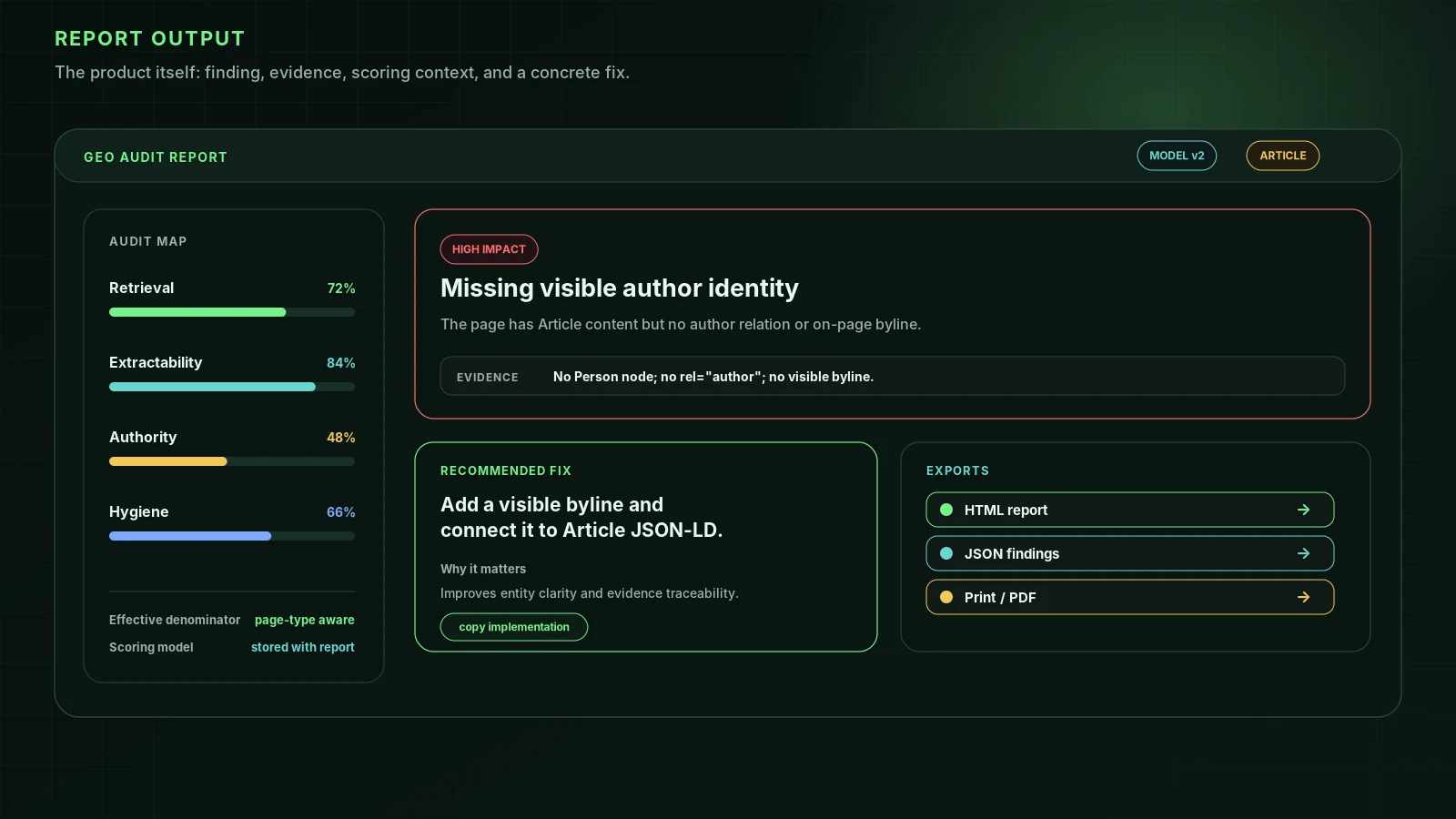
To show contribution rather than coincidence, compare like with like: if you rework twelve service pages and leave thirty similar ones alone, report whether the twelve moved and the thirty didn't. More on building the measurement plan in how to measure AI visibility, and on what a usable finding looks like in GEO audit reports that lead to fixes.
- Never promise a position, a rank or “#1 in ChatGPT”. There are no positions to hold.
- Never promise inclusion. Google: “Just because a page meets all requirements, best practices, and complies with the policies, doesn't mean that Google will crawl, index, or serve its content.”
- Never present a private visibility score as if it were an official metric. Google: “Be wary of third-party tools that promise ranking success or claim to use ‘internal’ Google metrics.”
- Never count your own test visits as AI referrals. Filter your office IPs and test devices out of analytics before the first report.
The snake-oil problem, and how to stay clear of it
GEO is easy to sell badly, because the outcome is hard to measure and the client can't check your claims. The tells of a weak offer are consistent: guaranteed AI placement, audits whose headline findings are a missing llms.txt and missing FAQ schema, one-off screenshots as proof, and scores without sources. Clients who have been burned once will ask about all of them.
Two shortcuts deserve a specific warning. Google says “seeking inauthentic ‘mentions’ across the web isn't as helpful as it might seem.” And self-promotion can backfire: in Lily Ray's analysis of 100 B2B “best [category]” queries in Google's AI Overviews (published 17 June 2026), when a brand's own self-promotional listicle was cited, “that brand was left out of the actual recommendation 69% of the time” (224 of 323). Earned third-party coverage is slower, and it is what the evidence supports.
The defence is to show your sources. If every recommendation in your audit carries the evidence behind it, graded by strength, a sceptical client can check you, and a competitor selling shortcuts has to explain why theirs don't.
Use a white-label audit as the first deliverable
The technical audit is the natural first deliverable: it is fast, it finds concrete problems, and every finding can be verified. Our white-label audit for agencies is built for that step. Here is exactly what it does today, so you can judge the fit:
- Free while in beta, with no account; usage is rate-limited per IP.
- Covers Google Search, AI Overviews, ChatGPT, Perplexity and Claude: robots.txt verdicts per crawler, requests sent as AI crawlers compared with a browser fetch (403s, 402 pay per crawl, challenges), raw HTML without JavaScript, snippet controls, freshness and entity presence.
- Every check carries an evidence grade (official, strong, moderate, weak, unstudied, practice or myth) with its sources, and the firewall test is labelled as simulated.
- Branded exports in HTML, Markdown and PDF with your agency name, logo and accent colour; shared reports show an “Audit shared by” banner linking to your site.
- An embeddable script that lets visitors audit their own site from your website, with the report opening under your name.
- Sitewide audits and a check-by-check comparison against a competitor.
- A live citation check (beta) that asks Claude, Perplexity and ChatGPT buyer questions with web search on, twice each, and reports how often the site was cited.
- Alerts: a weekly re-audit that emails you only if something controlling AI access breaks.
What it doesn't do: it isn't a prompt-tracking dashboard, it can't see the off-site signals that matter most, and reports are deleted after 24 hours, so download what you need. The off-site retainer is still yours to sell and deliver. That is the point of the split: the audit shows the client you know exactly what is wrong on their site, and the retainer is where you earn the monthly fee.
Before your next sales call, run a free audit on the prospect's site and open with the single finding that matters. It is a better first meeting than twenty generic tips, and it is true.
FAQ
How much should I charge for a GEO audit?+
Published audit prices we checked on 13 October 2026 ranged from $99 to £7,500 or more, and Similarweb's agency guide puts the usual range at $500 to $5,000. The scan itself is close to free now, so price the interpretation, prioritisation and implementation plan, and scale the fee with the number of engines, prompts and competitors you analyse.
Should GEO be a separate service or part of SEO?+
For Google it is SEO: Google says its AI features are rooted in its core Search ranking and quality systems. Many agencies sell it as an add-on to an SEO retainer, which DemandLocal prices at a 20 to 30 percent uplift, and sell the off-site visibility work as its own retainer.
How do I prove GEO results to a client?+
Use first-party data where it exists: Search Console's generative AI impressions, Bing's AI citation counts and GA4's AI Assistant sessions. Add share of answers across many runs per prompt, an AI option on the client's “how did you hear about us” field, and a comparison between pages you changed and similar pages you left alone. Present it as contribution, not proof of cause.
Can I guarantee a client will appear in ChatGPT?+
No, and Google warns against tools that promise ranking success. AI answers vary from run to run, and the engines alone decide what to cite. You can guarantee deliverables, such as fixed crawler blocks, new reviews or placements, and you can guarantee honest measurement.
What should a GEO audit include?+
At minimum: crawler access per bot, CDN and firewall treatment, whether content is in the raw HTML, indexing and snippet controls, entity and third-party presence, a baseline of which sources each engine cites for the client's buyer questions, and a prioritised fix list. It should say how strong the evidence is behind each recommendation.
Sources
- Agency benchmarks 2026: AI search — AgencyAnalytics (2026-06-30)
- AI Visibility Audit — Optimum Web
- AI visibility audit — Foundier
- AI Visibility Audit — Growth Anchors
- AI Search Visibility Audit — Veza Digital
- AI Search (GEO) Packages and Pricing — Percepture
- Generative Engine Optimization (GEO) cost breakdown — First Page Sage (2025-11-14)
- How much does generative engine optimization cost? — WebFX
- AI Search — iPullRank
- How agencies can sell AI visibility services — Similarweb (2026-06-01)
- GEO agency guide — LLM Pulse (2026-05-11)
- How to price GEO services — DemandLocal (2026-04-07)
- AI recommendations change with nearly every query: SparkToro — Search Engine Journal (2026-01-30)
- New research: AIs are highly inconsistent when recommending brands or products — SparkToro
- Optimizing for generative AI features on Google Search — Google Search Central (2026-07-10)
- Why calling yourself the best could cost you the recommendation — Lily Ray (Substack) (2026-06-17)
- Introducing AI Performance in Bing Webmaster Tools (Public Preview) — Microsoft Bing Webmaster Blog (2026-02-10)
- Generative AI performance report — Google Search Console Help
- Default channel group definitions (AI Assistant) — Google Analytics Help
- Brand mentions and AI visibility: correlation study — Ahrefs
Run it on your domain
See this lens as a finding, not a lecture.
Free technical GEO audit. Evidence-traced scores, LLM-ready export, no login.
Audit your website