Retrieval 8 min read
How to Get Your Business Cited and Recommended by Perplexity
Perplexity shows its sources on almost every answer, which makes it the most honest engine to work on: you can see exactly which pages won, and why you weren’t one of them.

Founder, SEO·AEO·GEO
Builds SEO·AEO·GEO and writes the crawler, schema, and citation research published here.
Key takeaways
- Perplexity answers from its own search index, built by PerplexityBot; Perplexity says to allow it “to ensure your site appears in search results”.
- PerplexityBot isn’t a training crawler, so allowing it doesn’t hand your content to model training.
- Firewalls are the usual blocker: allow Perplexity’s published IP ranges, not just the user agent. Changes take up to 24 hours.
- Perplexity cites sources on nearly every answer, so you can list exactly which pages to fix or get onto.
- Answer the question in the first lines of a page, with specifics and a real date; Perplexity favours direct, current answers.
To get your business cited and recommended by Perplexity, let its search crawler, PerplexityBot, reach your site through both robots.txt and your firewall; put direct, specific, dated answers to your customers’ questions in your pages’ HTML; and get onto the third-party pages Perplexity cites for your category, which it shows you on every answer. Perplexity says it recommends allowing PerplexityBot “to ensure your site appears in search results”. Nobody can guarantee a citation, but Perplexity makes it unusually easy to see what you’re up against.
How Perplexity builds an answer
For most questions, Perplexity searches the web, retrieves candidate pages, and writes an answer with numbered citations. Its index is built by PerplexityBot, which Perplexity describes as “designed to surface and link websites in search results on Perplexity”. It adds that PerplexityBot “is not used to crawl content for AI foundation models”, so letting it in is a search decision, not a training one. Perplexity doesn’t publish ranking factors; everything beyond access in this guide rests on studies and observation, and says so.
| Crawler | What it does | robots.txt |
|---|---|---|
| PerplexityBot | Builds Perplexity’s search index | Honoured. Allow it to appear in results |
| Perplexity-User | Fetches a page when a user asks about it | “Generally ignores robots.txt rules”, because a user requested the fetch |
Step 1: let PerplexityBot in, at robots.txt and at the firewall
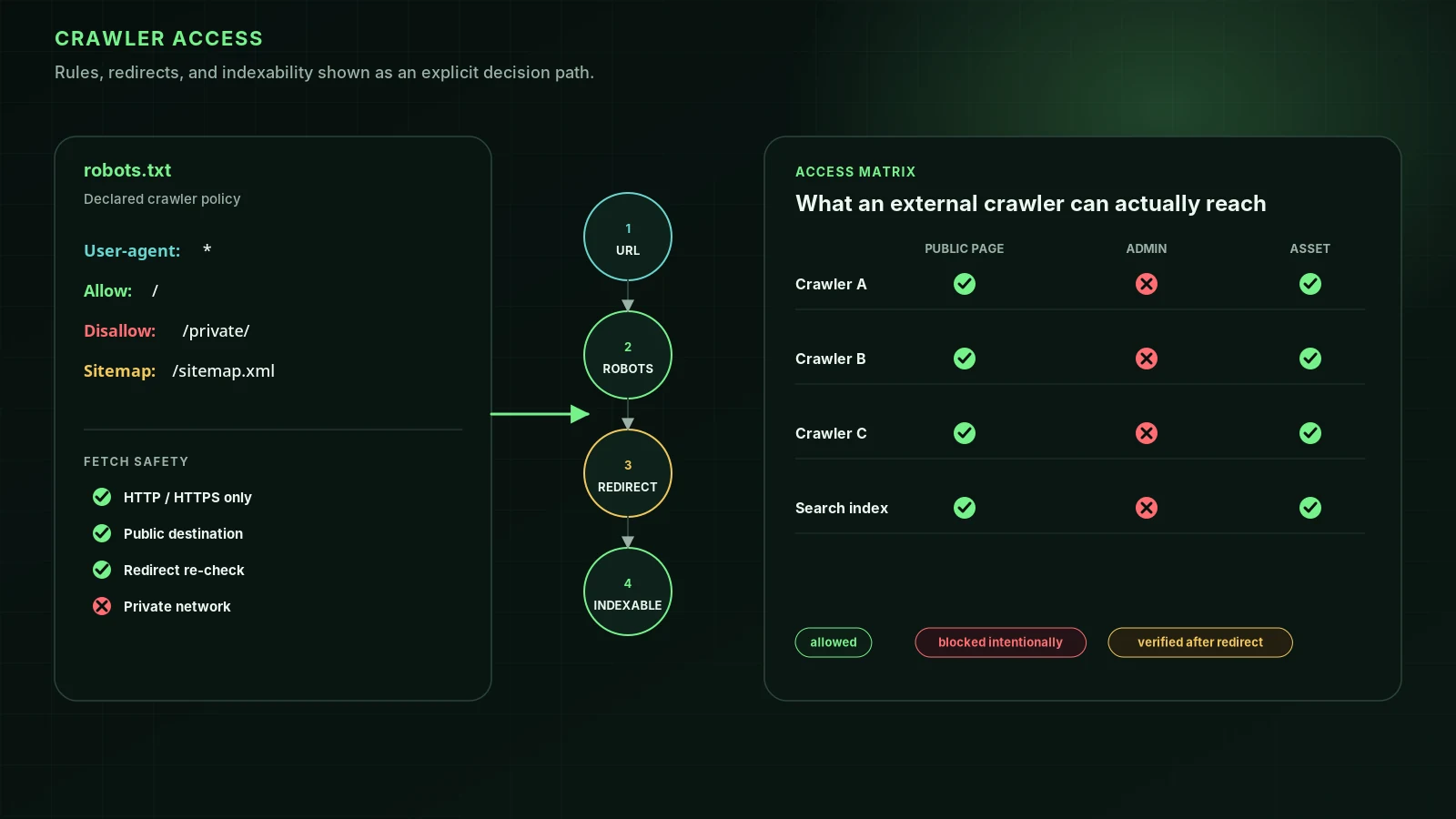
User-agent: PerplexityBot
Allow: /
If your robots.txt already has a User-agent: * group with rules you need, copy them into this group, because a crawler follows only the most specific group that names it. Then check the firewall. Perplexity publishes its crawler’s IP ranges and suggests allowing them; a bot-protection rule that challenges unknown traffic, or a Cloudflare setting that blocks AI crawlers, can refuse PerplexityBot even when robots.txt allows it. Perplexity says it may take up to 24 hours for changes to reach its systems.
Step 2: make your pages readable and quotable
- Put the facts in the HTML. Vercel’s crawler study found none of the major AI crawlers render JavaScript; if your prices or service areas only appear after scripts run, Perplexity probably can’t quote them.
- Answer first. Open each important page with a two- or three-sentence answer to the question the page targets, then the detail. Perplexity quotes passages, and a passage that answers on its own is easier to quote.
- Be specific. Numbers, places, prices, dates and named methods survive summarising; slogans don’t.
- Keep it current, honestly. Ahrefs found AI assistants cite newer content than Google’s organic results do (17 million citations, vendor study). Update facts when they change and show the date; changing only the date isn’t the same thing.
Step 3: read Perplexity’s sources, and get onto them
This is where Perplexity is more useful than any other engine. Ask your customers’ questions (“best [service] in [city]”, “[product] for [use]”, “[competitor] alternatives”), three times each, and copy every numbered source into a sheet. Within an hour you’ll have a ranked list of the pages that decide your category in Perplexity: your competitors’ pages, review sites, directories, “best X” articles and forum threads. Then:
- If your own page appears but you aren’t recommended, it probably doesn’t answer the question as directly as the winners. Compare the first paragraph of theirs with yours.
- If a list or directory appears repeatedly, get onto it with a short, checkable pitch (how to get on “best of” lists).
- If review sites appear, ask genuine customers for reviews on those platforms (reviews and AI recommendations).
- If forum threads appear, read them before you post anything; see Reddit and AI search for what helps and what gets you banned.
Selling products?
Perplexity has shopping features with product cards and checkout for some merchants, and a merchant programme. The programme details change often and its pages block automated reading, so check Perplexity’s own pages before you apply. The groundwork is the same as for any AI shopping surface: complete product pages with prices and availability in the HTML, and accurate product feeds (AI shopping guide).
Step 4: measure it
- Referrals from perplexity.ai in your analytics; GA4’s AI Assistant channel groups them with other assistants (GA4 guide).
- PerplexityBot and Perplexity-User requests in your server or CDN logs: if PerplexityBot never visits, step 1 isn’t done.
- The same question set, monthly, with the sources recorded. Our AI visibility checker, rolling out engine by engine, asks Perplexity with live web search and lists the sites it cites.
To check access for PerplexityBot alongside every other AI crawler in one go, run the [free audit](/). For the other engines, see Gemini, Copilot and Claude.
FAQ
How does Perplexity choose its sources?+
It searches its index for the question, retrieves a set of candidate pages, and writes an answer citing the ones it uses. Perplexity doesn’t publish ranking factors. Its documentation says PerplexityBot exists to surface and link websites in its search results, so being crawlable is the entry ticket; relevance, directness and freshness decide the rest, on the available evidence.
Should I allow PerplexityBot in robots.txt?+
If you want to appear in Perplexity, yes. Perplexity says PerplexityBot is designed to surface and link websites in its search results and is not used to crawl content for AI foundation models. Perplexity-User, which fetches a page when a user asks about it, generally ignores robots.txt rules because a person requested the fetch.
Can I pay to be featured on Perplexity?+
Not in the answers. Perplexity runs separate programmes for merchants and publishers, but a place in the cited sources isn’t for sale, and no one can guarantee you one.
How do I see if Perplexity sends me traffic?+
Perplexity visits show as referrals from perplexity.ai, and GA4’s AI Assistant channel groups them with other assistants. Pair that with a monthly check of your buyers’ questions in Perplexity, noting which sources it cites.
Sources
- Perplexity crawlers — Perplexity
- PerplexityBot IP ranges (JSON) — Perplexity
- Perplexity is using stealth, undeclared crawlers to evade website no-crawl directives — Cloudflare Blog (2025-08-04)
- Shop like a pro: Perplexity’s shopping features — Perplexity
- Default channel group: AI Assistant channel — Google Analytics Help (2026-05-13)
- Do AI assistants prefer to cite fresh content? (17M citations) — vendor study — Ahrefs (2025-07-28)
- The rise of the AI crawler (JavaScript rendering) — Vercel (2024-12-17)
- Accountable mixed-use AI crawlers (Disallow AI Training vs Block) — Cloudflare Blog (2026-09-15)
Run it on your domain
See this lens as a finding, not a lecture.
Free technical GEO audit. Evidence-traced scores and an LLM-ready export. See your score with no login.
Audit your website