Strategy 12 min read
SEO in Content Writing: How to Write Pages That Rank on Google and Get Quoted by AI
Good SEO writing starts with the reader, not the keyword. Google publishes what it rewards, what it treats as spam and what it thinks of AI-generated text. This guide turns that guidance into a way to write, brief and judge content.

Founder, SEO·AEO·GEO
Builds SEO·AEO·GEO and writes the crawler, schema, and citation research published here.
Key takeaways
- Google says its automated ranking systems are designed to prioritize helpful, reliable information created to benefit people, and it publishes the questions it uses to describe that kind of content.
- AI-written content isn't banned. What breaks the rules is automation used mainly to manipulate rankings, or many pages generated without adding value, which Google calls scaled content abuse.
- Google says it has no preferred word count, no ideal page length for its AI features, and no need to cut content into tiny pieces for AI. Clear headings, paragraphs and real text are what it asks for.
- Put the words your readers search with in the title, the main heading and the opening paragraph, once and naturally. Repeating them over and over is keyword stuffing, a spam policy violation.
- Judge a writer or an SEO content writing service on subject knowledge, a source for every claim, a real byline and a fact-check of any AI-assisted draft, not on word counts or keyword density.
SEO in content writing means writing pages that people searching can find, trust and use, and that search engines and AI answers can read, understand and quote. In practice it comes down to three things: answering the reader's real question better than the other results do, using the words people search with in the places that count, and structuring the page so its answers are easy to lift out and cite.
None of it needs guesswork. Google publishes guidance on helpful content, a policy on AI-generated content, and spam policies that say what goes too far. This guide quotes them directly, then turns them into a brief you can hand to a writer and a checklist for judging an SEO content writing service, an SEO copywriting service or an agency.
What Google rewards: people-first content
Google's guide to helpful content starts from one principle: its "automated ranking systems are designed to prioritize helpful, reliable information that's created to benefit people", rather than content made to gain rankings. It then lists self-assessment questions that describe such content. These are the ones that matter most to a writer, with what each means at the keyboard:
| Google's question | What it means when you write |
|---|---|
| "Does the content provide original information, reporting, research, or analysis?" | Add something the current results lack: your own data, a worked example, a photo, a price you paid, a test you ran. |
| "Does the content provide insightful analysis or interesting information that is beyond the obvious?" | Skip the paragraph every competing page already has, and start where they stop. |
| "Does the main heading or page title provide a descriptive, helpful summary of the content?" | Write a title that says what the page answers, and a main heading that keeps the same promise. |
| "Is this content written or reviewed by an expert or enthusiast who demonstrably knows the topic well?" | Have someone who has done the work write it or check it, and say who they are on the page. |
| "After reading your content, will someone leave feeling they've learned enough about a topic to help achieve their goal?" | Finish each section with the reader able to act: a number, a step or a decision. |
Warning signs of search-engine-first writing
The same guide lists questions that suggest content was made for search engines first. Five of them are worth checking against any writing brief you send or receive:
- "Are you writing to a particular word count because you've heard or read that Google has a preferred word count?" Google's own answer follows in brackets: "No, we don't."
- "Are you using extensive automation to produce content on many topics?"
- "Are you mainly summarizing what others have to say without adding much value?"
- "Are you producing lots of content on many different topics in hopes that some of it might perform well in search results?"
- "Are you changing the date of pages to make them seem fresh when the content has not substantially changed?"
Google's policy on AI-generated content, in its own words
Google doesn't ban content written with AI. It judges the result and the reason for making it. In its February 2023 guidance, written by Danny Sullivan and Chris Nelson for the Google Search Quality team, the key line is:
Our focus on the quality of content, rather than how content is produced, is a useful guide that has helped us deliver reliable, high quality results to users for years.
The same post says "Appropriate use of AI or automation is not against our guidelines", and draws the line at using "automation—including AI—to generate content with the primary purpose of manipulating ranking in search results", which it calls a violation of the spam policies. Google's spam policies give the concrete case under scaled content abuse: "Using generative AI tools or other similar tools to generate many pages without adding value for users".
Google's current page on generative AI content turns that into practical rules for anyone who writes with AI:
- Fact-check everything. Google: "It is critical to manually factcheck and review all AI-generated content for accuracy and trustworthiness before publishing", because generative models "predict a likely sequence of words" rather than retrieve facts.
- Review the metadata as well. Google says the same check applies to title elements, meta descriptions, structured data and image alt text, all of which can appear in search results.
- Disclosure is a suggestion for web pages. Google says "consider adding information on how your content was created" where readers might wonder how it was made; it isn't a blanket labelling rule.
- Product data is the exception. In Google Merchant Center, AI-generated titles and descriptions "must be specified separately and labeled as AI-generated", and AI-generated images need IPTC DigitalSourceType TrainedAlgorithmicMedia metadata.
- Never invent the author. Google's helpful content guide says fabricating creator profiles, for example with AI-generated headshots or made-up names, "is a form of deception".
Keywords: where they go, and where they don't
Google's SEO Starter Guide tells writers to "think about the words that a user might search for to find a piece of your content", and adds that its language matching is good enough that you don't need every variant. Find the phrase people use most, then put it where it does the work:
- The title element, near the start, as a clear summary rather than a list of terms.
- The H1, keeping the title's promise in slightly different words.
- The opening paragraph, ideally in the sentence that answers the question.
- One or two subheadings, where a related phrase is the natural name for that section.
- Image alt text, only where it honestly describes the image.
Then stop. The starter guide says that excessively repeating the same words, even in variations, "is tiring for users", and keyword stuffing is one of Google's spam policies. Its list of things not to worry about includes the keywords meta tag ("Google Search doesn't use the keywords meta tag"), length ("The length of the content alone doesn't matter for ranking purposes") and the order of headings. We found no keyword density target anywhere in Google's documentation.
Structure that search engines and AI answers can extract
Google's guide to its generative AI features is blunt about what isn't required: "There's no requirement to break your content into tiny pieces for AI to better understand it", "There's no ideal page length", and "You don't need to write in a specific way just for generative AI search." In its words, optimizing for generative AI search "is optimizing for the search experience, and thus still SEO."
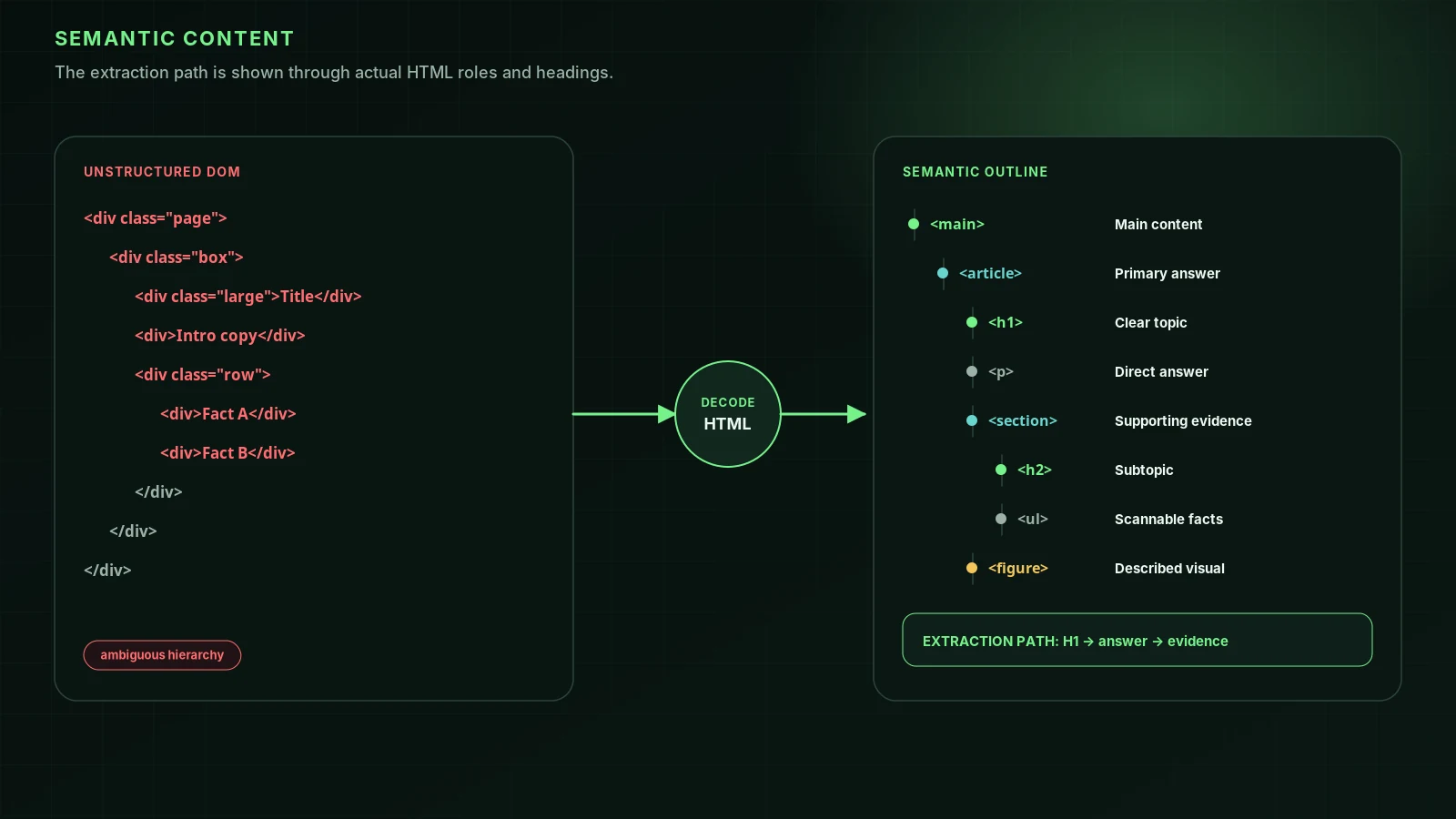
What it does ask for is ordinary good structure: people appreciate pages "organized by paragraphs and sections, along with headings that provide a clear structure to navigate content." Google's page on AI features adds that important content should be available in textual form, and that structured data should match the visible text. A page also has to be indexed and eligible to show with a snippet before it can get into AI Overviews or AI Mode as a supporting link.
Within those rules, a few habits make any page easier for a search system, an AI answer or a skimming reader to quote accurately. These are our recommendations, not Google requirements:
- Answer the main question within the first two or three sentences, then explain and qualify.
- Give every section a single job and a heading that names it, so a passage still makes sense when it's read on its own.
- State each fact with its source and date in the same sentence: who measured it, and when.
- Put comparisons in a table and steps in a numbered list instead of burying them in paragraphs.
- Keep the words in the HTML. Some AI crawlers aren't known to run JavaScript, so text that appears only after scripts run may never be seen.
Google also warns against "commodity content" built on common knowledge that "could originate from anyone", and recommends unique expert or first-hand takes that go beyond it. That's the best reason to write from your own experience: it's the one part of the page no other source can supply, which is what makes it worth citing.
Titles, headings and meta descriptions
Google's starter guide says a good title is "unique to the page, clear and concise, and accurately describes the contents of the page". Its title-link guidance adds: avoid keyword stuffing, avoid repeated or boilerplate titles, and brand titles concisely. Google can build the title link it shows from the title element, the main visible heading, other headings or anchor text, so keep the title and the H1 telling the same story.
A meta description is a suggestion, not a guarantee. Google says snippets "are primarily created from the page content itself", and that it uses the meta description when that gives searchers a more accurate summary. Write one per page: a short, specific description of what the page answers, never a string of keywords.
Who wrote it: bylines, expertise and trust
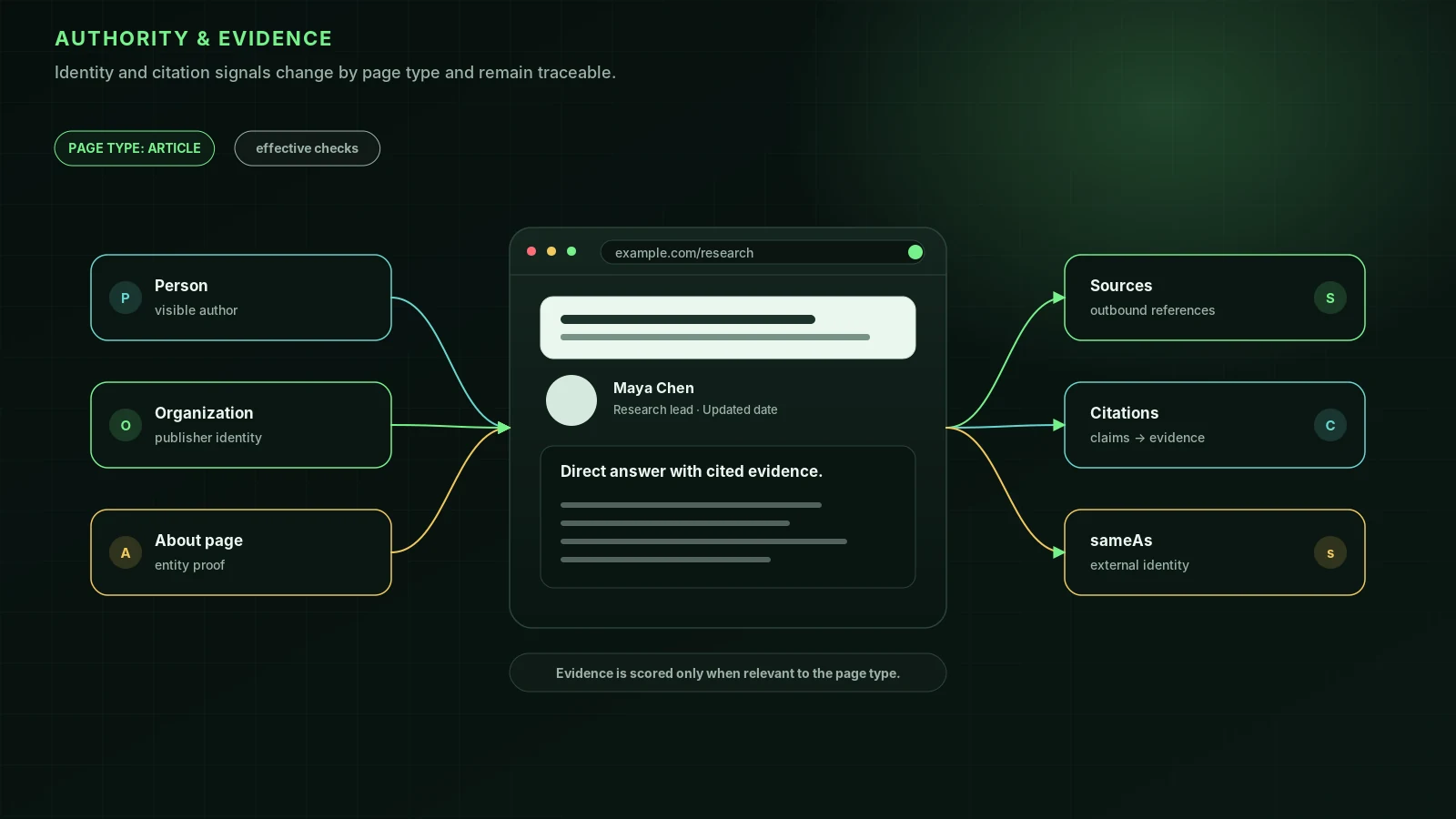
Google's helpful content guide asks three things of every page: who created it, how, and why. On the first it says: "We strongly encourage adding accurate authorship information, such as bylines to content where readers might expect it." Of the four parts of E-E-A-T (experience, expertise, authoritativeness and trustworthiness) it says "trust is most important". The starter guide adds that E-E-A-T itself is not a ranking factor, so treat it as a description of what readers need before they believe a page.
For a writer, that means a real name, a line on why they know the subject and a link to an author page, plus a visible date that changes only when the content does. The markup side is covered in authorship and sameAs.
How to brief an SEO content writer
Most weak SEO content starts with a weak brief: a keyword and a word count. A brief that produces a page worth ranking answers these before anyone starts writing:
| Brief field | What to give the writer |
|---|---|
| Reader and question | Who is searching, what they're trying to do, and the exact question the page must answer first |
| Main phrase and variants | The words people search with, from Search Console or a keyword tool, and where each belongs: title, H1, opening |
| What the results miss | A note on the current top results: what they all say, and what none of them covers |
| Your evidence | Data, examples, photos, quotes, prices or test results that only your business has |
| Sources | Primary sources for each factual claim: official documentation, standards, original studies |
| Outline | A proposed H1 and section headings, and where a table or a list would help the reader |
| Next step | Where the reader should go after the page, and the internal links to add |
| Review | Who checks the facts and who signs off, by name |
How to judge an SEO content writing service or copywriting agency
Whether you hire a freelancer, an SEO content writing service, an SEO copywriting service or a full agency, ask for evidence rather than promises:
- Samples in your field with the live URL, so you can see each page as published and check its claims.
- How they research: which sources they use, and how a claim is checked before it's published.
- Whether and how they use AI, and who fact-checks the draft. Google expects AI-assisted content to be reviewed for accuracy before it goes live.
- Whose name goes on the byline, and whether that person really wrote or reviewed the piece.
- What they need from you: interviews, data, product access. A writer who needs nothing from you can only repeat what's already online.
- How they measure success: Search Console impressions and clicks for the page's queries, and what readers do next, rather than words delivered.
Red flags in SEO writing services
- Packages priced and sold mainly on word count. Google says it has no preferred word count.
- A keyword density target, or a list of phrases to repeat a set number of times per page.
- Hundreds of articles a month on subjects outside your expertise, produced mostly by automation.
- Guaranteed rankings. Google's page on hiring an SEO says "No one can guarantee a #1 ranking on Google."
- Stock or invented author profiles in place of a real, named writer or reviewer.
- No sources, or sources that turn out to be other blog posts summarizing the same thing.
Content writing service, copywriting service or agency?
| SEO content writing service | SEO copywriting service | SEO content agency | |
|---|---|---|---|
| Usually writes | Guides, articles and blog posts that answer questions | Service, product and landing pages that persuade | Both, plus the plan, the briefs and the editing |
| Judge it on | Accuracy, depth, sources and search traffic to the pages | Clarity, proof, and enquiries or sales from the page | Whether the plan, the writing and the results hang together |
| Ask for | A sample guide with sources and a named expert reviewer | A rewritten page and what changed in enquiries afterwards | A sample brief, its editorial checklist and a named editor |
Agencies that resell writing under their own name, sometimes called white-label content writing, face the same tests plus one more: they answer for work they didn't write. See white-label SEO for vetting a partner, SEO copywriting for the craft itself, and SEO blogging for a blog workflow.
Check a draft before it goes live
- The first paragraph answers the question and uses the main phrase once.
- The title and the H1 make the same promise, and the title is short enough to show in full on a results page.
- Every number, date and quotation has a source you could show a reader.
- Each section stands on its own under a heading that names what it answers.
- The author is a real, named person, and the date shows when the content last changed.
- Images have alt text that describes them, and no important text is inside an image.
- The page links to related pages on your site and to its primary sources.
FAQ
What is SEO in content writing?+
Writing pages so that people searching can find, trust and use them, and so that search engines and AI answers can read and quote them. It means answering the real question, using the words searchers use in the title, main heading and opening, and giving the page clear headings and sources.
What does an SEO content writing service do?+
It researches what your customers search for, then writes articles, guides or pages that answer those searches, with titles, headings and internal links set up for search. A good one checks facts, cites primary sources and works from your expertise and data instead of rewriting what already ranks.
What should an SEO copywriting service include?+
Research into the words buyers use, a page structure that answers their questions and objections, persuasive copy backed by proof you can stand behind, a title and meta description for each page, and a fact check. Copywriting usually means service, product and landing pages rather than articles.
Is AI-generated content bad for SEO?+
Not by itself. Google says appropriate use of AI or automation is not against its guidelines, and that it focuses on the quality of content rather than how it is produced. It becomes spam when automation is used mainly to manipulate rankings, or to generate many pages that add no value.
Do I have to label AI-generated content?+
Not on ordinary web pages. Google suggests adding a note on how content was created where readers would reasonably expect one. Product data is different: in Google Merchant Center, AI-generated titles and descriptions must be labelled as AI-generated.
How long should SEO content be?+
As long as the answer needs. Google says it has no preferred word count, that the length of content alone doesn't matter for ranking, and that there's no ideal page length for its generative AI features.
How many times should I use a keyword?+
There's no target number. Use the main phrase in the title, the H1 and the first paragraph where it reads naturally, and related words where they fit. Google calls excessive repetition keyword stuffing and lists it in its spam policies.
Do I need to write differently for AI search?+
Google says no: you don't need to write in a specific way for generative AI search, or split pages into small chunks. Direct answers, clear headings, text in the HTML and a source for each claim serve readers and AI answers alike.
How do I choose the best SEO copywriting services?+
We don't rank providers. Compare them on live samples in your field, how they research and fact-check, who signs the byline, how they use AI and how they measure results. Rule out anyone who guarantees rankings or sells mainly on word count.
Sources
- Creating helpful, reliable, people-first content — Google Search Central (2026-10-05)
- Google Search's guidance on generative AI content on your website — Google Search Central (2026-10-01)
- Google Search's guidance about AI-generated content (Danny Sullivan and Chris Nelson) — Google Search Central Blog (2023-02-08)
- Spam policies for Google web search — Google Search Central (2026-08-28)
- SEO Starter Guide — Google Search Central (2025-12-10)
- Google's Guide to Optimizing for Generative AI Features on Google Search — Google Search Central (2026-07-10)
- AI features and your website — Google Search Central (2025-12-10)
- Influencing title links in Google Search — Google Search Central (2025-12-10)
- How to write meta descriptions (snippets) — Google Search Central (2026-04-20)
- Do you need an SEO? — Google Search Central (2026-06-05)
Run it on your domain
See this lens as a finding, not a lecture.
Free technical GEO audit. Evidence-traced scores and an LLM-ready export. See your score with no login.
Audit your website