Strategy 9 min read
SEO vs AEO vs GEO: What's Actually Different, and What Isn't
Three acronyms, one question: what do you actually have to do differently? Less than the hype suggests, and more than “it's all just SEO”. Here is the line, with sources.

Founder, SEO·AEO·GEO
Builds SEO·AEO·GEO and writes the crawler, schema, and citation research published here.
Key takeaways
- SEO earns a ranked link, AEO earns being the extracted answer, and GEO earns a citation or mention inside an AI-generated answer.
- For Google's AI Overviews and AI Mode, Google says the work is SEO: no special files, markup or chunking are needed beyond normal Search eligibility.
- For ChatGPT, Claude and Perplexity, three things genuinely differ: their own crawlers, no JavaScript rendering, and firewalls that often block them by accident.
- Off-site signals, what other sites, reviewers and communities say about you, matter more in AI answers than any on-page tweak.
- Measure each separately: Search Console for clicks and AI impressions, Bing for AI citations, and sampled prompts for ChatGPT, Claude and Perplexity.
SEO, AEO and GEO aim at different outcomes on mostly the same foundations. SEO is about ranking a page in search results. AEO, answer engine optimization, is about your content being the answer an engine extracts and shows. GEO, generative engine optimization, is about being retrieved and cited when an AI system writes a new answer. For Google's own AI features, Google says the work is simply SEO. For ChatGPT, Claude and Perplexity, a handful of technical things really are different, and they're worth knowing because they fail silently.
The three terms, defined plainly
| SEO | AEO | GEO | |
|---|---|---|---|
| Goal | A ranked link people click | Being the extracted answer | Being cited or mentioned in a generated answer |
| Where it shows | Search results pages | Featured snippets, voice assistants, quoted passages | ChatGPT search, Perplexity, Claude, Google AI Overviews and AI Mode |
| Success looks like | Rankings, clicks | Your sentence shown as the answer | Your page cited, your brand named |
| Measured with | Search Console, analytics | Search Console, snippet tracking | Search Console and Bing AI reports, sampled prompts |
“Generative engine optimization” comes from a 2023 research paper that tested how changes to a source affect its visibility in AI-written answers (Aggarwal et al.). “Answer engine optimization” is older and was coined for featured snippets and voice search. In practice the industry now uses AEO and GEO almost interchangeably for “show up in AI answers”. Searches for both rose sharply from near zero and levelled off in early 2026, with GEO searched roughly twice as often as AEO, according to a third-party keyword analysis.
What's the same: most of it
Google is explicit. Its guide to its generative AI features says optimizing for them is still SEO, and that you don't need an llms.txt file, special schema.org markup, AI-specific files or content chunking to appear in AI Overviews or AI Mode (Google). A page has to be indexed and eligible to show a snippet; beyond that, the same ranking and quality systems apply (Google).
The foundations carry over to every AI system too:
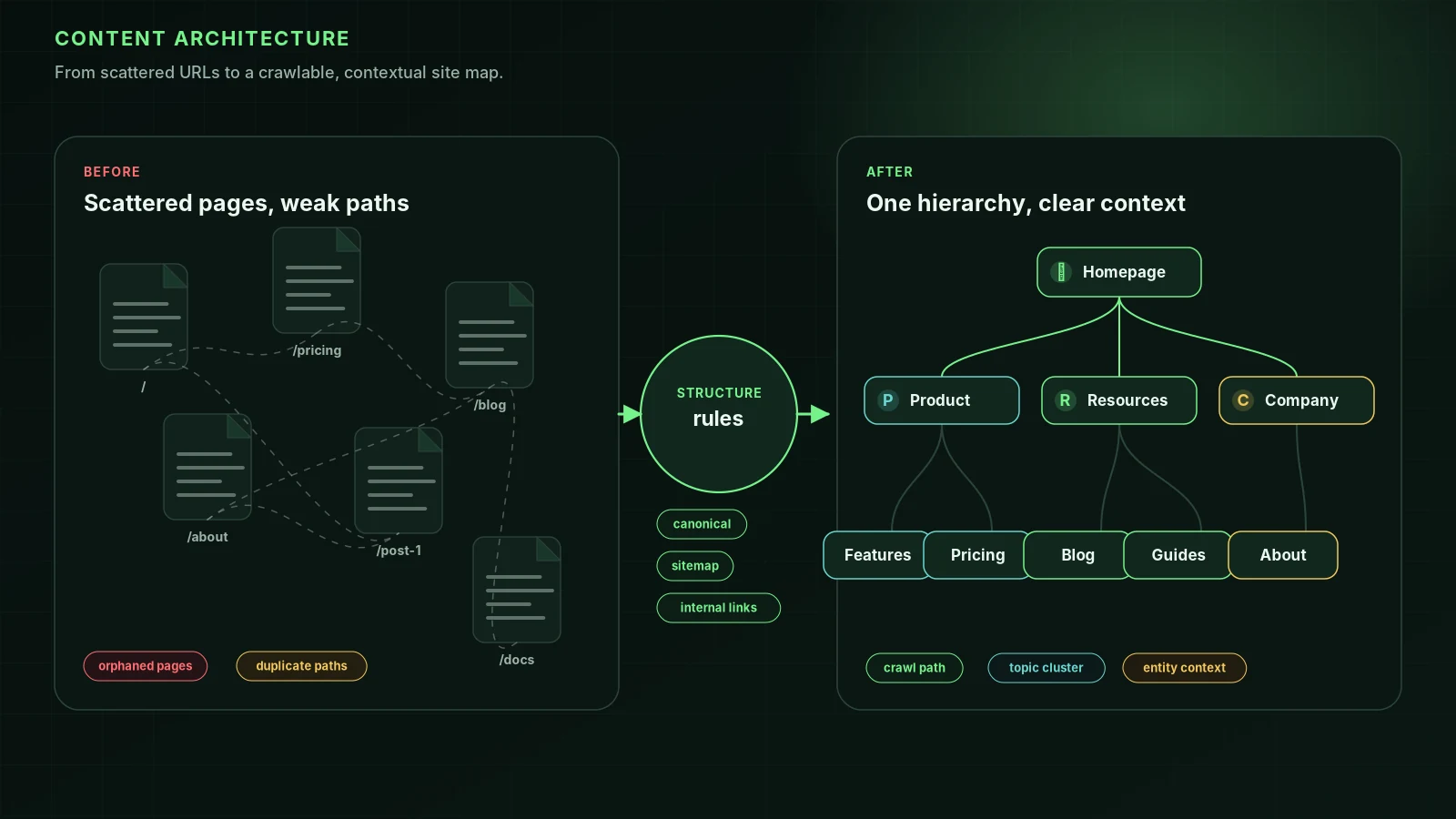
- Pages that can be fetched, indexed and given a sensible canonical URL.
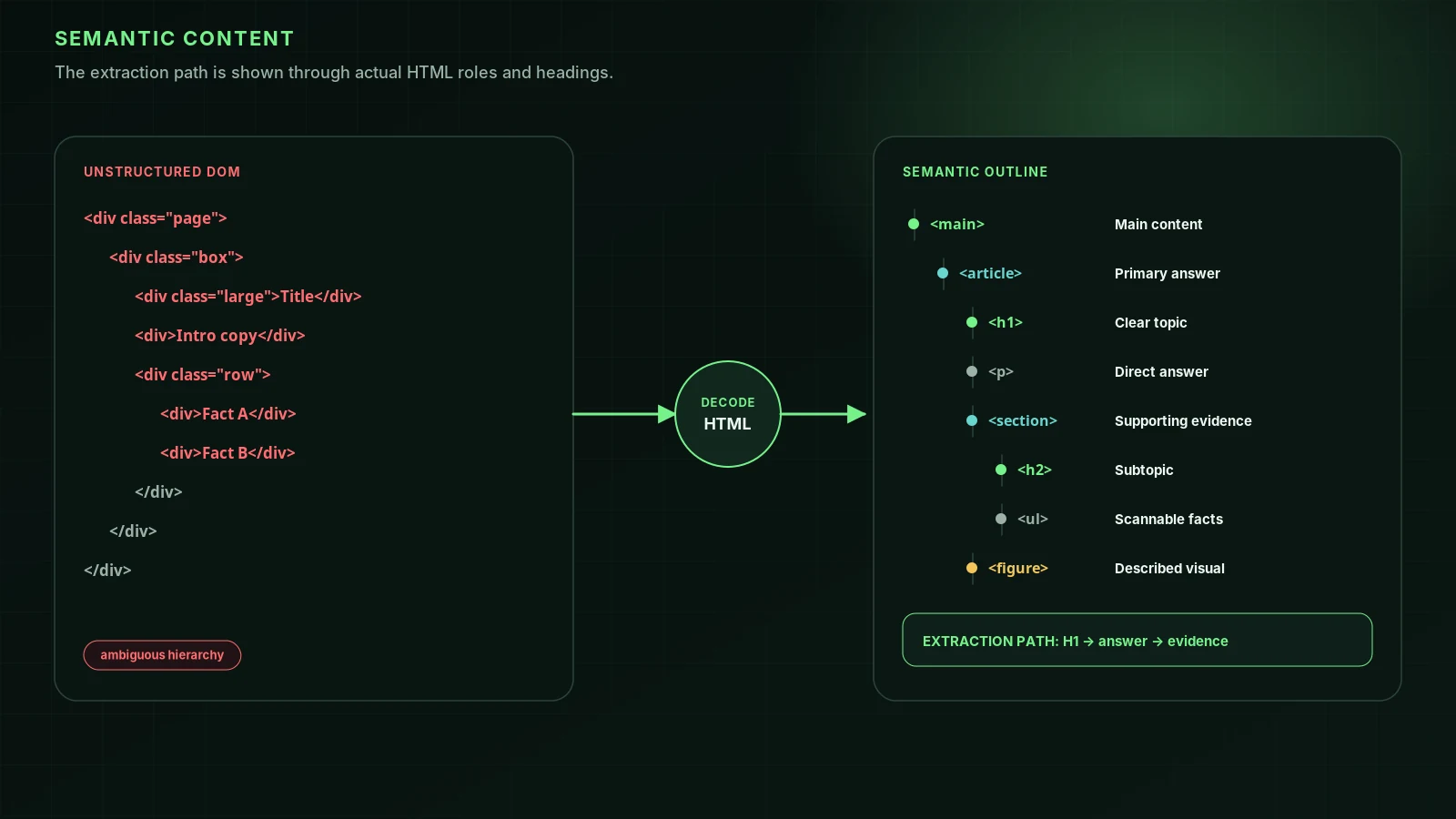
- Content that answers the question clearly, near the top, in plain sentences.
- Specific facts with sources, and a visible author and date where they matter.
- A clear identity: who runs the site, how to reach them, and consistent naming across the web.
If you do these well for SEO, you've done most of AEO and GEO already. That's why tools and agencies selling “GEO” as a separate discipline should be able to show you exactly which additional work they do. See how to choose a GEO audit tool.
What's actually different for ChatGPT, Claude and Perplexity
Three technical differences are real, and each one can make a page invisible to AI assistants while it ranks perfectly well on Google.
1. Their own crawlers, with separate rules
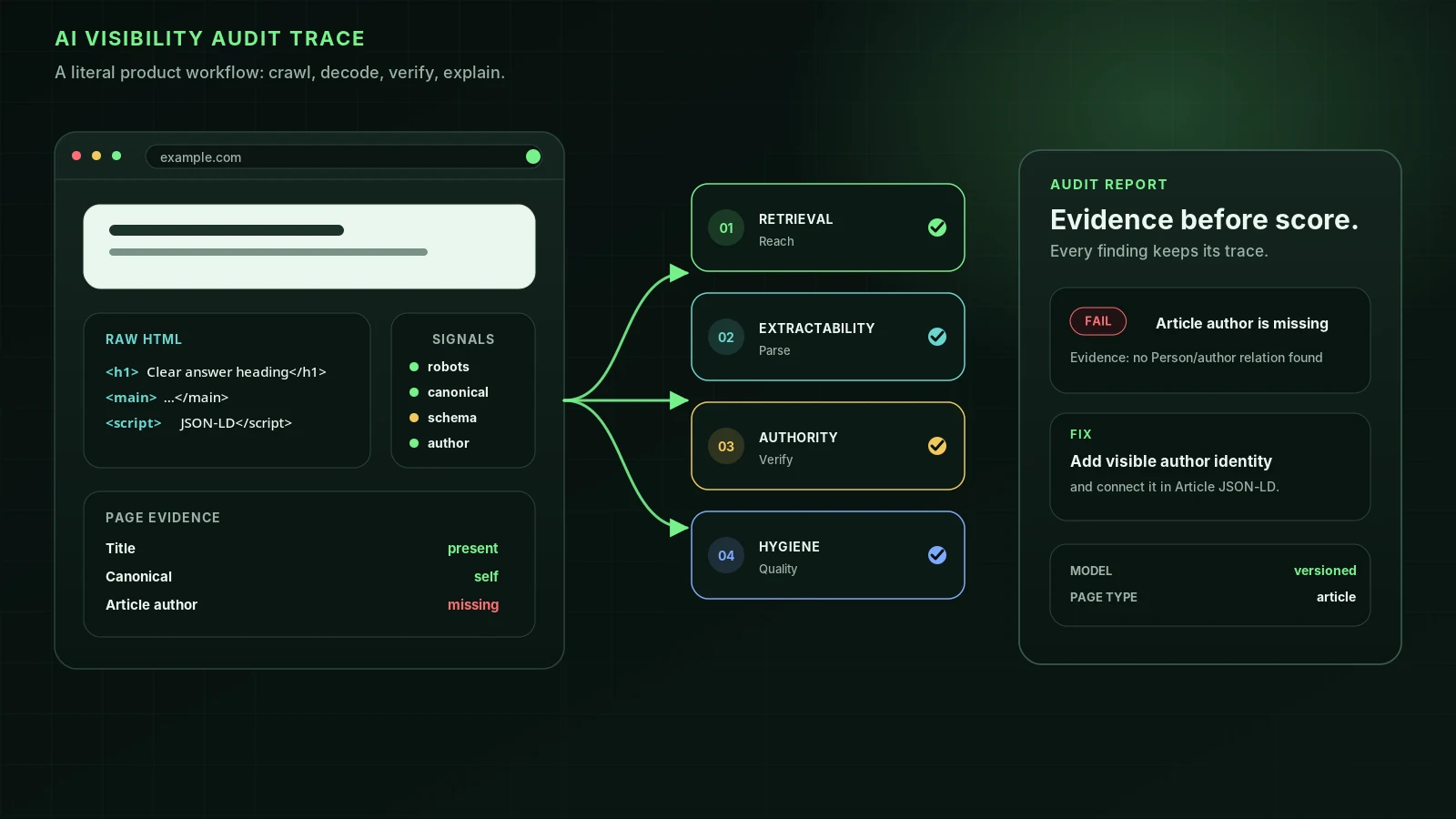
Each AI company runs separate crawlers for search and for training. OpenAI's OAI-SearchBot decides ChatGPT search inclusion while GPTBot collects training data (OpenAI); Anthropic splits Claude-SearchBot from ClaudeBot (Anthropic); Perplexity runs PerplexityBot (Perplexity). A robots.txt written years ago for Googlebot may say nothing about them, or block them by accident. The rules are in GPTBot vs OAI-SearchBot.
2. No JavaScript
Googlebot renders JavaScript. The crawlers behind ChatGPT, Claude and Perplexity read the HTML your server sends, and an analysis of real crawler traffic found no sign that OpenAI's or Anthropic's crawlers execute JavaScript (Vercel). A page whose text is built in the browser can rank on Google and be nearly empty to an AI assistant. Can ChatGPT, Claude and Perplexity read your website?
3. Firewalls that block them
CDNs and bot-protection products often treat AI crawlers differently from Googlebot. In our test of the top 5,000 sites, 2.9% of the sites whose robots.txt allowed the AI search crawlers still refused them at the edge in a way aimed at AI crawlers by name. Nothing on the site looks different to a person, which is why this is the most common silent GEO failure. Cloudflare users should check their AI crawl settings.
The biggest difference isn't on your site
AI answers lean heavily on what other sources say. When ChatGPT or Perplexity recommends a business, it is usually summarising reviews, comparison articles, directories, forums and Wikipedia rather than quoting the business's own homepage. That makes off-site presence, being mentioned and reviewed in the places those engines cite, the strongest lever for being recommended, and it's one no on-page audit can fix for you. We cover it in why ChatGPT recommends your competitor and how ChatGPT chooses its sources.
How to measure each one
- SEO: Search Console and your analytics, as always.
- Google AI features: Search Console's generative AI performance report shows impressions by page, country and device for every verified site, since 31 August 2026 (Google). Setup guide.
- Copilot and Bing's AI answers: Bing Webmaster Tools' AI Performance report shows citations and sampled grounding queries (Bing). Setup guide.
- ChatGPT, Claude and Perplexity: no first-party report exists, so sample the questions your customers ask, repeat them, and track the trend, plus AI referral traffic in analytics. How to measure AI visibility.
A one-page checklist for all three
- The page is indexable, has the right canonical and isn't blocked from showing snippets.
- robots.txt allows OAI-SearchBot, Claude-SearchBot, PerplexityBot, Googlebot and Bingbot; decide training crawlers separately.
- Your CDN or firewall doesn't challenge those crawlers.
- The main content is in the server's HTML, not only after JavaScript runs.
- The answer is stated near the top, with specific facts and sources.
- Author, dates, About and Contact pages make the source identifiable.
- You're present and accurately described on the review sites, directories and communities in your field.
The first six are checkable from outside in under a minute. Run a free SEO·AEO·GEO audit on your most important page to see where it stands on each, or use the GEO check and AEO check for the AI-specific parts.
FAQ
Is GEO just SEO?+
For Google's AI features, Google says yes: optimizing for them is still SEO. For other AI assistants the foundations are the same, but their crawlers, their lack of JavaScript rendering and how often firewalls block them make a few technical checks different.
What is the difference between AEO and GEO?+
AEO, answer engine optimization, is about your content being the answer an engine extracts: a featured snippet, a voice answer or a quoted passage. GEO, generative engine optimization, is about being retrieved and cited by systems that write a new answer, like ChatGPT search or Perplexity. They overlap heavily, and many people use the terms interchangeably.
Do I need a separate GEO strategy?+
Not a separate strategy, but a few extra checks: that AI search crawlers can reach your pages, that the content is in the server's HTML, and that you're mentioned on the sites those engines cite. Everything else is good SEO and clear writing.
Which matters more in 2026, SEO or GEO?+
Search still sends most of the traffic, and AI features in Google are built on Search. Treat AI visibility as an extension of SEO, not a replacement: fix the foundations once and they serve both.
Where does AIO fit in?+
AIO usually means AI optimization or AI Overviews optimization. It's the same idea under another name: making sure AI systems can find, read and cite you.
Sources
- Google's guide to optimizing for generative AI features on Google Search — Google Search Central (2026-07-10)
- AI features and your website — Google Search Central
- GEO: Generative Engine Optimization (Aggarwal et al., KDD 2024) — arXiv
- Overview of OpenAI Crawlers — OpenAI
- Does Anthropic crawl data from the web, and how can site owners block the crawler? — Anthropic
- Perplexity Crawlers — Perplexity
- The rise of the AI crawler — Vercel and MERJ (2024-12-17)
- Search Console generative AI performance report — Google Search Console Help
- AI Performance — Bing Webmaster Tools
- State of AI Search — Rankability (third-party keyword analysis) (2026-09-23)
Run it on your domain
See this lens as a finding, not a lecture.
Free technical GEO audit. Evidence-traced scores, LLM-ready export, no login.
Audit your website