Strategy 11 min read
What Is SEO? Search Engine Optimization Explained in Plain English
SEO is the work of making your pages easy for search engines to find, understand and show. Here is how Google actually ranks pages, what you can control, what Google says to ignore, and where AI search fits.

Founder, SEO·AEO·GEO
Builds SEO·AEO·GEO and writes the crawler, schema, and citation research published here.
Key takeaways
- SEO stands for search engine optimization. Google defines it as helping search engines understand your content and helping people decide whether to visit your site from the results.
- Google works in three stages: crawling (finding pages), indexing (storing and understanding them) and serving (choosing which ones to show for a query). SEO is making sure your pages get through all three.
- You can't pay Google to rank higher or to be crawled more often. Ads are separate and labelled as ads.
- The work splits into technical SEO (can it be crawled and indexed), on-page SEO (is the page clear and useful) and off-page SEO (do other sites mention and link to you).
- AI search uses the same foundations. Google says AI Overviews and AI Mode need nothing beyond normal Search eligibility; ChatGPT, Claude and Perplexity also need their own crawlers to be allowed in.
SEO stands for search engine optimization. It's the work of making your website easy for search engines to find, understand and show to people who are searching for what you offer.
Google's own definition is short: SEO is about helping search engines understand your content, and helping users find your site and decide whether to visit it from the results. Nothing in it is about tricking anyone. The rest of this guide explains how that works in practice.
How Google Search works, in three stages
Google describes Search as three stages. A page has to get through each one before it can bring you a visitor.
| Stage | What Google does | What can go wrong |
|---|---|---|
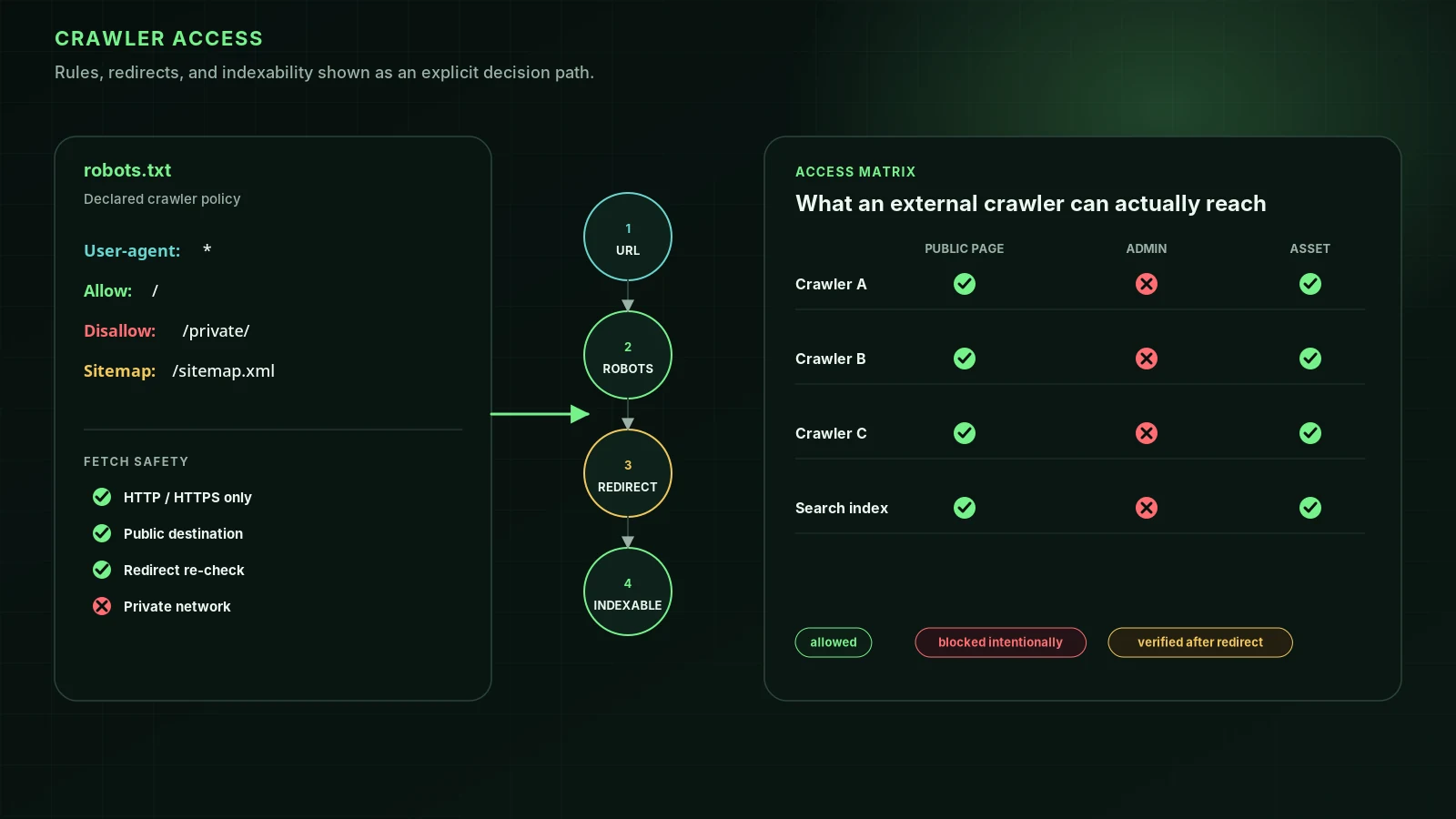
| 1. Crawling | Automated programs called crawlers (Googlebot) download text, images and video from pages they find, mostly by following links. | robots.txt blocks the page, a firewall turns the crawler away, or no other page links to it. |
| 2. Indexing | Google analyzes the page and stores it in the Google index. | A noindex tag, a canonical pointing elsewhere, duplicate content, or text that only appears after JavaScript runs and fails. |
| 3. Serving | For each search, Google returns the indexed pages it judges most relevant and useful. | The page doesn't answer the question as well as other pages do, or doesn't use the words people search with. |
Google is clear that money doesn't enter into this: it doesn't accept payment to crawl a site more often or to rank it higher. Paid ads exist, but they're sold separately and labelled as ads.
The three parts of SEO
SEO work is usually split into three areas. They map loosely onto the three stages above.
Technical SEO: can the page be crawled and indexed?
- The page returns a 200 status, not a 404 or a soft 404.
- robots.txt allows the crawlers you want, and no noindex tag is hiding the page.
- The canonical tag points at the page itself (or at the version you want to rank).
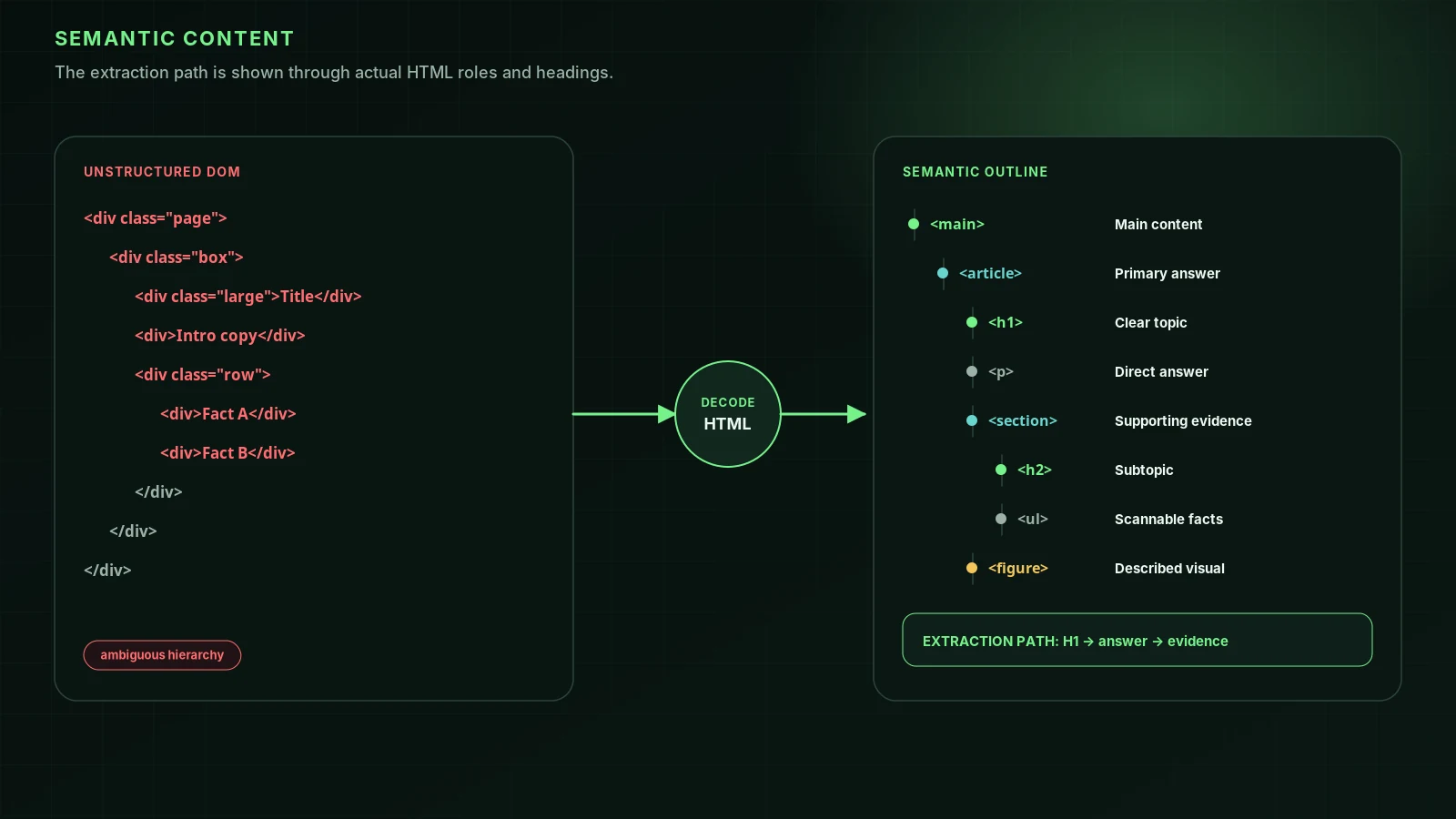
- The main text is in the HTML the server sends, not only added later by JavaScript.
- There's an XML sitemap, listed in robots.txt, and the site uses HTTPS.
- Pages load quickly and work on a phone.
More detail: technical SEO, explained and the full technical SEO checklist.
On-page SEO: is the page clear and useful?
- A unique title tag that says what the page is, in the words people search with.
- A meta description that summarizes the page; Google may show it as the snippet.
- One clear H1 and headings that outline the content.
- Content that answers the question fully, written for people, with facts you can back up.
- Descriptive links to related pages on your site, and alt text on meaningful images.
Off-page SEO: does the rest of the web vouch for you?
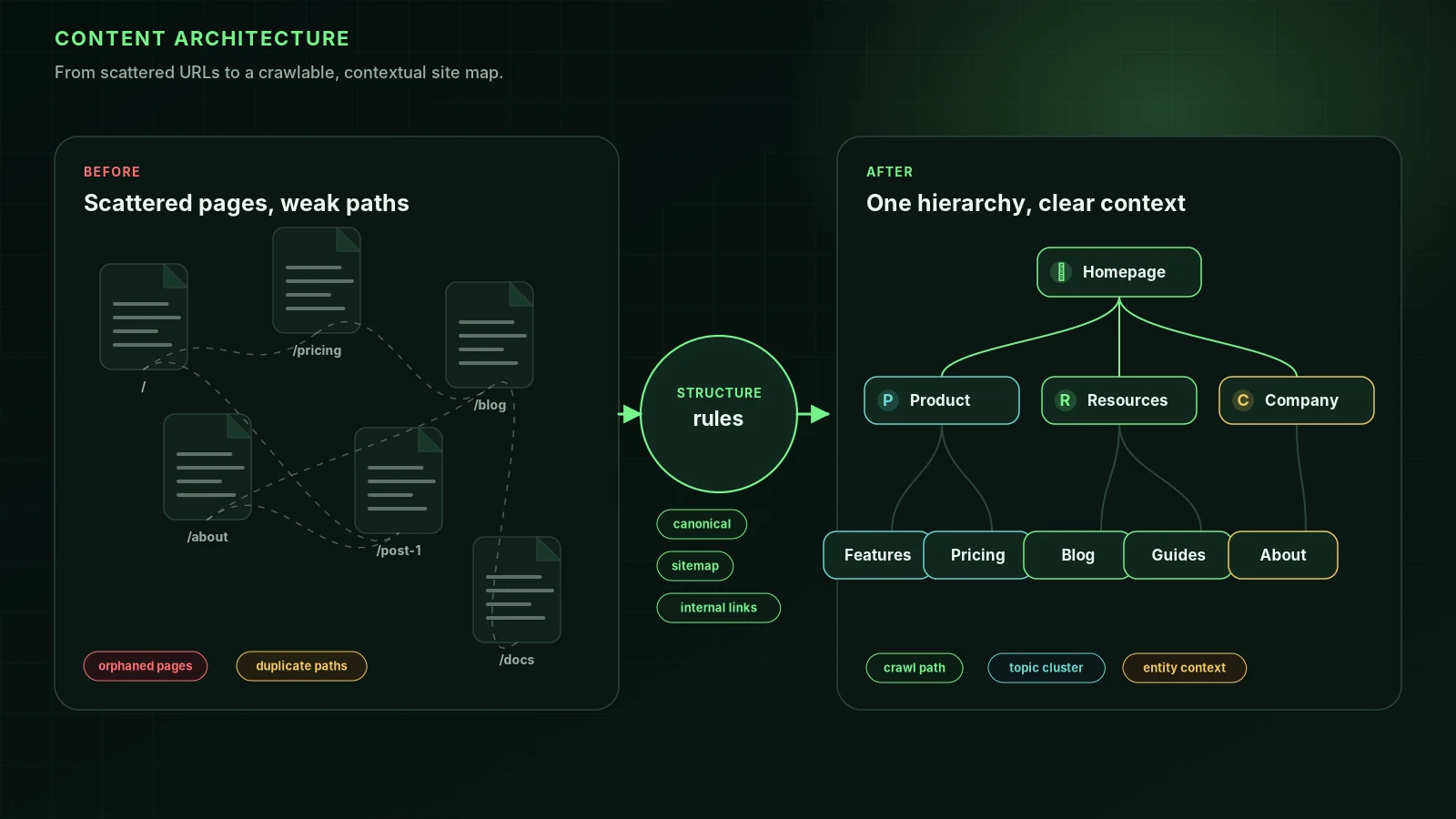
Links from other sites help Google discover your pages and judge their importance. PageRank, Google's original link algorithm, is still one signal among many. Mentions, reviews and a real presence where your customers spend time also matter, especially for local businesses. Buying links or swapping them at scale breaks Google's spam policies; see black hat vs white hat SEO.
What Google says not to worry about
A lot of SEO advice online is out of date. Google's SEO Starter Guide lists things it says don't matter, or matter much less than people think:
| Common belief | What Google says |
|---|---|
| You need a meta keywords tag. | Google Search doesn't use the keywords meta tag. |
| Repeat your keyword as often as possible. | Keyword stuffing frustrates readers and is against Google's spam policies. |
| Put the keyword in your domain name. | Keywords in the domain or URL path have hardly any ranking effect. |
| Pages need at least 1,500 words. | There's no minimum or ideal length. Length alone doesn't affect ranking. |
| Subdirectories beat subdomains (or the reverse). | Choose whichever suits how you run the site. |
| Duplicate content gets you penalized. | It's inefficient, but it isn't a penalty. Copying other sites' content is a different matter. |
| Headings must be in strict order, with a set number. | Heading order and count don't matter for Search; use them to make the page readable. |
| E-E-A-T is a ranking factor. | Google says it isn't a ranking factor in itself. |
SEO and AI search
AI answers haven't replaced SEO; they sit on top of it. For Google's AI Overviews and AI Mode, Google says a page needs to be indexed and eligible to show a snippet, with no special markup. Snippet controls such as nosnippet and max-snippet can keep a page out of them.
ChatGPT search, Claude and Perplexity run their own crawlers (OAI-SearchBot, Claude-SearchBot, PerplexityBot). They don't run JavaScript, and they're often blocked by robots.txt rules or firewalls that were meant for other bots. So the AI layer adds three checks to normal SEO: let those crawlers in, make sure the content is in the raw HTML, and don't block snippets you want quoted. The AI crawler list names every bot and what it does. For the differences between SEO, AEO and GEO, see SEO vs AEO vs GEO.
A starter SEO checklist
- Search Google for site:yourdomain.com to see roughly which of your pages are indexed.
- Set up Google Search Console and submit your XML sitemap.
- Give every important page a unique title and meta description.
- Make sure each page has one clear topic and answers it near the top.
- Link related pages to each other with descriptive anchor text.
- Add alt text to images that carry meaning.
- Check that robots.txt allows Googlebot and the AI search crawlers you want.
- Load a key page with JavaScript turned off. If the text disappears, crawlers may not see it either.
- Get listed where your customers look, such as Google Business Profile, industry directories and review sites.
- Review Search Console's Performance report monthly to see which queries bring clicks.
Do you need to hire someone?
Not necessarily. Google's own page on hiring an SEO says a good one can save you time, and it lists what they typically do: review your content and structure, give technical advice on hosting, redirects and JavaScript, develop content, do keyword research and train your team. It also warns that no one can guarantee a first-place ranking. If you're comparing providers, how to choose an SEO agency covers the questions to ask, and SEO pricing covers what it costs.
Where to go next
- New to all of this: SEO for beginners, a 90-day plan.
- The vocabulary: the SEO glossary.
- Your platform: SEO guides for WordPress, Shopify, Wix and more.
- Rankings: how to improve your Google ranking.
FAQ
What does SEO stand for?+
SEO stands for search engine optimization: improving a website so search engines can find, understand and show its pages for relevant searches. In digital marketing it usually means unpaid (organic) search, as opposed to paid search ads.
How long does SEO take to work?+
Google says some changes can take effect within hours and others can take several months, and suggests waiting a few weeks before judging a change. A new site usually takes longer than an established one, because Google has to discover and trust it first.
Can I pay Google to rank higher?+
No. Google says it doesn't accept payment to crawl a site more often or rank it higher. You can pay for Google Ads, which appear in separate, labelled ad slots.
Is SEO still worth it with AI search?+
Yes. Google's AI Overviews and AI Mode draw on pages that are indexed and eligible to show a snippet, so ordinary SEO is the entry ticket. Other AI assistants also retrieve web pages, and they can only cite pages their crawlers can reach and read.
Can I do SEO myself?+
Yes. Most of what Google's own SEO Starter Guide recommends, such as clear titles, useful content, descriptive links and a sitemap, needs no special tools. Hire help when the technical side or the volume of content is beyond your time.
Sources
- SEO Starter Guide — Google Search Central (2025-12-10)
- In-depth guide to how Google Search works — Google Search Central (2025-12-18)
- Google Search Essentials — Google Search Central
- Do you need an SEO? — Google Search Central (2026-06-05)
- AI features and your website — Google Search Central
Run it on your domain
See this lens as a finding, not a lecture.
Free technical GEO audit. Evidence-traced scores, LLM-ready export, no login.
Audit your website